• Home
  • Blog
  • Gallery
  • Pricing
  • Home
  • Blog
  • Gallery
  • Pricing
Start creating

Creator blog

Better stories start here

Discover practical AI tools, interactive storytelling methods, and production lessons—from the first idea to a story people can play.

DRAMAFORKStories · Craft · Possibility
Topics
AllProduction PracticeProduct workflowInteractive narrativeCreation tutorialsChoosing toolsGetting started
201 articles

Editorial / 07

Latest articles

Practical methods for narrative structure, visual production, and everything in between.

Two negotiators check an agreement using a deposit token, a delivery crate, and a written-looking but illegible agreement ribbon.Featured
Interactive narrative2026.09.12

How to Keep Terms Consistent in Text Adventure Negotiations: How Are Promises, Offers, and Retractions Recorded?

In text adventure negotiations, terms can quietly change by the third round. Track each statement as an offer, promise, or retraction so accepted conditions stay consistent and reversals have consequences.


DramaFork Editorial Team14 min read
Continue reading

Blog categories

  • All201
  • Production Practice59
  • Product workflow34
  • Interactive narrative49
  • Creation tutorials19
  • Choosing tools33
  • Getting started7

Make your story playable for the first time

Start with one story decision

Create a project

The next move is yours

Make your story playable for the first time

Do not wait for every video to be finished before testing the story. Build the characters, rules, and branches first, then let real choices guide what you make next.

Start with one story decision

Try a playable example

Let agents handle production complexity while you keep creative control.

Start with one story idea, then shape scripts, characters, shots, and branches into a playable first version.

Product

  • Pricing
  • Capabilities
  • Workflow
  • Examples
  • FAQ

Explore

  • Playable gallery
  • Creator blog
  • Creator partnership

Legal

  • Privacy
  • Terms
© 2026 DramaFork/AI interactive story studio
Press Enter to send, or drag away and release.
A traveler stands beside a simple landmark map made of physical stones, a tower model, and a river ribbon, oriented toward a visible real tower in the distance.
Interactive narrative2026.09.12

Text Adventures Without Map Images: How Can Players Know Where They Are?

Write space as a repeatable list, not as location hinted at through narrative atmosphere. After reading a passage, the player should be able to answer three questions: what is the place I am in called, what recognizable reference is nearby, and where can I go next. On the author's side, keep a topology table that does not change with writing style, recording places, connections, and return paths. The fictional teaching example "Grey Reef Island" below illustrates the method; the island's place names, directions, and turns are all invented and do not correspond to any real project.

DramaFork Editorial Team15 min read
Continue reading
Whispers turn into faint smoke, while a ledger and direct observation records sit under lamplight.
Interactive narrative2026.09.12

Rumors, Observations, and Verified Facts: How Do You Write Them Separately in a Text Adventure?

Conclusion first: treat every piece of information as a "clue item" with a source and a degree of confirmation, rather than writing it directly into the narration. Rumors use "someone says/it is said" and state the speaker's identity and stance; observations use actions, sounds, and positions the narrator can perceive on the spot; verified facts are upgraded only after a reviewable record appears or multiple people independently corroborate them. Whether players can test it depends on whether you leave the source and the confirmation path in the text.

DramaFork Editorial Team14 min read
Continue reading
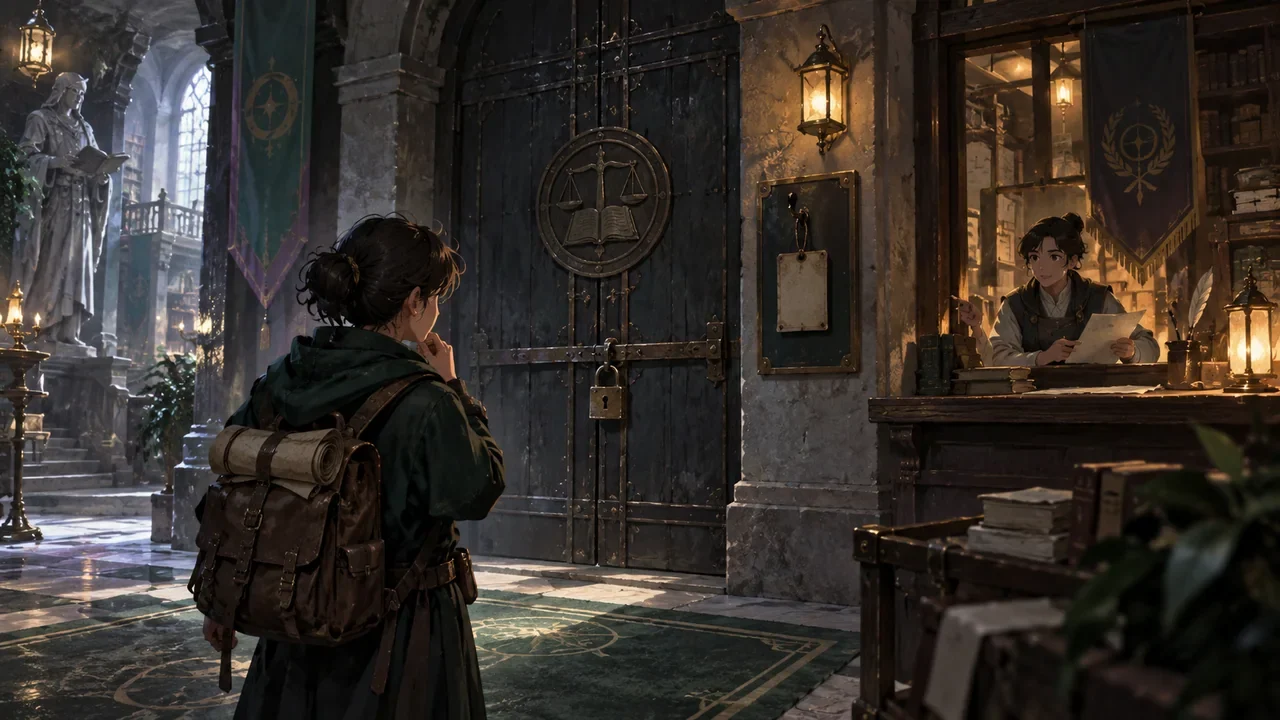
A closed archive door has a missing permit hook and a nearby clerk's open service window, showing blocked entry with an understandable requirement and next action.
Interactive narrative2026.09.11

How to Explain When a Location Cannot Be Entered: A Text Adventure's Threshold Must Be Understandable and Changeable

When a location cannot be entered, don't rush to write "the door is locked." The author must first classify the threshold, then decide what the player sees and can do. Once the classification is clear, the rules at the entrance will not change on the fly.

DramaFork Editorial Team15 min read
Continue reading
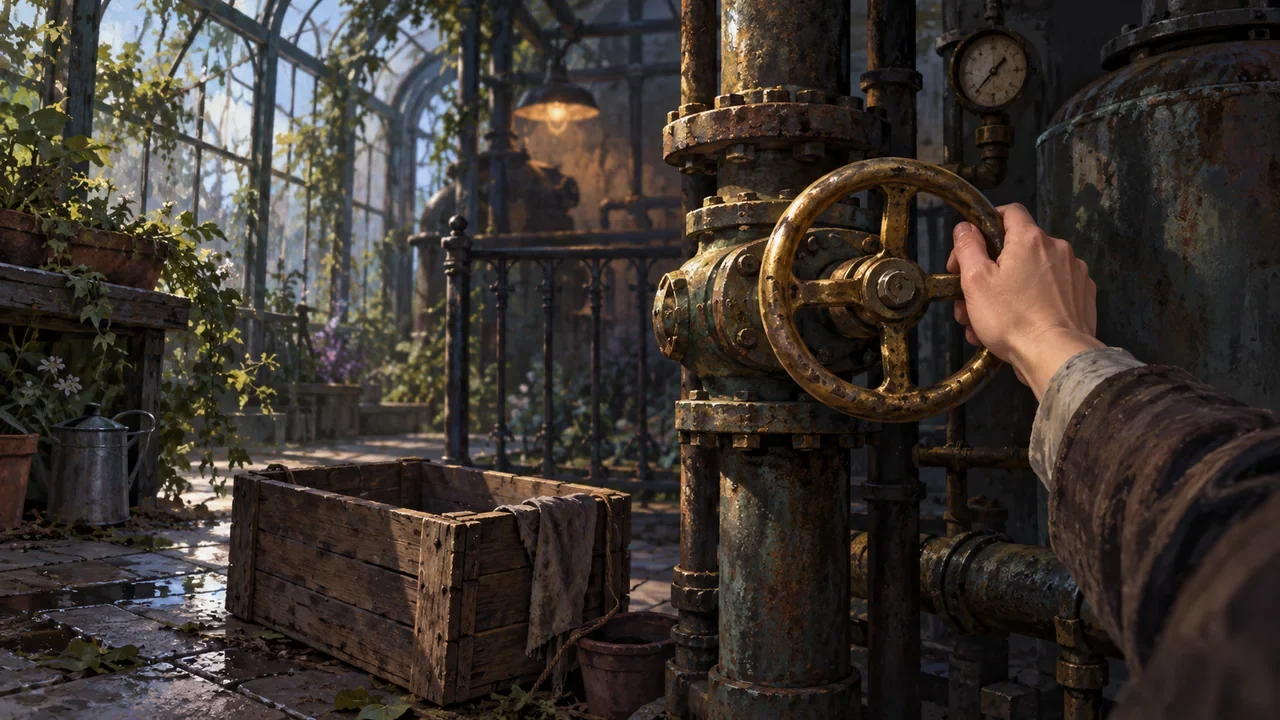
A valve, fixed railing, and wooden box in a machine room show different executable actions.
Interactive narrative2026.09.11

Make Text Adventure Objects Operable: Which Usage Clues Should Descriptions Reveal?

The player is stuck in the "old greenhouse" and enters "unscrew," "turn," "open," and "twist open" at a brass valve, but the system only replies, "You can't do that." The problem is usually not the verb library, but that the description does not provide usage clues. An operable object description must simultaneously reveal four types of information: material and structure, position and orientation, current state, and connections. Based on these, players infer "what can be done to it," rather than guessing the one unique verb in the author's mind.

DramaFork Editorial Team13 min read
Continue reading
A failed attempt to lift a jammed greenhouse latch reveals fresh scratch marks underneath, close-up on the useful clue rather than a punitive failure screen.
Interactive narrative2026.09.11

After a Text Adventure Action Fails, How Do You Give Players New Usable Information?

After an action fails, players need to get something that can change their judgment for the next step. The method is to first break the failure into "who is blocking, what condition is missing, what can be tried next," then make losses correspond one-to-one with clues: the player loses time, tools, or someone's trust, and at the same time gains a fact that was previously unavailable. Below, we walk through the fictional teaching example "Observatory Tower Antenna Repair." All characters and numbers are made up and are only used to demonstrate structure.

DramaFork Editorial Team14 min read
Continue reading
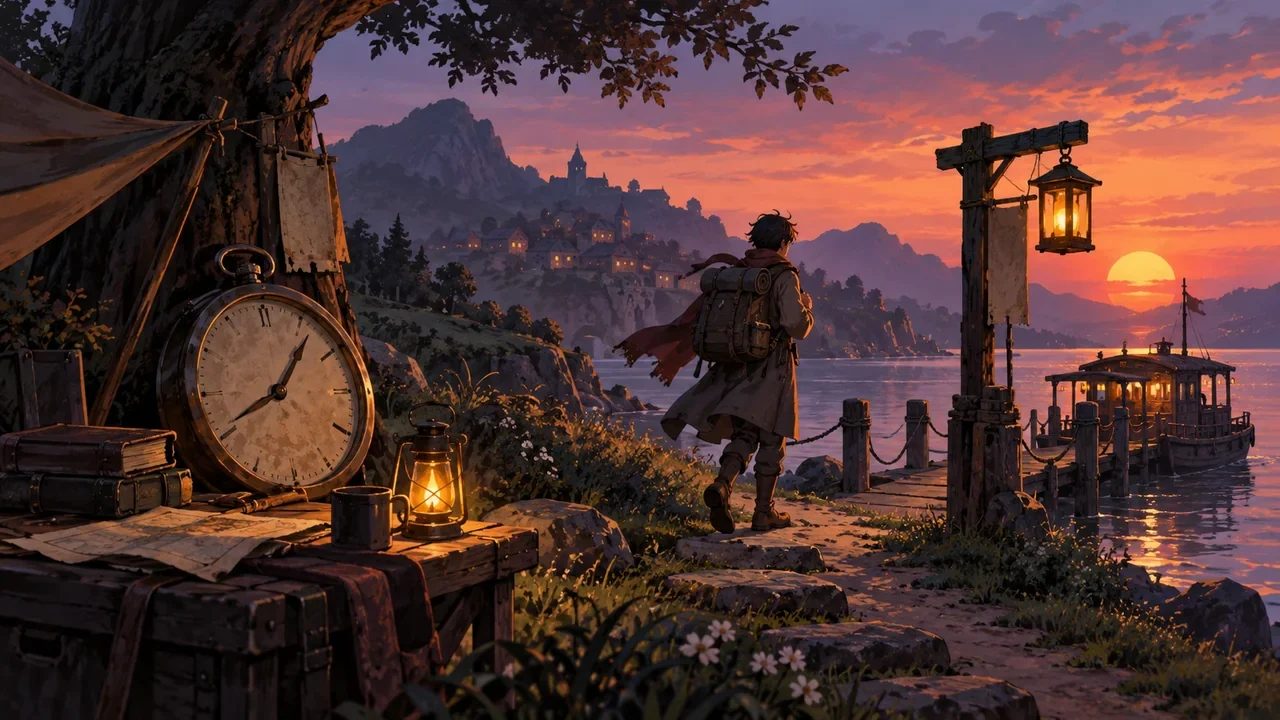
A campsite clock, ferry departure lantern, and lowering sun suggest that actions consume time.
Interactive narrative2026.09.10

When Time Advances in a Text Adventure: Observation, Action, and Waiting Must Be Separated

You can start with a checkable set of time rules: observation does not advance the story clock; actions such as movement and negotiation advance by prewritten durations; active waiting advances to the next event or waiting limit. This is the design approach used in this article's example. If a work requires observation to consume time too, it should be disclosed in advance and applied consistently. Below, the fictional "Last Ferry at the Crossing" breaks the rules into three types of clock tables; place names, characters, and numbers are all teaching settings.

DramaFork Editorial Team16 min read
Continue reading
An adventurer pauses before exchanging the last water flask for passage, with both the flask and the dry onward trail visible.
Interactive narrative2026.09.10

Before Deducting Resources in a Text Adventure, How Do You Let Players Understand the Cost?

Making costs clear depends on dividing "what I can be certain of now, what I can only estimate, and what I cannot know at all" into three layers, and disclosing only the first two before an action.

DramaFork Editorial Team14 min read
Continue reading
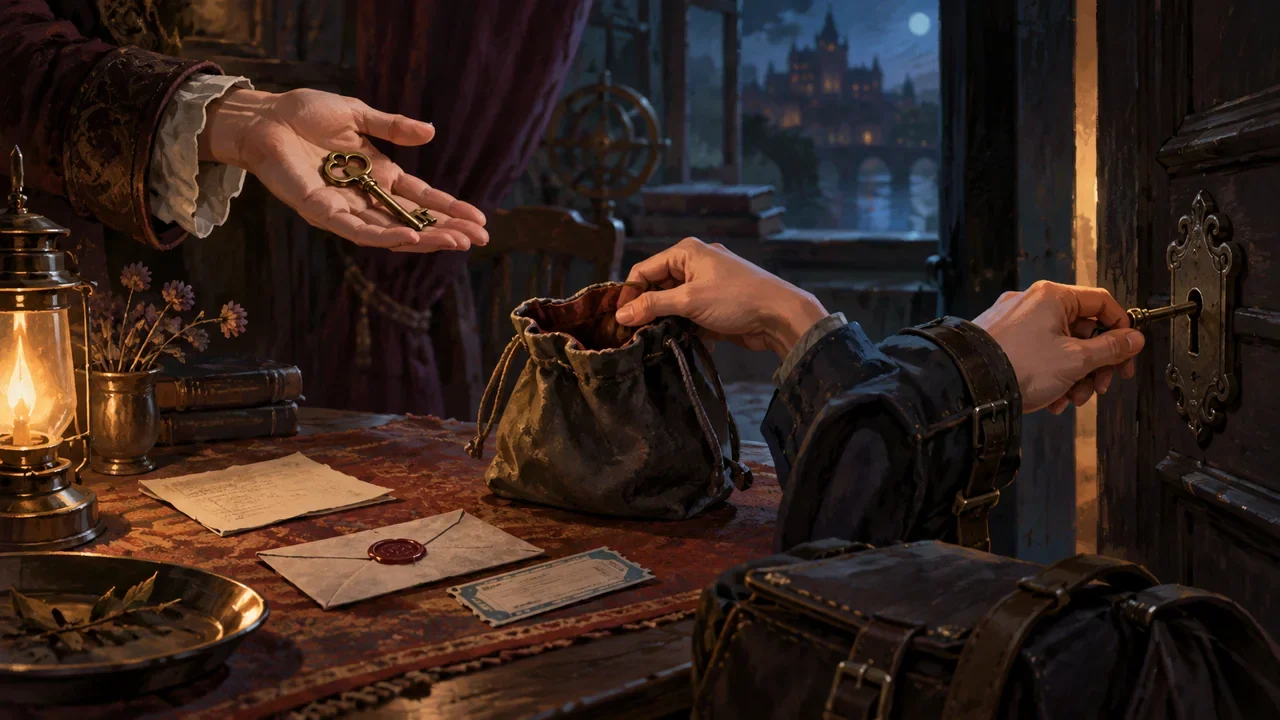
A borrowed brass key travels visibly from an owner's open palm through a cloth pouch to a lock.
Interactive narrative2026.09.10

Where Do Items in Text Adventures Come From: Use Provenance Records to Avoid Keys Appearing Out of Thin Air

You can maintain a provenance record for each item, answering four questions: from whose hands, in what way, under what conditions, and in which scene it entered the player's disposable range. This record, beyond the item name list, lets the author verify whether the appearance of keys, letters, and tickets has a basis; each subsequent transfer still needs to be checked item by item.

DramaFork Editorial Team13 min read
Continue reading
A gatekeeper examines an unfamiliar badge offered by a visitor while the official seal remains securely on the desk.
Creation tutorials2026.09.09

How to Write When a Player Commands a Character to “Forget the Setting”: Five Types of Boundary-Crossing Inputs and Sample Responses

When a character is rewritten by an irrelevant command, it is usually not one big collapse, but a single response quietly handing over identity, relationships, or secrets. During review, boundary-crossing inputs can be grouped into five types: demanding secrets, faking relationships, rewriting identity, asking for real-world professional advice, and forcing consent. Below, a fictional teaching example, “Archive Assistant Cen Mo,” is used for a manual review.

DramaFork Editorial Team15 min read
Continue reading
Three figures form recognition cues through different gestures, tools, and speaking rhythms.
Creation tutorials2026.09.09

Three People All Sound the Same? Writing Distinguishable Dialogue Fingerprints for Interactive Stories

Dialogue homogenization usually isn't because the author can't write lines, but because each character corresponds in the author's mind to only one set of labels: calm, lively, sharp-tongued. Labels only determine tone, not how sentences are put together. A distinguishable dialogue fingerprint must land on four observable dimensions: sentence-length rhythm, focus object, information expression method, avoidance habit. Below, a fictional teaching example is used to run through the whole process; the characters and lines are all fabricated and do not correspond to any real work.

DramaFork Editorial Team14 min read
Continue reading
  1. 1
  2. ...6
  3. 7
  4. 8
  5. ...19