Backtracking After Branches Merge: Checking Screen Direction in an Interactive Film Game
Two routes leading to the greenhouse cannot necessarily cut straight into the same corridor shot. Use a screen-direction continuity chart to record story routes, frame exits and entrances, and landmarks separately, then give any entrance that requires a change of direction a visible spatial basis.
Introduction
To fix movement that looks like backtracking after branches merge, first record “where the character is going” separately from “which way the character moves on screen,” then check each incoming route. A shared destination does not establish that a straight cut will work, and different screen directions do not always require a reshoot. What matters is whether visible information around the cut shows that the character has turned a corner or that the camera has moved to the other side.
Map the story routes first, then mark screen direction
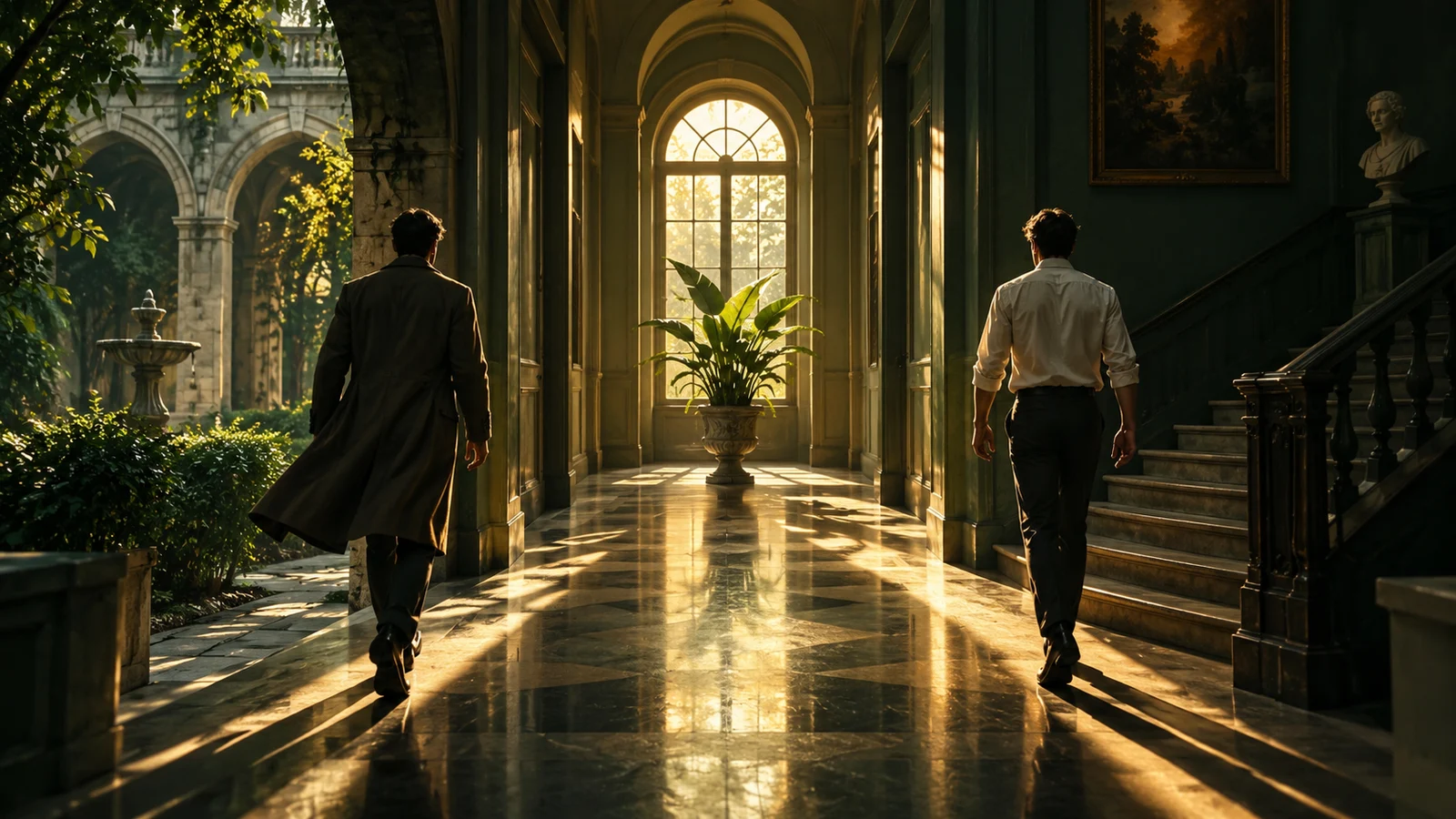
The courtyard, staircase, and greenhouse below are an original fictional teaching example, not a real user case, measured findings, or a record of hands-on testing. They do not represent DramaFork product features. Xu Ning, an adult character, can reach the greenhouse from either the courtyard or the staircase. Both routes must feed into the same corridor shot. The physical space stays the same; the issue is how the edit presents movement.
For the overhead sketch, place north at the top, south at the bottom, west on the left, and east on the right. This defines the example’s physical space, not directions within the camera frame:
                         North
                    Staircase exit
                           ↓
Courtyard gate ──→ Merge point ──→ Greenhouse door
                        Corridor
       Window-side potted plant south of merge point
                         South
The courtyard route runs straight from west to east. The staircase route heads south first, then turns east at the merge point. Both ultimately lead to the greenhouse, but only the staircase route requires a physical turn. Making this explicit lets you determine whether the missing information is the turn itself or spatial orientation after a change of camera position.
Now consider the shared shot. The camera is on the south side of the corridor, facing north, with the greenhouse on the right of the frame. Xu Ning enters from the left and walks right past the window-side potted plant. Here, “right” is only the projection from this camera position. It is not shorthand throughout the work for “toward the greenhouse.”
Use frame diagrams to locate the specific conflict
Suppose the final courtyard shot is also filmed from the south, with Xu Ning exiting frame right. The final staircase shot, however, looks west from the east side. After descending the stairs, Xu Ning walks out of frame left. This shot does not show the turn toward the greenhouse.
Courtyard end:   [Xu Ning → Right edge]
Staircase end:   [Left edge ← Xu Ning]
Shared corridor:[Left edge → Xu Ning → Potted plant → Toward greenhouse]
Cutting from the courtyard to the shared segment preserves rightward movement, so the straight cut can provisionally stay. Cutting from the staircase to the shared segment suddenly changes leftward movement to rightward movement. With the turn omitted as well, viewers might interpret this as Xu Ning doubling back. This is a risk inferred from the diagrammed relationships, not a finding from audience testing.
Do not simply write “left/right mismatch.” Record the issue as: “Xu Ning exits frame left at the staircase, then enters the next shot from the left and walks right; the turn from the staircase toward the greenhouse to the east is not established.” This identifies the join, the ambiguity, and the missing information together.
Conversely, rightward movement in both shots does not guarantee a shared destination. If the camera crosses to the north side of the corridor, someone heading west back to the courtyard may also move right on screen. Read the arrows together with the landmarks, camera positions, and destination.
Put the proposed fixes into a screen-direction continuity chart
In this example, we add a spatial orientation shot for the staircase entrance and provisionally leave the courtyard entrance as it is. The table below is the continuity chart for handoff. For a real project, add shot IDs, source footage ranges, and versions.
| Join | Movement in story space | Exit from preceding frame | Entry into following frame | Landmarks | Basis for direction change and decision |
|---|---|---|---|---|---|
| Courtyard end → Shared corridor | East toward the greenhouse | Exits right | Enters from left, walks right | Courtyard gate, window-side potted plant | No physical turn; provisionally retain straight cut |
| Staircase end → New orientation shot | South away from staircase | Exits left | Enters from staircase opening at top of frame, walks downward | Staircase opening, potted plant, greenhouse door | Re-establish position through their relationships within one frame |
| Orientation shot → Shared corridor | Turns east toward greenhouse | Exits right after turning | Enters from left, walks right | Same potted plant, greenhouse door on right | Show the full turn before cutting into the shared segment |
Place the new camera high on the south side of the corridor, looking north and downward. The staircase opening should sit at the top of the frame and the greenhouse door on the right, with the potted plant and the character’s path visible. Xu Ning emerges from the staircase, walks to the merge point, and turns toward frame right. This shot must establish “where the character came from, where the turn happens, and where the character goes next.”
The potted plant needs to convey spatial relationships. Inserting just one frame of a close-up may suggest the same location, but it cannot establish which side the greenhouse is on. If it obscures the character’s turn, it cannot fully establish the direction change either. The plant’s presence in both shots is not enough to conclude that directional continuity works.
Work through the correction along both incoming routes
First, keep the version that cuts directly from the staircase as a comparison. Start at the last point where the staircase exit is recognizable, and continue into the shared segment until Xu Ning has passed the potted plant. Using only this uninterrupted sequence, the reviewer should try to identify where Xu Ning came from, where the turn occurs, and which way the greenhouse lies. Any point that requires the sketch to fill in the explanation may indicate information missing from the footage.
Next, insert the orientation shot. Its in-point must make the relationship between the staircase opening and the character readable; its out-point should come after the turn is established. Cutting away as soon as Xu Ning appears leaves the turn unexplained, however wide the shot is. Waiting until the character has walked the entire corridor repeats the action in the shared segment. Let the readability of the action and landmarks determine how much to retain, without prescribing a universal duration.
Then check whether the character passes the potted plant twice across the two shots. If the shared segment begins to the left of the plant, the orientation shot should end before Xu Ning reaches it. Alternatively, adjust the shared segment’s in-point so movement keeps progressing toward the greenhouse. Correcting direction while moving the character a step backward in position can still look like backtracking.
Finally, reconnect the courtyard route to the same shared segment and check whether the revised in-point removes orientation information that the courtyard entrance needs. Record specific issues separately, such as “the straight cut still omits the turn” and “does the added shot repeat a position?” This example can only deliver a proposal awaiting validation. Written reasoning must not be presented as a solution that has already passed final review.
When footage is limited, choose alternatives by the information missing
If existing footage includes the full turn and both openings, first try selecting different edit ranges. The tradeoff is that the pacing may slow. If only front- or rear-view shots of the character walking are available, they can soften an abrupt reversal of left/right movement, but they may not explain how the routes connect. Still check whether the destination is identifiable.
If a new orientation shot is needed, explicitly specify the staircase opening, greenhouse door, potted plant, and turning action. Avoid adding an empty corridor shot that provides only atmosphere. If the spatial relationship cannot be established, retain a separate corridor entrance for the staircase route and merge only once the character’s position and facing direction match. The tradeoff is another segment of footage to maintain.
Do not simply mirror the image to align the arrows. Mirroring may create conflicts in door positions, the hand holding an object, and other spatial clues; check them individually. This chart applies to movement continuity within one continuous space. If the narrative intentionally involves getting lost, doubling back, or skipping part of a journey, document that narrative basis separately and distinguish actual backtracking from unintended directional ambiguity.