Branch Transitions Must Not Decide for the Player: What Is Missing Between “Ask” and “Sign”
If the player only agreed to ask about the terms, an edit cannot make signing a done deal. Use a transition checklist to distinguish actions that can be compressed from commitments that require a player decision, and preserve each branch’s choices in a shared scene.
Introduction
If the player only agreed to ask, they cannot already have signed when the next scene begins. Rewrite the transition so it ends at “the terms are clear, but no commitment has been made.” Show the information that affects the decision, then let the player accept, keep negotiating, or leave. Walking, waiting, and repetitive questions can be omitted; omissions cannot introduce payments, changes in affiliation, or obligations accepted on someone else’s behalf.
1. Find the Verbs the Transition Quietly Added
“Fog Station Recruitment Office,” the case below, is a fictional teaching example. Its characters, agreements, and branches are writing examples, not real user cases, measured test results, or product features.
The player takes the role of Lin Yan, a mechanic who wants to learn about a convoy’s recruitment offer. The option reads, “Go ask about the pay and departure time.” After the player chooses it, the scene cuts to a garage at dawn, but the narration says, “With the contract signed, you collect your uniform and prepare to leave the city with the convoy.”
The problem is not that dawn arrives too quickly. It is that “asking” has become “signing.” That narration may also quietly add decisions to join the convoy, leave the city, and abandon existing plans. Even if signing takes only one second on screen, that second cannot make the decision for the player.
To check a transition, reduce each end to its shortest statement: before, “I am going to ask”; after, “I have joined.” Then circle the new actions that must have happened between those statements. If any involves a commitment the player has not chosen, the edit has skipped past the decision point.
A character can certainly encounter surprises. But “the garage suddenly closes” is an external event, while “you voluntarily stay to work for them” expresses the player’s stance. The two cannot be conflated.
2. Use a Table to Define What Can Be Omitted
Use the following table to check transitions one by one. “Can be omitted” only means that something need not be shown in full; the player must still be told any necessary results.
| Content to omit | Decision criterion | Treatment in this example |
|---|---|---|
| Travel to a destination already chosen | The journey introduces no new route choice or known significant cost | Cover arrival at the recruitment office in one sentence |
| Waiting and repetitive questions | No opportunity the player is weighing will be missed | Compress into a brief conversation |
| Receiving an explanation of the terms | The information affects the next decision | Omit the exchange, retain a summary of the terms |
| Signing or verbally agreeing | Creates an obligation or changes status | Stop and let the player choose |
| Paying, pledging collateral, or handing over an item | Uses resources or changes who holds something | Specify what or whom the action involves and its cost before the decision |
| Agreeing for a companion or taking a public position | Broadens who is covered by the commitment and the scope of its effects | Check separately whether the player chose it |
Each time you copy the table, add four lines: “Player’s exact words,” “New commitment,” “Which choice authorizes it,” and “Where to stop.” If you cannot fill in the third line, you cannot write the commitment as completed.
Do not judge solely by the name of an action. Receiving a uniform to try on may be part of learning about recruitment. But if taking it away signifies formally joining, it crosses the commitment boundary. The author must judge the act by its actual role in the story.
The same applies to time. Walking to the counter can be glossed over. If waiting means missing the last departure, however, waiting itself becomes something the player must weigh and can no longer be treated as an inconsequential interlude.
3. Rewrite the Same Transition as a Scene with a Choice
The problematic passage reads, “You finish asking about the terms. The next day, you stand in the garage as a new member.” It never establishes when the player agreed. Adding “After thinking it over, you agreed” merely invents the player’s thoughts for them.
It could become:
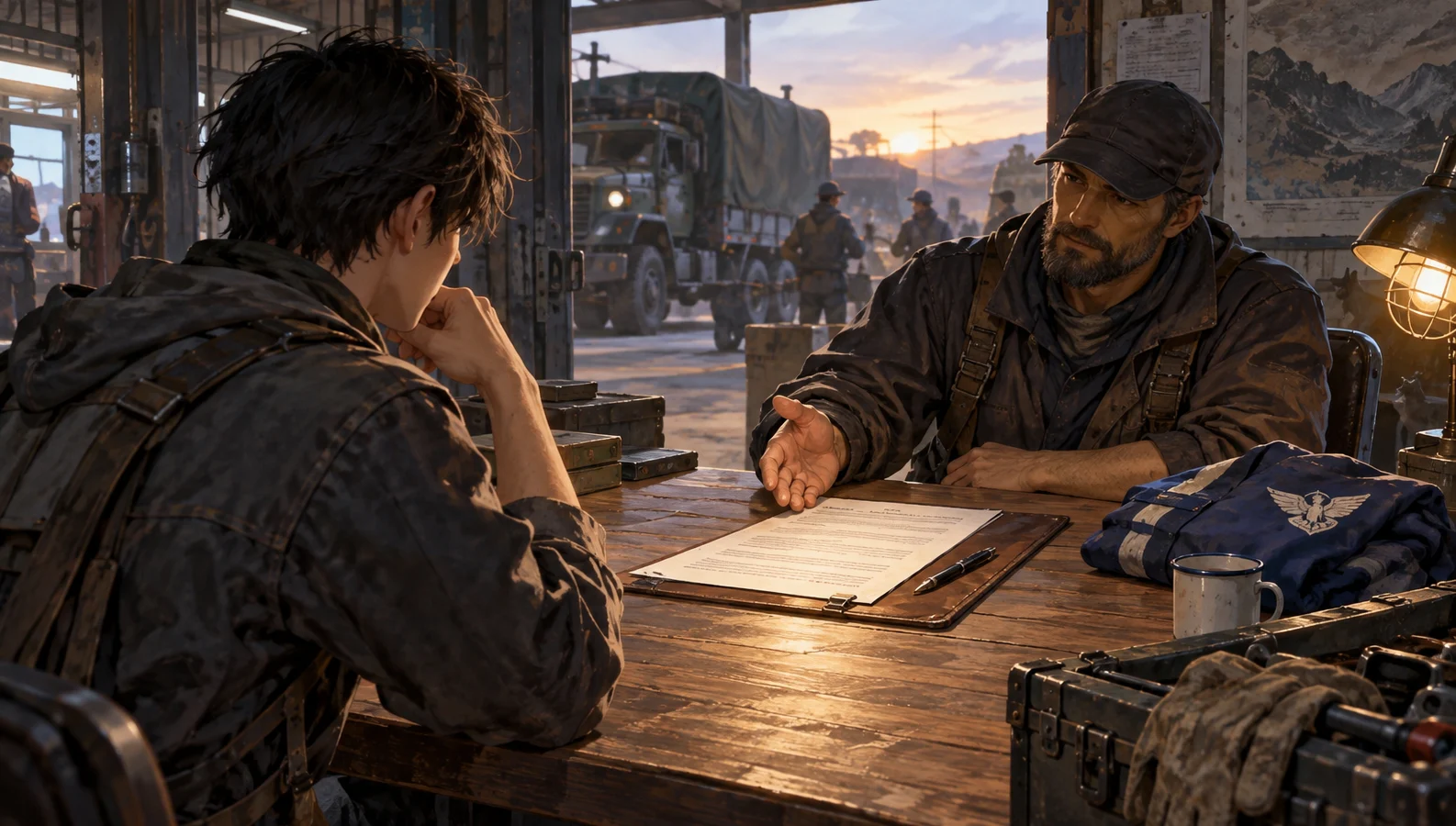
The recruiter writes the terms on a sheet of paper: departure tomorrow morning, three nights with the convoy, and payment upon return. Before departure, your repair kit must be left in the garage for loading with the other equipment. He places a pen beside the paper and waits for your answer. You know the terms now, but you have not agreed to join.
Then offer three specific actions: “Accept these terms and sign,” “Ask whether you can carry your own repair kit,” and “Decline and leave the recruitment office.” Treat free-text input according to what it actually says, too. Do not take “Sounds good” as signing a contract.
Suppose the player chooses the second option. The recruiter replies, “Yes, but you’ll be responsible for it on the road.” The terms have changed; the decision to join is still pending. The next line should be “Do you want to join under the revised terms?” rather than “You nod in satisfaction and sign.”
Only after the player explicitly accepts should the story move to:
You sign your name and agree to meet at the garage tomorrow morning. At dawn the next day, you enter the garage carrying the repair kit you will look after yourself, and the convoy leader hands you a uniform.
Putting away the pen, saying goodbye, and resting overnight can now be omitted because there is an explicit basis for signing. The corresponding record should read “Joined; responsible for own repair kit,” rather than carrying over the original arrangement for loading it with the other equipment.
If the player refuses, write, “You push the sheet of terms back and leave the recruitment office.” This branch does not need humiliating narration to punish refusal, nor does it need to promise that refusal will have no story consequences.
4. Preserve the Pace by Changing the Entry Point or Where the Transition Ends
The first approach is to state the full choice in advance. If the terms have already been presented, change the option to “Sign under the terms above and depart with the convoy tomorrow morning.” You can then cut straight to the garage and keep the pace brisk. This moves the decision earlier, so key restrictions cannot be hidden until after the transition.
The second approach is to retain the option to ask, but insert a shorter pause. The recruiter explains the terms in two sentences, the player decides, and the story moves to dawn. This preserves one necessary choice without requiring every line of the conversation to be performed.
The third approach lets different branches share the garage scene. Those who signed arrive to report for duty; those who have not signed are invited to inspect the equipment; those who declined come to retrieve something they left behind. The setting can be the same, but the opening form of address, reason for being there, and available actions must differ. The leader cannot tell everyone, “Since you’ve already joined.”
If the player explicitly said, “Take care of it for me as long as the terms stay the same,” the actions involved can be compressed within that scope. Once the pay, duration, or method of handing over items changes, the original consent no longer supports the new commitment, and the scene must stop again.
5. Check for Omissions with Refusal, Silence, and Branch Convergence
When reviewing the draft, first replace the player’s answer with a refusal. If the next scene still requires them to fulfill the agreement, the branch has only changed the dialogue, leaving the imposed commitment intact.
Next, try silence or an ambiguous comment. “Let me see,” “Got it,” and “These terms are interesting” cannot establish acceptance on their own. You can keep waiting, have the other character ask again, or end the conversation under previously explained scene rules. Do not turn no answer into voluntary signing.
Finally, check the first task after the branches converge. Even if the opening acknowledges that the player has not joined, immediately requiring them to “fulfill your night-watch duty as a member” merely delays the same error. For each new status, resource handover, and relationship change, trace one subsequent line of text.
This checklist does not guarantee that characters can change their situation at any time. The other party may refuse to negotiate or close up and leave. The story can also depict conflicts involving forged signatures or mistaken assumptions, but it must present them as someone else’s actions or erroneous conclusions, not declare that the player voluntarily accepted.
Before handing in the draft, retain four things: the player’s exact words before the transition, a summary of the terms, an explicit decision, and what the player has committed to after the transition. Readers should be able to find the basis for the commitment in these four items. If a commitment has no basis, return the decision to the player. Only the execution of an already authorized decision can be safely compressed.