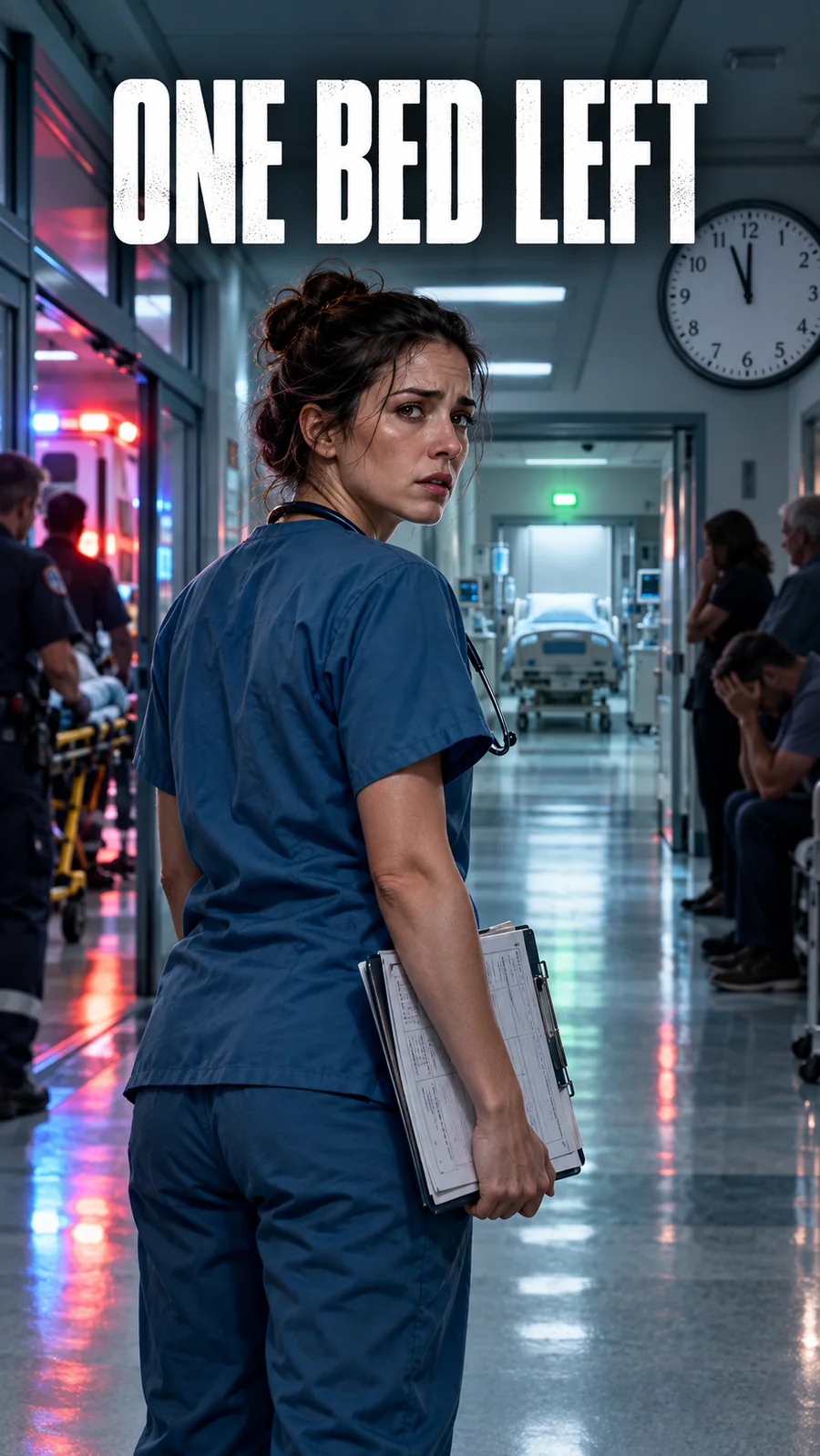
One Bed Left
One intensive-care bed remains and several patients need it. Every clinical decision carries a human cost.
- Story clips
- —
- Story choices
- —
- Published
- Sep 25, 2026
- Supported devices
- Desktop and mobile
Story profile
Detailed introduction
Story premise and central conflict
One Bed Left is an interactive film built around urban realism and medical ethics. Its crisis breaks ordinary life immediately: On a disaster night, one intensive-care bed remains for five patients while hospital pressure and hidden records complicate every decision. The player is not an observer waiting for a fixed plot to unfold. Every reply, hesitation, and overlooked detail changes which information becomes available next and how the cast responds. Suspense comes from the gap between what the player knows and whom they are willing to trust, so progress depends as much on judgment as it does on revelation.
The story does not ask for one universally correct answer. It asks the player to accept consequences while evidence is incomplete, time is limited, and relationships remain unstable. A rational plan can injure the person closest to the protagonist, while a safe action can make decisive evidence disappear. Understanding the immediate emergency is only the first layer; the player must also connect motive, hidden rules, and earlier behavior to build a coherent account of the event.
Player role and relationships
The player becomes the emergency department's attending physician. That identity grants access to the center of the incident but also imposes credible limits. Professional knowledge or unusual memory does not reveal what everyone truly wants. The emotional spine is patients, families, colleagues, and administrators pulling in different directions. It changes through kept promises, shared secrets, and the person protected first when pressure rises, rather than through a simple sequence of approval points.
Every major character has a private objective, a fear, and a boundary they will not willingly cross. Someone who helps in one chapter may withhold information later because of an earlier decision. The player must notice not only spoken claims but pauses, evasions, and contradictions. Trust is both an emotional result and a practical resource that can open an investigation route, expose a new scene, or alter who remains present at the ending.
Opening and immersive experience
The opening hook is immediate: Five ambulances arrive at once while the system shows only one available bed. It establishes danger, presents a question, and gives the first player response a visible consequence. The world is not explained through a long block of exposition. Location sound, phone screens, eye lines, and environmental changes deliver the rules through action. From the first minute, the player needs to observe actively instead of waiting for the story to summarize the correct interpretation.
Short scenes alternate with dense bursts of information. Urgent moments use timed responses, while quieter intervals allow the evidence record and relationship state to be reviewed. Camera, sound, and interface carry different parts of the narrative at the same time. Important warnings sit inside natural dramatic behavior, and even choosing to remain silent can be interpreted by another character as a deliberate position.
Core interaction and rules
The main systems are diagnostic evidence, a continuously shrinking clock, and public trust in the hospital. They record discovered clues, key relationships, and the immediate impact of important decisions, but they do not expose every calculation. The interface provides enough feedback for the player to understand risk while preserving uncertainty. Decisions therefore feel like judgments made inside a real crisis rather than a search for the button with the highest visible score.
Some options appear only after a requirement involving evidence, trust, or time has been met. The same sentence may produce a different response in another context, and a detail already inspected can acquire a new meaning after a later revelation. Key nodes can be revisited to understand cause and effect, but a single run cannot deliver every piece of information without cost. Exploration and replay both have a clear purpose.
Choices and chains of consequence
Representative decisions include whether to prioritize one patient, transfer someone, attempt a risky procedure, or defy management. These choices are not isolated buttons. They create a continuing chain of consequences: protecting someone early may earn crucial testimony later, while hiding the truth to escape quickly may destroy cooperation in the final act. The system pays attention to whether the player's actions remain consistent and whether the protagonist accepts the price of the position they claimed to support.
Major nodes usually change three layers at once: whether the immediate crisis improves, how the relationship network shifts, and whether the truth can still be uncovered. A apparent failure may open a deeper route, while a visible success may only postpone danger. The design encourages players to act according to principles they can defend instead of consulting a guide for a supposedly perfect answer.
Endings and replay value
The principal ending directions include the critical patient survives, several lives are saved, the doctor sacrifices a career, or the system is reformed. No conclusion is selected by the final choice alone. The game looks back at how the player handled evidence, trust, risk, and personal commitments before composing the resolution. Two runs can reach the same broad ending while leaving individual characters in different places, exposing different portions of the truth, and preserving very different relationships.
After finishing one route, the player can return to meaningful nodes and test an opposing strategy. New runs reveal lines that were easy to overlook, motives that were concealed, and conditional options that make familiar scenes read differently. Replay is not just repeated viewing; it lets the player test a theory, compare competing values, and identify which losses truly could not have been prevented together.
Visual direction and production form
The project is conceived as an emergency-room-centered live-action drama designed around high-pressure dialogue and consequence review. Visual direction prioritizes readable reactions and legible information. Color, framing, and changes in physical space communicate safety, authority, and distance from danger. Sound has an equally active narrative role: environmental noise, a delay on a call, a change in breathing, or a short silence can all become evidence used to understand the situation.
The interface stays restrained so that choices, clues, and character states remain readable without breaking the filmed experience. Mobile and desktop layouts preserve the same narrative information, with sufficient touch space for urgent decisions. Dialogue rhythm, subtitle length, and scene transitions are designed together, allowing the player to concentrate on people and consequences instead of struggling with complex controls.
Who the experience is for
One Bed Left is primarily intended for players who enjoy grounded professional drama, ethical debate, and post-choice reflection. Players who enjoy building conclusions from small details, accepting choices without absolute answers, and seeing the ending respond to earlier behavior should find a sustained sense of participation. This is not simply a short film with occasional branch buttons. Story, relationship, and system state continually affect one another.
For a first playthrough, following instinct to one complete ending is recommended instead of immediately trying to collect every route. Reviewing nodes and clues afterward makes it easier to see how the work remembered each decision. The subject matter may involve crisis pressure, moral conflict, or emotional loss. This page presents the complete concept and intended interaction; a playable status will be clearly marked after production and publication are complete.
Artwork previewVisual archive
Featured scenes