When Breathlessness Suddenly Vanishes in an Interactive Film Game: Connect Breathing to the Action Just Completed
When a character speaks calmly right after running up the stairs, the problem may lie in the continuity of the entire performance. Use a breathing continuity sheet to connect prior exertion, evidence of recovery, dialogue breaks, and physical action, then check the pause-to-recover and immediate-response routes separately.
Introduction
If a character has just run up the stairs but appears steady and relaxed in the next shot, delivering a long sentence in one breath, first check whether the story establishes how they recovered. Only then decide whether to add sound, use a different performance, or revise the dialogue. Putting breathing, dialogue breaks, and physical action on a single “breathing continuity sheet” helps the next line carry through the action the character has just completed. Review continuity against what the character has experienced, not the order in which the footage was shot.
Find evidence of recovery before deciding that breathlessness is missing
Do not start by asking, “How breathless should this line sound?” Watch the preceding action, the pause after arrival, and the start of the dialogue together. Note what the character last did, whether anything adds further exertion, and whether the story explicitly establishes that time has passed. Stopping a run only means the movement has ended. A cut alone does not establish that the body has settled.
Evidence of recovery must be present in the narrative. For example, the character might wait at the doorway until the person inside finishes looking through some documents before speaking, or the work might explicitly establish that the conversation resumes later. Cutting to the other person's face does not automatically mean the character has had enough rest. The real-world time a player spends at a choice can count as evidence only if the work explicitly treats it as time passing within the story.
Write the judgment in terms that can be checked: “There is no pause after arrival, and the question comes immediately, so the opening line still carries the physical state of the hurried approach.” Do not write, “A character must pant for a set number of seconds after exertion.” This is about performance continuity. It provides no physiological thresholds and does not require every character to behave identically.
Build a complete breathing continuity sheet for two routes
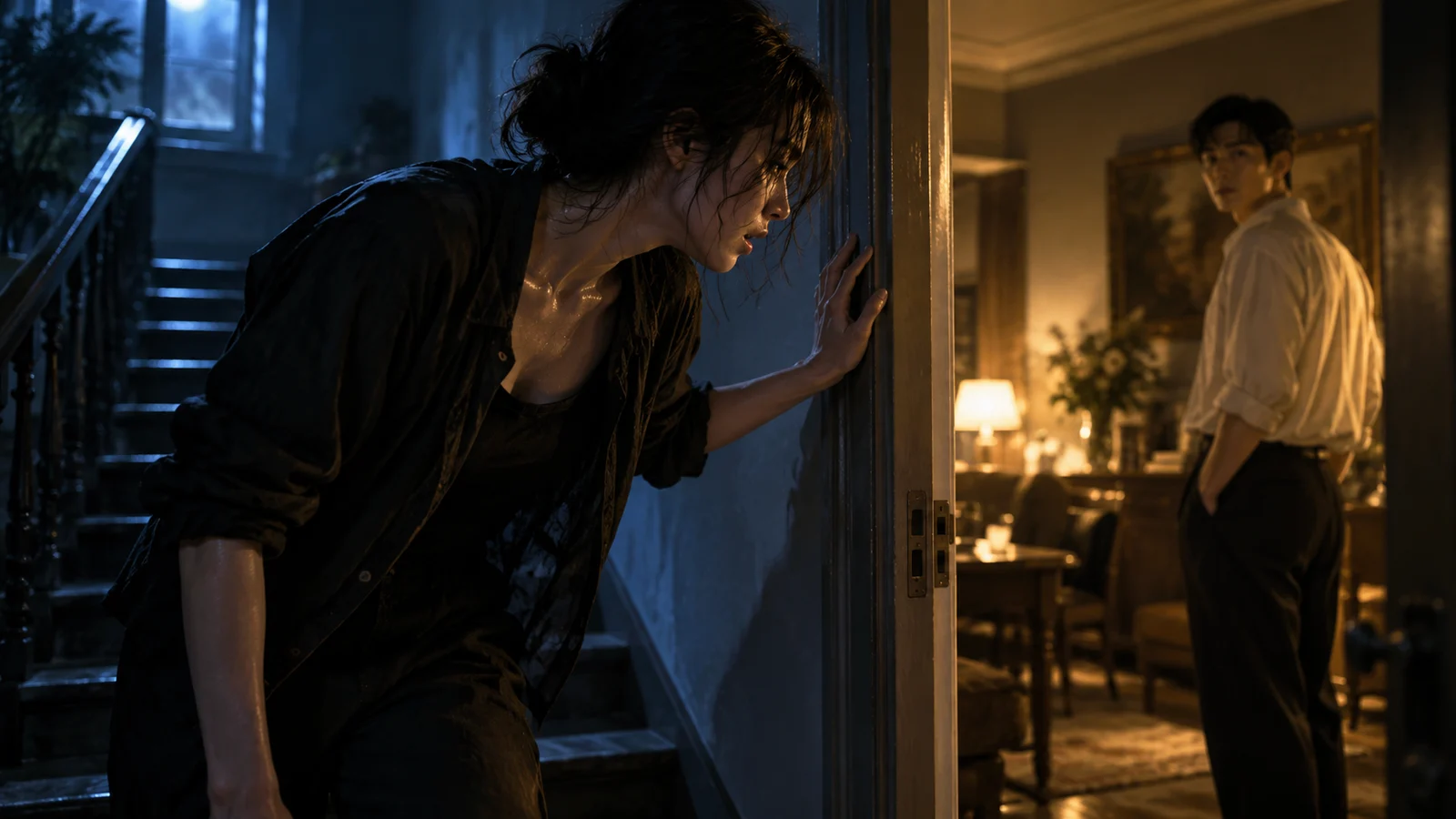
The following is a fictional teaching example, not a real user case, measured result, firsthand test record, or DramaFork product feature. The protagonist, Xu Ning, rushes up the stairs to the records room to stop the records clerk from sending a document away. The clerk turns and asks, “Which one are you looking for?” Route A gives her time to stop and catch her breath; Route B requires an immediate answer.
First, establish the shared entry: Xu Ning climbs the final step, braces a hand against the doorframe, and looks for the document while her shoulders and back are still rising and falling. Both routes inherit this state, but they do not need the same performance for the opening line. The “/” marks on the sheet indicate planned breaths or brief pauses. Confirm their actual placement against the sound and picture.
| Route and point | Prior exertion | Evidence of recovery | Dialogue breaks | Physical action |
|---|---|---|---|---|
| Shared entry | Has hurried up the stairs and just stopped moving | No recovery has yet been established | Does not speak yet | Braces against the doorframe; shoulders and back rise and fall; eyes search for the document |
| A: First line after stopping | Carries the state of the hurried approach, with no additional action | The clerk turns back to examine documents on the desk while Xu Ning stays by the door and catches her breath | “Last night's/dispatch log.” | Keeps her hand on the frame, gradually straightens, and releases her grip only at the end of the line |
| B: Immediate response | Is questioned as soon as she arrives | No additional pause | “Don't send it away yet./That dispatch log/from last night.” | Keeps her hand on the frame, looks up to answer, and retains movement in her shoulders and back as she breathes |
| Both routes: Moving into the explanation | A has had time to catch her breath; B must still carry through the preceding line's physical state | The clerk looks down to find the log while Xu Ning waits by the door | “I need to check the signature.” | Confirm that her body has naturally settled into a steady stance before moving into a fuller sentence |
This sheet does not ask actors to follow the table mechanically as they breathe. It gives the director and editor a shared basis for review: which experience supports each change, and which physical action belongs with each line. To reuse it, retain the four core fields and add the dialogue entry and the point where the branches converge.
Decide how to deliver the information before planning the recovery
The key to Route A is the brief opportunity to collect herself. Preserve the wait so that the first line can be relatively complete, while the hand remaining on the frame and the body straightening only at the end of the line show that recovery is still in progress. A calm face alone is not enough; you cannot rely on an explanation that she has just caught her breath.
The key to Route B is stopping the document from being sent away. Start with “Don't send it away yet” to put the urgent information first, then identify the document. If the original line is “Could you help me find that dispatch log from last night so I can check the signature?”, the information can be split up. This avoids asking the actor to look physically strained while delivering a long sentence without a single pause.
Breaking up a line has costs, too. Too many pauses can turn urgency into hesitation. Deliberately separating the time reference, “last night,” from the identifying phrase, “that one,” can also suggest that the character is searching her memory. Preserve the character's intent first, then find places to breathe. Do not mechanically insert breathlessness every few words.
Choose just a few physical actions that change over time: put weight on the doorframe, then lean on it less; lean forward, then straighten; prepare to take a step, then stop to answer. Do not pile on bending at the waist, touching the chest, wiping away sweat, and other gestures all at once, as this can change what the character's state conveys. Performance choices should serve the story; actors need not reach actual exhaustion to produce the effect.
Sound can fill a gap, but it cannot make the body recover on screen
Imagine that a calm take has mistakenly been used in Route B: Xu Ning's arms hang loosely at her sides, her shoulders and back are still, and she visibly delivers the long line without interruption. Adding pronounced panting would demonstrate the mismatch: the sound says she has not recovered, while her body and way of speaking do not reflect that state.
First, watch the passage muted and check whether the image still carries through the hurried approach. Next, listen without watching and check whether the breaths fit the sentence structure. Finally, watch and listen together. Make sure no breath falls where the character is visibly speaking continuously, and that an ordinary pause has not acquired an additional emotional implication.
Adding breathing may address the main gap only when the image already shows pauses, bodily movement from breathing, or recovery actions, but the corresponding sound cues are missing. If the whole performance is too calm from the outset, prioritize choosing suitable footage, revising the dialogue, or filming a connecting pickup. A cut to the clerk's reaction can make room for a pause, but Xu Ning must still be in an explainable state when the shot returns to her.
If footage is limited, the narrative can also be revised: explicitly add a wait for the document before moving into calm dialogue. The cost is reduced urgency. Assess whether that undermines the scene's purpose; do not extend time arbitrarily just to hide a join.
Check each route's recovery before the branches converge
Both routes can share the later explanation shot, provided that each has reached an appropriate state at that entry. Route A includes time to catch her breath before the opening line; Route B needs further recovery while the clerk searches for the log. If, one moment, Xu Ning is still gripping the frame and answering breathlessly in Route B, then the next moment she is calmly turning pages, the shared shot still fails to connect.
During review, watch each route continuously from the staircase action onward. Check each piece of evidence on the sheet against the finished sequence: whether the stop remains, whether dialogue breaks have been cut, whether she releases her hand or straightens too early, and whether the shared dialogue erases a change that was still in progress. When you find a problem, mark the specific entry and the missing evidence. Avoid leaving only a note that gives no direction for a fix, such as “The breathing feels unnatural.”
This method suits scenes without an explicit time jump, where the audience needs to keep feeling the aftereffects of the action. If the story has clearly skipped past recovery, there is no need to force breathlessness into the scene. If a character deliberately conceals fatigue, the performance should also provide a basis for that suppression. The final deliverables are a continuity sheet that accounts for every route, along with the corresponding dialogue and progression of physical action.