Different Memories of the Same Event in an Interactive Film Game: Which Shots Can Change and Which Cannot?
Separate what happened from what each character claims to remember before deciding how the images can change. Use a memory-shot comparison table to track each shot’s source, fixed facts, variable presentation, and items to verify. Let the reveal correct specific accounts while preserving the cues that identify where earlier versions came from.
Introduction
Shots of the same past event can vary in focus, pacing, and emotional expression. But changes to who did what, the order of actions, or who was present must be recorded as competing claims, not treated as atmosphere. First establish the underlying event, then identify the source of each filmed version. Viewers may remain uncertain about the truth for a while, but they need enough information to recognize whose memory they are seeing and what remains unverified.
Establish the event before assigning what each character knows
The following is an original, fictional teaching example. It demonstrates only internal script consistency. It is not a real user experience, a tested result, a psychological finding, or a DramaFork product feature.
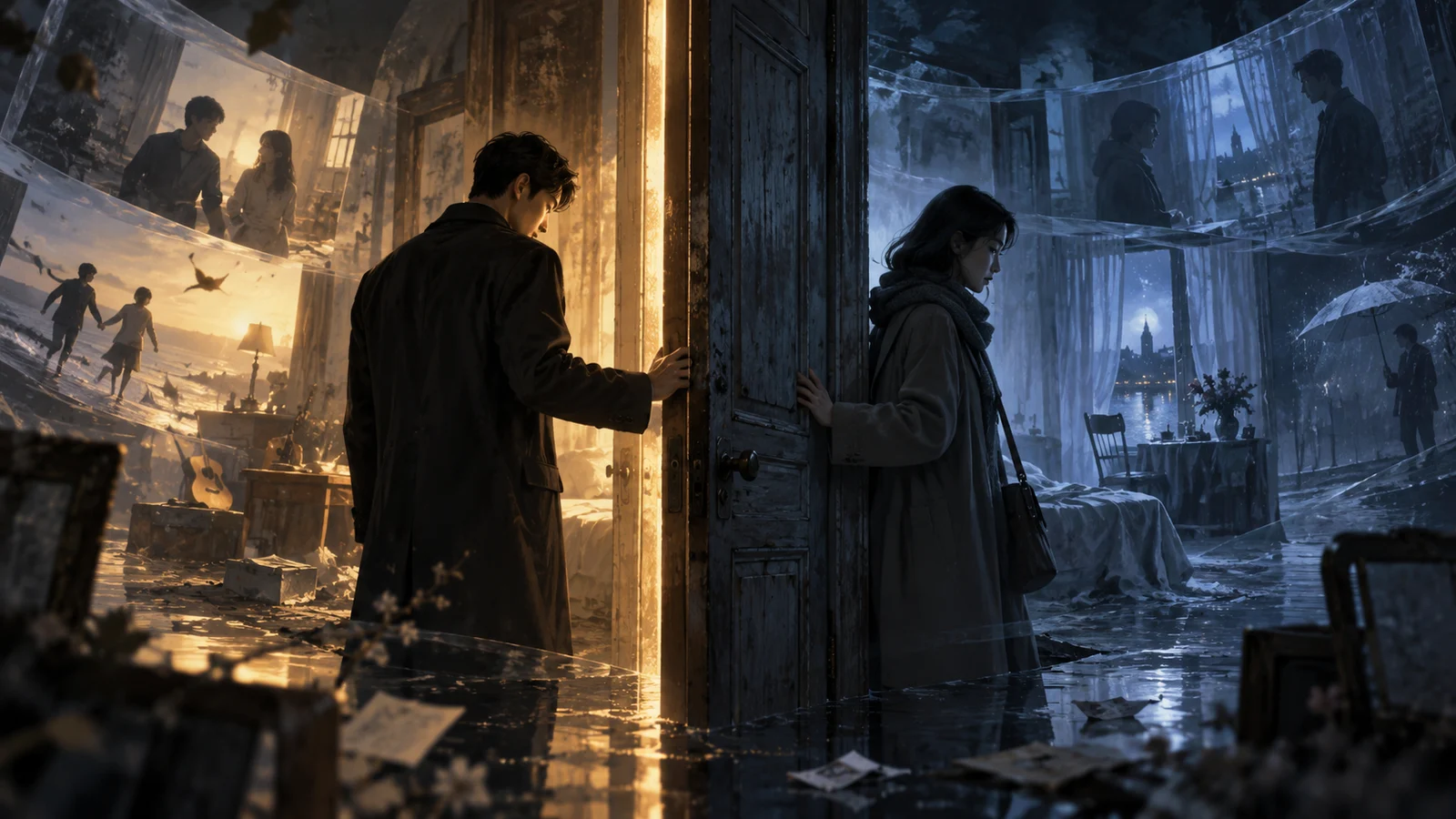
Years later, two adult longtime friends, Shen Ning and Zhou Yuan, revisit a farewell. Shen was inside the doorway of their old home; Zhou was outside. Both remember that the door eventually closed. Shen says Zhou turned away first, while Zhou says Shen did. Earlier in the story, we also learn that they had propped up a phone in the hallway to record their final moments before moving out. The player can examine that recording later.
The author’s event outline establishes the sequence: Zhou turned away first; Shen then turned toward the interior, turned back, and pushed the door shut. They did not shake hands. The phone continuously recorded both characters’ upper bodies and the door, so the footage can establish the order of their turns and the door-closing action. It cannot establish what either person felt or intended. This camera coverage is a fictional premise of the example.
“Both remember the door closing” is a shared account. Agreement alone does not amount to independent verification. The door closing is a fixed fact in this example because the author has established it in the event outline. The comparison table should distinguish what the author has settled, what characters claim, and what the player knows. This keeps the answer from reaching the player prematurely and prevents the author from confusing those levels of knowledge.
Use four source categories to decide what can change
Shared facts constrain the identifying details of the event and the outcomes of its actions: the same door, the two characters’ positions, and the door going from open to closed. A close-up may temporarily hide the person outside, but it cannot turn that person into someone who was never there.
Subjective emphasis determines what the person remembering magnifies. Shen may repeatedly see Zhou’s back; Zhou may remember only Shen averting her gaze. Color temperature, side lighting, and the length of pauses may differ, provided those differences do not serve as new evidence. Once a pause is used to establish that “she waited a long time before closing the door,” it makes a claim about the event’s duration and can no longer be classified as presentation alone.
A memory gap marks something the source cannot supply. After turning away, Zhou did not directly see all of Shen’s subsequent actions. The shot could stay on his back or cut to the present while the sound of the door plays. It cannot automatically supply a clear close-up of Shen and then treat that image as something he witnessed.
Deliberate fabrication requires the author to establish explicitly that the character knows they are inventing something. In this example, Zhou makes an additional claim: they shook hands before parting. He wants to make the farewell sound more dignified. That motive is part of his characterization, not a psychological judgment inferred from conflicting images. Misremembering and lying cannot be treated as the same thing merely because the images differ.
Map the same actions in a memory-shot comparison table
The “Fixed facts” column is for the author’s reference; not every version needs to show all of them. “Items to verify” identifies what cannot support a conclusion before the reveal. Shot numbers follow the event’s actions so the two versions can be compared row by row.
| Shot and source | Fixed facts | Variable presentation | Items to verify |
|---|---|---|---|
| 1: Shen recalls their positions at the doorway | Shen is inside; Zhou is outside | Look at Zhou over Shen’s shoulder, with cooler side lighting | No new factual claim |
| 1: Zhou recalls the same positions | Their positions are unchanged | Look at Shen over Zhou’s shoulder, with warmer side lighting | Lighting color cannot establish a different time |
| 2: Shen claims Zhou turned away first | The outline places Zhou first, then Shen | Hold longer on Zhou’s back | The player has not yet confirmed the order |
| 2: Zhou claims Shen turned away first | The underlying sequence remains unchanged | The reversed sequence in his account may be shown | Conflicts with Shen’s version; requires verification |
| 3: Zhou’s memory after turning away | Shen subsequently turns back and pushes the door | Stay on Zhou’s back and continue with the sound of the door | Actions he did not see cannot be treated as eyewitness evidence |
| 4: Both recall the door closing | Shen pushes the door; it eventually closes | Vary the loudness of the door sound and the framing of door-closing details | A loud sound does not establish force or anger |
| Addition: Zhou describes a handshake | No handshake occurred in the outline | If shown, keep the image attributed to Zhou’s account throughout | Verify whether the action occurred and whether he knowingly invented it separately |
When filling out the table, first write the event claim each shot will lead viewers to believe, then describe lighting and editing. “Shen turned away first,” for example, is itself an unresolved claim. Labeling the shot only “Zhou’s version, more emotionally distant” is insufficient. The first description locates the contradiction; the second conceals it.
Work through two memories and one reveal
Shen’s version begins with Shen in the present. She mentions the door, and the scene moves into her perspective from inside. We first see Zhou turn away, then skip Shen’s turn toward the interior and cut to her hand pushing the door. That omission can remain, but it does not justify saying she never turned away. Her explanation, “He left first,” is still an interpretation of what the action meant.
Zhou’s version likewise establishes who is telling the story before entering the memory. He claims Shen turned away first, and the images show that sequence. His present-day narration continues over the memory, which ends by returning to him as he speaks. The added handshake stays within this same source frame. A warm filter alone is insufficient: it does not tell viewers whether they are seeing a personal account or an objective reconstruction.
Players may listen to either person first and then examine the other version, but both entry points must retain source cues. If a player has seen only Zhou’s version, the reveal should still make clear, on its own, that the order of actions is what requires verification. It cannot depend on the player remembering another route.
At the reveal, play the previously established phone footage: Zhou turns away first, Shen then turns toward the interior, and she turns back to push the door. The continuous recording also covers the period in which the handshake supposedly occurred. Both characters’ hands are clearly visible, and there is no handshake. This settles questions about actions; it cannot establish who was more heartless. Whether Zhou knowingly fabricated the handshake is confirmed separately in later scenes.
Do not replace the earlier memories with this material. When an old shot reappears, preserve its original narrative introduction, viewpoint, and sound so viewers can recognize it as “the version Zhou gave at the time.” The answer about the event has been updated; the record of who supplied that account remains valid.
Check the boundaries before keeping, reshooting, or cutting
Before handing in the script, rewrite every difference between the versions as a plain statement. “The door sounds harsher” can be subjective emphasis. “The door drowns out an apology” introduces an apology and the question of whether it was heard, so it must enter the “Items to verify” column. “His back fills the frame” redirects attention; “no one was ever outside the door” changes who was present.
Then check three things for every route into the scene: whether the source is identifiable, whether a gap has quietly been filled in as fact, and whether the reveal material actually covers the disputed action. When a shot exceeds those boundaries, first narrow what it asserts. Use a view from behind instead of a frontal expression with no identifiable source, clearly attribute conflicting versions to their teller, and remove added actions for which you cannot provide a basis for verification.
Showing an incorrect version in full makes its emotional impact more immediate, but requires clearer source cues. Showing only fragments makes it easier to preserve uncertainty, but may weaken the conflict between characters’ accounts. Either approach can work. The choice depends on whether this passage asks the player to compare testimony or experience the gaps in memory.
This table applies to multiple sources presenting the same past event. If the premise allows the past itself to be rewritten, define separate timeline rules. If the images are merely an imagined future, they cannot carry the same evidentiary expectations as memories. The question to keep asking at review is: does this shot change the presentation, or does it put forward a different factual claim?