• Home
  • Blog
  • Gallery
  • Pricing
  • Home
  • Blog
  • Gallery
  • Pricing
Start creating

Creator blog

Better stories start hereBetter stories start here

Discover practical AI tools, interactive storytelling methods, and production lessons—from the first idea to a story people can play.

DRAMAFORKStories · Craft · Possibility
Topics
AllCreation tutorialsInteractive narrativeGetting startedGalgame Route DesignVisual Novel ProductionInteractive Fiction DesignNarrative Design for Interactive Film GamesInteractive Film AccessibilityInteractive Film WorkflowInteractive Game BasicsInteractive Film Presentation and DeliveryInteractive Film LocalizationInteractive Film ProductionNarrative MechanicsCreative CollaborationGetting startedFictional Case StudyStory LocalizationMobile and AccessibilityActing and StagingExploring Time and SpaceRelationships and GroupsResources and ConstraintsInformation and CommitmentsProduction PracticeProduct workflowChoosing tools
25 articles

Editorial / 01

Latest articlesLatest articles

Practical methods for narrative structure, visual production, and everything in between.

Cinematic editorial illustration: two adult companions have just lowered the hands they raised during an argument and look together toward water seeping from beneath a workbench.Topic selection
Interactive Film Game Narrative Design2026.10.13

Interactive Film Games: Adding the Beat That Makes Characters Willing to Talk When an Argument Suddenly Turns Calm

When an argument abruptly gives way to cooperation, what is often missing is an immediate reason for the characters to temporarily change what they are doing. Use an emotional transition worksheet to connect an unfinished action, a new trigger, a physical change, and the next action while keeping the unresolved disagreement intact.


DramaFork Editorial Team18 min read
Continue reading

The next move is yours

From a story to a playable world.From a story to a playable world.

Do not wait for every video to be finished before testing the story. Build the characters, rules, and branches first, then let real choices guide what you make next.

Start with one story decision

Try a playable example

From a story to a playable world.

Create interactive narrative games with DramaFork: connect scripts, characters, shots, and choices into a playable first version.

Explore & play

  • Explore gallery
  • Interactive film
  • Text game
  • Character IP
  • Rankings
  • Works index

Create & collaborate

  • My creations
  • Film studio
  • Text-game studio
  • Character studio
  • Creator partnership

Reading room

  • Creator blog
  • Story topics
  • Article archive

Story guides

  • Interactive storytelling
  • Making interactive films
  • Designing text games
  • Character and worldbuilding

Plans & credits

  • Pricing
  • Credits

Policies & support

  • Privacy
  • Terms
  • Cookies
© 2026 DramaFork/DramaFork · Interactive narrative games
Press Enter to send, or drag away and release.
Cinematic editorial illustration: an adult actor gently rests one hand on a companion’s shoulder while absentmindedly picking up keys from the edge of a table with the other.
Interactive Film Game Narrative Design2026.10.13

Can an Actor’s Improvised Action Stay in an Interactive Film Game’s Branches?

Whether an improvised action can stay depends on which facts change when it ends. Use an improvised-action decision card to distinguish adjustments in expression and posture from relationship responses and object transfers, then decide whether to keep the action, revise the performance for a specific route, or remove it.

DramaFork Editorial Team18 min read
Continue reading
Cinematic editorial illustration: an adult character at the center silently lowers their eyes. At different depths on the left and right, an offered keepsake and a questioning hand gesture frame the same expression through two spatial relationships. No text, letters, numbers, logos.
Interactive Film Game Narrative Design2026.10.13

Why the Same Neutral Expression Changes Meaning When Joined to Different Shots in an Interactive Film Game

To decide whether a reaction shot can be reused, consider what the preceding shot asserts and what happens next. A reaction-shot context table helps you check whether the same lowered gaze has been edited to suggest evasion, grief, or tacit agreement, then decide whether to keep the footage, change the sequence, or replace the shot.

DramaFork Editorial Team18 min read
Continue reading
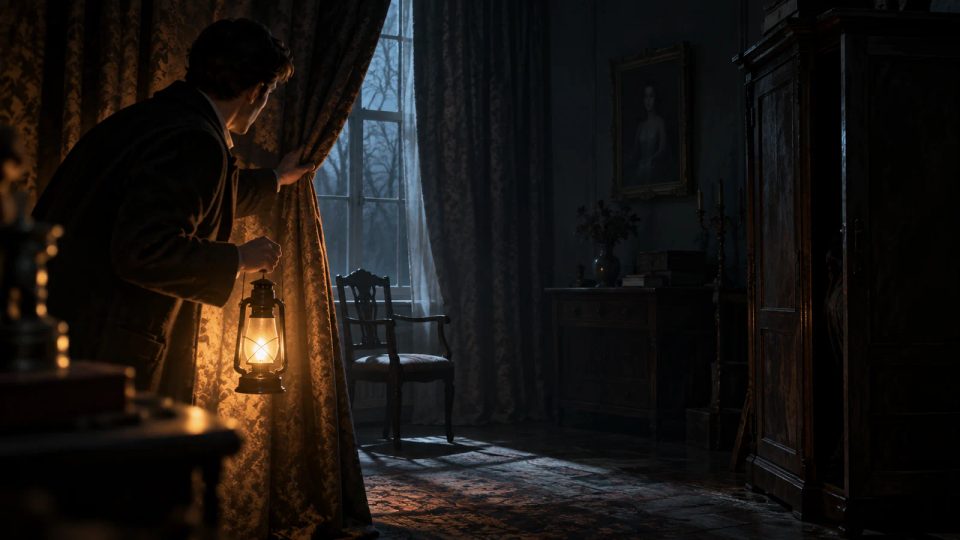
A cinematic editorial illustration shows an adult character holding a lantern and turning toward a partly closed curtain.
Interactive Film Game Narrative Design2026.10.13

Designing Horror Negative Space in an Interactive Film Game: What to Reveal After Players Choose Where to Look

When players choose to look behind a curtain, the shot owes them an answer with a clear scope. Use a negative-space reveal card to connect the area of interest, the inspection action, what can be confirmed, and what remains out of sight. An empty shot can then rule out a specific suspicion while preserving uncertainty grounded in what remains unseen.

DramaFork Editorial Team17 min read
Continue reading
Cinematic editorial illustration: a formally dressed adult ceremoniously draws back a curtain to reveal a neighbor holding an ordinary folding ladder.
Interactive Film Game Narrative Design2026.10.13

Where to Place Choices Around an Interactive Film Game’s Comic Reveal: Let Players Choose the Action Without Giving Away the Joke

Place the choice before the welcome begins. Make the action, its recipient, and the degree of commitment clear, while saving the visitor’s identity and the explanation of the misunderstanding for the reveal. Afterward, let the character finish reacting before handing back the next decision. Use a comedy interaction beat card to check for spoilers, unfulfilled actions, and interrupted reactions.

DramaFork Editorial Team18 min read
Continue reading
Cinematic editorial illustration: an adult in the foreground reaches toward a prominent rope loop across the water.
Interactive Film Game Narrative Design2026.10.13

When Close-ups Mislead: Making Action Distance Clear in an Interactive Film Game

A large image of a target tells players it matters, not that their character can reach it in time. A fictional dockside choice shows how to establish routes, scale references, and barriers before a decision, and how to complete a reusable distance readability storyboard worksheet.

DramaFork Editorial Team18 min read
Continue reading
Cinematic editorial illustration: a worn doorframe in an old workshop, an unfolded tool cloth with no writing, and the side silhouette of a character bending down to inspect form successive layers of imagery.
Narrative Design for Interactive Film Games2026.10.13

Reordering Investigation Montages in Interactive Film Games: Don’t Invent Causality Through Shot Order

Separate what each investigation shot requires the character to know from what its action establishes, then decide which shots can change places. A completed montage order constraint table distinguishes dependencies across the sequence from prohibited direct cuts, keeping characters from making judgments before their evidence appears.

DramaFork Editorial Team17 min read
Continue reading
Cinematic editorial illustration: glass marbles hang in midair above a tilting tray as an adult reaches toward its two ends with both hands.
Interactive Film Game Narrative Design2026.10.13

Slow-Motion Choices in an Interactive Film Game: Thinking or Hesitating?

Before staging a branch, establish whether a slow-motion choice consumes time within the story. A slow-motion timing card separates playback duration, story events, and the character’s experience, giving actions and accusations after normal speed resumes a clear basis.

DramaFork Editorial Team18 min read
Continue reading
Cinematic editorial illustration with structural beams and columns naturally dividing the composition: a lighthouse watchkeeper at night on one side and an adult maintaining the light in daylight on the other.
Interactive Film Game Narrative Design2026.10.13

Are Split-Screen Events Simultaneous? Making Timing Clear in Interactive Film Games

Establish the time relationship between split-screen panels before deciding how they echo each other. A fictional lighthouse watch and an earlier maintenance recording show how to fill out a split-screen timing agreement, checking synchronization anchors, sound sources, and supported inferences so that reviewing old footage does not look like live collaboration.

DramaFork Editorial Team18 min read
Continue reading
Cinematic editorial illustration: the same old door appears under different side lighting in overlapping memory spaces.
Interactive Film Game Narrative Design2026.10.13

Different Memories of the Same Event in an Interactive Film Game: Which Shots Can Change and Which Cannot?

Separate what happened from what each character claims to remember before deciding how the images can change. Use a memory-shot comparison table to track each shot’s source, fixed facts, variable presentation, and items to verify. Let the reveal correct specific accounts while preserving the cues that identify where earlier versions came from.

DramaFork Editorial Team18 min read
Continue reading
Cinematic editorial illustration: an adult protagonist holds an unopened old letter. A hazy space behind glass shows an imagined scene of a companion leaving, while the seat at the actual table remains occupied. Different qualities of light distinguish dream from reality; no text.
Interactive Film Game Narrative Design2026.10.13

How to Keep Imagined Outcomes Before a Choice from Looking Like Facts in an Interactive Film Game

An imagined sequence before a choice needs to establish whose thoughts we are seeing, what they are based on, and which consequences remain uncertain, then end with a clear return to the present scene. A fictional storyboard involving an old letter and a companion walking away shows how to fill out a reusable imagined-sequence boundary card.

DramaFork Editorial Team18 min read
Continue reading
Cinematic editorial illustration: an adult stops at the top of a staircase, bracing a hand against a doorframe, shoulders and back still rising and falling.
Interactive Film Game Narrative Design2026.10.13

When Breathlessness Suddenly Vanishes in an Interactive Film Game: Connect Breathing to the Action Just Completed

When a character speaks calmly right after running up the stairs, the problem may lie in the continuity of the entire performance. Use a breathing continuity sheet to connect prior exertion, evidence of recovery, dialogue breaks, and physical action, then check the pause-to-recover and immediate-response routes separately.

DramaFork Editorial Team18 min read
Continue reading
Cinematic editorial illustration: successive poses of an adult character rising from a wooden chair overlap within one composition.
Narrative Design for Interactive Film Games2026.10.13

Why Characters Stand Up Twice in Interactive Film Games: Fixing Branch Cuts by Action Phase

Similar poses can belong to different phases of an action. Use an action-phase cut table to distinguish preparation, push-off, upward movement, and settling, then decide whether to remove a repeat, restore a missing movement, or move the cut until after the character has settled into a standing position.

DramaFork Editorial Team18 min read
Continue reading
Cinematic editorial illustration: two walking silhouettes of the same adult character enter a bright corridor from a courtyard and a staircase.
Interactive Film Game Narrative Design2026.10.13

Backtracking After Branches Merge: Checking Screen Direction in an Interactive Film Game

Two routes leading to the greenhouse cannot necessarily cut straight into the same corridor shot. Use a screen-direction continuity chart to record story routes, frame exits and entrances, and landmarks separately, then give any entrance that requires a change of direction a visible spatial basis.

DramaFork Editorial Team16 min read
Continue reading
Cinematic editorial illustration: an adult character's face in profile softens into shadow in the foreground, while a broken clasp at the table's edge is in sharp focus.
Interactive Film Game Narrative Design2026.10.13

Revealing Clues with a Rack Focus in an Interactive Film Game: Design “Seeing an Object” and “Seeing Its Details Clearly” Separately

A clasp appearing on screen does not mean its break has been revealed. Use a rack-focus disclosure card to review the object's presence, the legibility of its details, and the conclusions those details support separately. Let the shot establish the damage; leave responsibility to later evidence.

DramaFork Editorial Team17 min read
Continue reading
Cinematic editorial illustration: in a dim dressing room, a wall conceals a visitor by the door. An angled mirror reflects only a hand holding a distinctive cane; the foreground character has not turned around. No text, letters, numbers, logos, watermarks, brand elements, or interface screenshots.
Narrative Design for Interactive Film Games2026.10.13

Do Mirror Details Count as Clues in Interactive Film Games? Checking for Early Reveals

Hiding a visitor in the main frame does not necessarily keep their identity secret. Treat the mirror as a separate information channel, then use a reflection disclosure review sheet to check recognizable details, prior evidence, and choice timing. Decide whether to retain the reflection as an intentional clue, develop it into supported misdirection, or remove the early reveal.

DramaFork Editorial Team18 min read
Continue reading
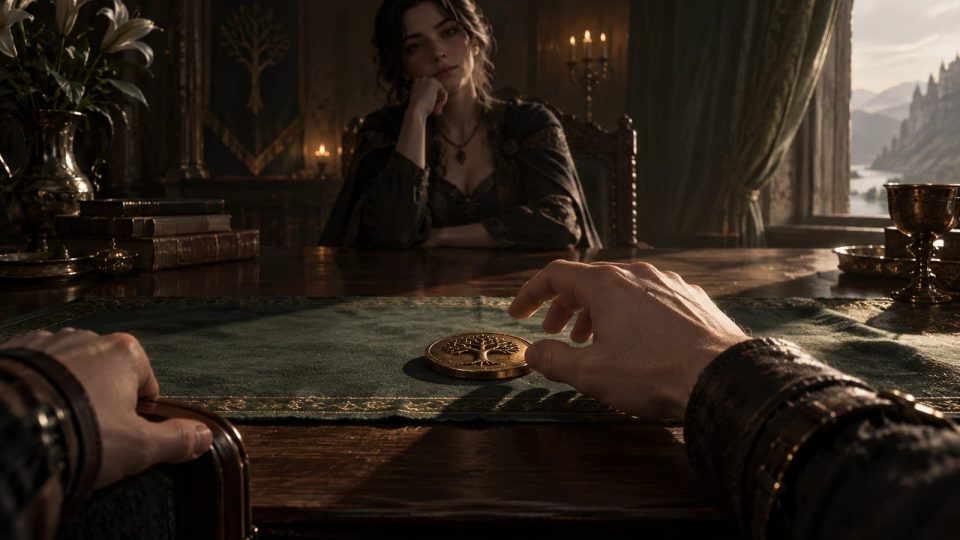
Cinematic editorial illustration: from a first-person perspective, one adult hand pauses above a badge on a table while the other remains against the chair edge.
Interactive Film Game Narrative Design2026.10.13

First-Person Hands in an Interactive Film Game: Act Only on the Player’s Decision

Hands in a first-person shot can give players a sense of physical presence, but they must not accept, refuse, or take possession ahead of a choice. Using a borrowed badge, this article separates body positioning, preparation, and decision-expressing gestures, then turns them into a first-person hand-action score for storyboarding and rehearsal.

DramaFork Editorial Team19 min read
Continue reading
Cinematic editorial illustration: an adult tower keeper looks straight toward the viewer. A mirror behind him to one side reflects a plain recording device and an empty chair, conveying the tension between an in-world conversation and a recorded message. No text, letters, numbers.
Interactive Film Game Narrative Design2026.10.13

When Interactive Film Game Characters Look into the Lens, How Do You Make Clear Who They Are Talking To?

A look into the lens takes its meaning from whose view the shot represents, who the dialogue addresses, and who can respond. Use a fictional tower keeper’s shift from a live conversation to a recorded message to fill out a direct-gaze agreement card, giving each of the two frontal gazes a clear recipient.

DramaFork Editorial Team18 min read
Continue reading
Cinematic editorial illustration: two adults whisper beside a folding screen while a third person carrying glasses pauses on the other side. Candlelight separates concealed and exposed spaces. No text, letters, numbers, logos, watermarks, brand elements, or interface screenshots.
Interactive Film Game Narrative Design2026.10.13

How to Film Whispers in an Interactive Film Game: Staging Who Can Hear What So It Can Be Checked

A close-up alone cannot make a whisper private. Use a whisper staging card to coordinate the intended listener, the server’s route, the screen, ambient sound, and the timing of a pause, giving both the secrecy and overhearing branches a basis in the scene.

DramaFork Editorial Team17 min read
Continue reading
  1. 1
  2. 2

Blog categories

  • All500
  • Creation tutorials40
  • Interactive narrative60
  • Getting started11
  • Galgame Route Design25
  • Visual Novel Production25
  • Interactive Fiction Design25
  • Narrative Design for Interactive Film Games25
  • Interactive Film Accessibility10
  • Interactive Film Workflow10
  • Interactive Game Basics10
  • Interactive Film Presentation and Delivery10
  • Interactive Film Localization10
  • Interactive Film Production10
  • Narrative Mechanics11
  • Creative Collaboration11
  • Getting started1
  • Fictional Case Study10
  • Story Localization10
  • Mobile and Accessibility10
  • Acting and Staging10
  • Exploring Time and Space10
  • Relationships and Groups10
  • Resources and Constraints10
  • Information and Commitments10
  • Production Practice59
  • Product workflow34
  • Choosing tools33

From a story to a playable world.

Start with one story decision

Create a project