When Interactive Film Game Characters Look into the Lens, How Do You Make Clear Who They Are Talking To?
A look into the lens takes its meaning from whose view the shot represents, who the dialogue addresses, and who can respond. Use a fictional tower keeper’s shift from a live conversation to a recorded message to fill out a direct-gaze agreement card, giving each of the two frontal gazes a clear recipient.
Introduction
When a character looks directly into the lens, establish whose view the shot represents, who the line is addressed to, and who can answer in the moment before directing the performance. If a scene shifts from speaking to the protagonist to leaving a recorded message, show the actions that start and end the recording, and change the available responses accordingly. A change in the actor’s tone alone may still leave the intended recipient unclear.
The following tower keeper scene provides a worked example of a “direct-gaze agreement card.” Its characters, dialogue, and shot sequence are original fictional teaching examples. They are not real user experiences, measurements, or hands-on tests, and they do not represent DramaFork product features.
1. Break “looking at me” into three separate questions
The setup: the player takes the role of Lin Zhou, a visitor asking the tower keeper, inside the tower, why the doors are closed at night. The keeper first answers Lin Zhou, then records a message for the person taking over the next shift, who has not yet arrived. Lin Zhou stays in the room throughout, but only one of the two passages is addressed to him.
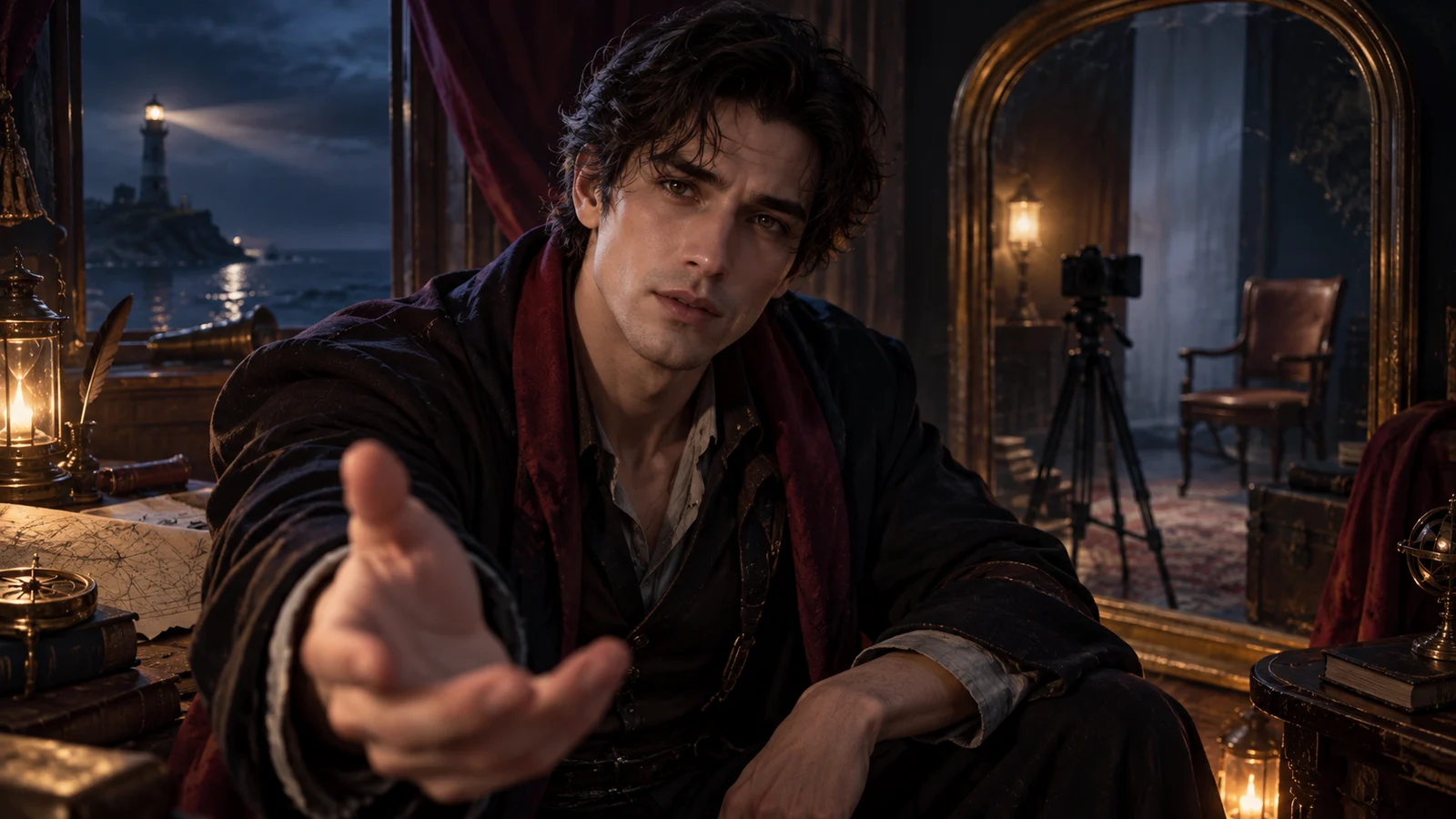
The first passage uses the protagonist’s point-of-view shot. When the keeper looks into the lens, he is looking at Lin Zhou within the story; the player can choose Lin Zhou’s reply. The second uses the viewpoint of an in-world recording device in the room. The keeper still looks straight ahead, but his intended recipient is now the person taking over who will watch the recording later. The device records the message; it is not a conversation partner capable of answering.
Specify “where the shot is viewing the scene from,” “who is being spoken to,” and “who may answer” separately. The protagonist’s ability to hear the message does not mean the message is asking him a question. Nor does the player’s view of a face looking straight ahead mean the character knows someone exists beyond the screen.
When is a direct gaze likely to be read as breaking the fourth wall? If the scene has not established an in-world recipient, the dialogue says “you decide,” and an actionable response appears at the same time, that interpretation becomes possible. If the intention is simply an in-world conversation, provide more evidence of that relationship.
2. Fill out the agreement card before directing the gaze
This scene makes a specific trade-off: no options for the protagonist to interrupt are offered during the recording, and conversation resumes afterward. That makes the two kinds of gaze easier to distinguish, at the cost of temporarily reducing the player’s opportunities to act. This restriction is a creative choice for this example, not a rule all recording scenes must follow.
| Agreement field | Live conversation | Recorded message |
|---|---|---|
| Whose view the shot represents | Lin Zhou’s point of view | The viewpoint of the recording device in the room |
| Intended recipient | Lin Zhou, standing in front of the keeper | The person taking over, watching the message later |
| Permitted responses | The player answers or stays silent as Lin Zhou | The person taking over cannot respond now; no option for Lin Zhou to interrupt is offered in this passage |
| Entry cue | Establish the two characters facing each other, then cut to the protagonist’s POV | Show the keeper move to the device, start recording, and address the person taking over |
| Exit cue | The keeper says he needs to leave a message, then turns and moves away from his position in front of Lin Zhou | Show him stop recording, then turn and call Lin Zhou by name |
| Performance focus | Wait for Lin Zhou’s reaction | Leave gaps between phrases without waiting for an answer in the room |
To reuse the card, keep these fields and substitute your own characters, device, and transition actions. Do not write only “first person” or “speaking to the player.” The former does not identify whose viewpoint it is; the latter does not establish the role in which the player responds.
If you choose to allow interruptions during recording, add another agreement: Lin Zhou speaks from beside the device; the keeper first shifts his gaze away from it, then answers Lin Zhou. Afterward, make it clear whether he continues or stops recording. Do not have him keep staring at the device while answering the protagonist without any transition.
3. Test both viewpoints with the same line
Comparing shot sequences built around “Did you hear me clearly?” exposes problems more readily than giving the two passages entirely different wording.
The live version begins with a medium shot from the side, establishing Lin Zhou by the door and the keeper opposite him. Cut to Lin Zhou’s POV. Looking into the lens, the keeper says, “After dark, don’t open the north door. Did you hear me clearly?” He then waits. Offer Lin Zhou the replies “I heard you” and “Why can’t I open it?” The first earns a nod; the second prompts an explanation. The pause, the choices, and the subsequent reactions all point to the same recipient.
The recorded version first establishes the device on the table and Lin Zhou stepping back to the side of the table. The keeper starts recording, then the shot cuts to the device’s viewpoint. He says, “To whoever takes over tomorrow morning: after dark, don’t open the north door. Did you hear me clearly?” After a brief pause, he continues, “I’ll say it again. Do not open the north door.” No reply options for Lin Zhou appear here. The pause belongs to the delivery of the message; it is not an invitation to a live exchange.
Even in a recording, that question may still sound as though it is waiting for an answer. If this suspense serves no purpose, change it to “Please remember: do not open the north door” to reduce ambiguity. If the question must remain, retain the explicit address and the action of continuing the message, so viewers do not have to guess who is being spoken to.
The point of the comparison is not which performance feels more natural. When the same line moves to a shot representing a different viewpoint, both the person who can respond and the purpose of the pause must change with it.
4. Show the transition as a complete action
The sequence can be arranged in five steps: Lin Zhou presses for the reason the doors are closed; the keeper answers; the keeper says, “Hold on. I need to leave a message for the next shift”; the shot shows him walk to the device and start recording; then it cuts to the device’s viewpoint as the message begins. The explanation before the transition establishes intent, while the intervening action establishes the source of the new viewpoint.
The exit needs to be complete as well. After the message, first show the keeper stop recording. Then have him turn back toward the door and say, “Lin Zhou, where had you got to with your questions?” Return to the protagonist’s POV and restore the opportunity to answer. If choices simply pop up at the end of the message, it may be hard to tell whether they mean replying, operating the recording, or answering as the person who will take over later.
Changes in aspect ratio, color treatment, or sound can help distinguish the passages, but this example does not rely on them alone. If both passages must use the same frontal close-up, retain a shot between them that establishes the spatial relationship. If the pacing leaves no room for a close-up of the device, show the recording being started within a medium shot from the side. You can shorten the transition, but do not cut every cue that makes it identifiable.
5. Check response permissions line by line, then revise misreadings
Once the shot sequence is complete, annotate each line with four things: whose view the current shot represents, the intended recipient, who can respond, and the visible result of that response. In the live passage, “Did you hear me clearly?” leads to Lin Zhou’s reply and the keeper’s reaction. In the recorded passage, it addresses the person who will take over later, while only the keeper continues speaking in the present. If you cannot fill in these details for a line, fix the relationship between speaker and recipient before polishing the dialogue.
Common failures include showing the device only in the opening background, with no action at the transition; leaving the previous passage’s reply option available during the message; or having the keeper continue to address the lens as “whoever is taking over” after returning to the protagonist’s POV. These require, respectively, evidence that recording has started, a change to when responses become available, and a turn back toward the protagonist with an appropriate form of address.
For review, you can ask someone who was not involved in planning the scene to pause at each of the two direct gazes, explain “who he is speaking to, and who I can answer as right now,” and identify the evidence behind that reading. This is a proposed check to carry out; this article does not claim that it has produced test results.
The card suits scenes that need a clear distinction between live conversation and a message recorded on a device. You can also use it when a work deliberately leaves the player’s identity unresolved, but specify which field remains undisclosed, which interpretations are permitted, and when clarification will come. Suspense can preserve the secret of the recipient’s identity. Once the player is asked to make a consequential response, however, there should first be evidence establishing the role in which they are answering.