Designing Horror Negative Space in an Interactive Film Game: What to Reveal After Players Choose Where to Look
When players choose to look behind a curtain, the shot owes them an answer with a clear scope. Use a negative-space reveal card to connect the area of interest, the inspection action, what can be confirmed, and what remains out of sight. An empty shot can then rule out a specific suspicion while preserving uncertainty grounded in what remains unseen.
Introduction
When designing horror shots around negative space in an interactive film game, first specify what this inspection can rule out, then decide how to reveal what lies in shadow. If players choose to look behind a curtain, the image should answer whether someone is there. If the shot covers only the window area, it cannot also declare the entire room safe. A meaningful inspection need not reveal a monster, but it must provide new information with clearly defined limits.
The following original, fictional teaching scene walks through a complete “negative-space reveal card.” Its character, room, and branches are instructional examples, not real user experiences, measured results, or DramaFork product features. Nor does the example imply that any scare effect has been validated.
1. Turn negative space into an answerable question
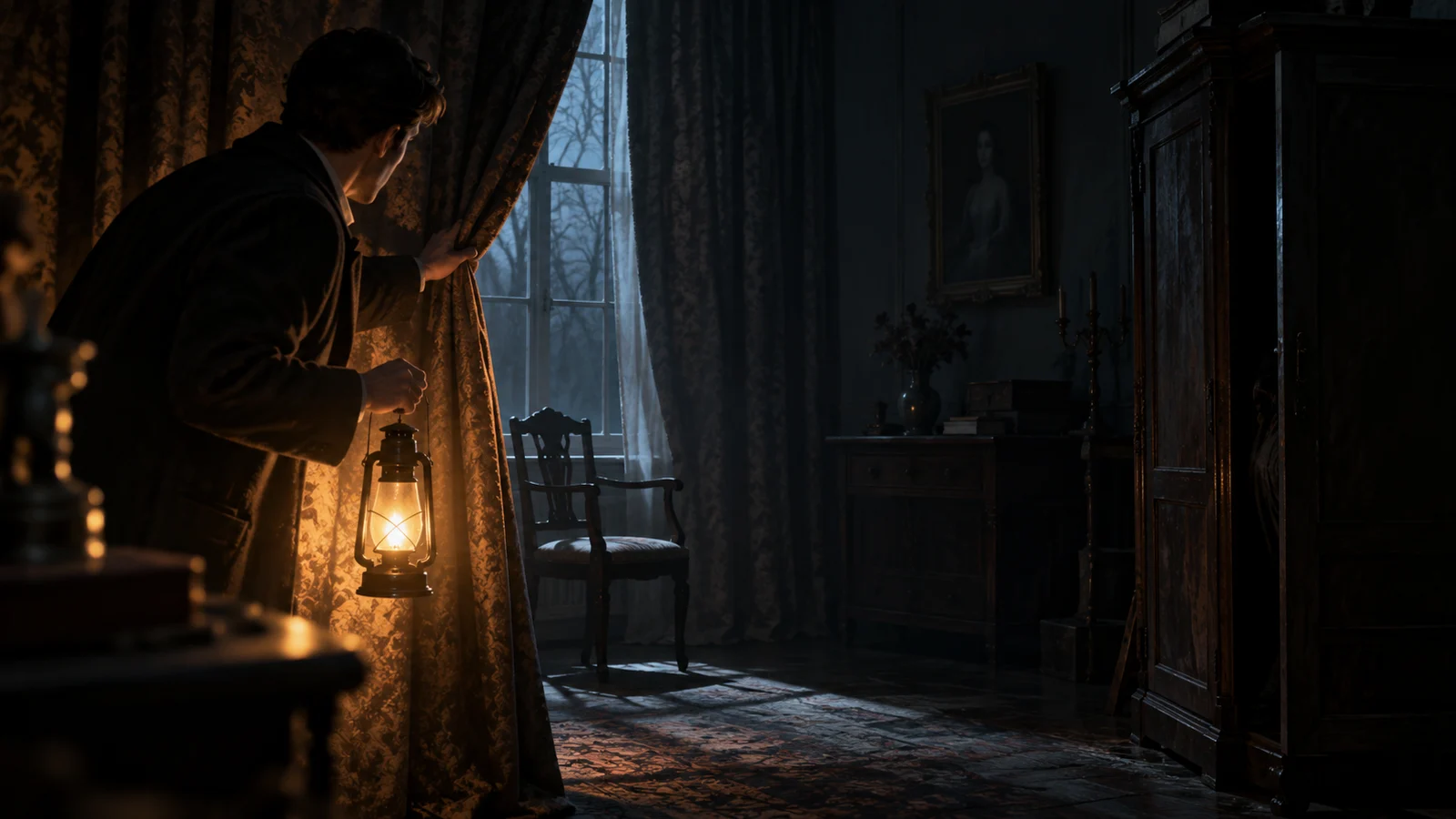
The scene begins with an adult character entering a room with a lantern. A curtain hangs on the left, concealing a recess beside the window. Only the back of a chair is discernible in the center, while a tall cabinet on the right blocks the area beyond it. No preceding footsteps prompt the inspection. The motivation comes from the composition: the character is already looking toward the curtain, but the lantern has yet to illuminate the space behind it.
The director first defines the player's immediate question: “Is someone standing in the space hidden by the curtain?” This is better suited to a single turn-and-look action than “What's in the room?” The former specifies a location and the conditions needed to rule out a possibility. The latter asks the shot to search the whole room, making it easy for the option to promise more than the image covers.
The option therefore reads “Shine the lantern behind the curtain,” not “Check that the room is safe.” To carry it out, the character turns their head and body, raises the lantern, and then draws the curtain aside. Moving the curtain must be part of the inspection. If the character merely turns their head and the previously opaque fabric somehow stops blocking the view, the answer has no visual basis.
Viewers must also recognize the target before choosing. The curtain edge, chair back, and cabinet corner serve as spatial reference points. Retain some of these after the turn to help players confirm that the shot is answering the question they just asked.
2. Use a frame sketch to distinguish visible, unlit, and obstructed areas
The original text-based frame sketch below shows only spatial relationships. It is neither a product interface nor a representation of exact dimensions.
Frame before inspection
┌──────────────┐
│ Curtain hides recess │ Faint chair back │ Tall cabinet │
│ Lantern not yet aimed here │ Unlit floor │ View behind cabinet blocked │
└──────────────┘
Frame after inspection
┌──────────────┐
│ Curtain drawn aside: window frame, recess back wall, and floor │
│ Empty chair: seat, space underneath, and both sides clearly visible │
│ Cabinet remains in frame on the right; the area behind it is still blocked │
└──────────────┘
These are two different kinds of unknown. Moving the light may make a dark area discernible, but seeing behind the cabinet requires a change of viewpoint. Increasing brightness cannot remove a physical obstruction. Calling both “dark areas” invites a later mistake in which turning up the light inexplicably allows the viewer to see through furniture.
In this example, the window recess is shallow, with no corners extending sideways out of view. Only when drawing the curtain aside reveals the back wall, both side boundaries, and the floor as a continuous space, with the area beneath the chair also visible, is it reasonable to state, “There is no one in this spot by the window.” If the storyboard adds a deep wall projection or heavy curtain folds, the conclusion must be narrowed, or another viewing angle added.
Blank areas in a sketch are not automatically evidence. The director should mark, area by area, which surfaces are discernible and which outlines are merely inferred, so that “no person was drawn” is not mistaken for “the absence of a person has been established.”
3. Complete the reveal card before deciding how long to hold the shot
This card can be copied to other inspection points, but its scope must be filled in anew each time. Do not apply a generic “Nothing unusual found” to every scene.
| Field | Entry for this example |
|---|---|
| Area of interest | The shallow recess hidden by the curtain and the space around the chair within it |
| Inspection action | The character turns their head and body toward the window, raises the lantern to illuminate the recess, and draws the curtain aside; the camera settles with their gaze |
| What can be confirmed | At the time of this inspection, no one is in the recess; no one is hiding on the chair seat, underneath it, or on either visible side |
| What remains out of sight | Behind the tall cabinet, behind the character, and the doorway outside the frame |
| Suspicion ruled out | “Someone is currently hiding in the recess concealed by this curtain” |
| Conclusions not permitted | The entire room is unoccupied; the doorway is safe; the window area will remain unchanged later |
| Follow-up | The player may choose to look around the cabinet or return to the doorway with this limited confirmation |
The execution order is to retain a reference point for the target, complete the change in obstruction, and then present the result. Do not cut away as soon as the curtain starts moving, or let the lantern's glare obscure the space beneath the chair. Otherwise, the action has taken place, but the inspection is not yet complete.
There is no need to prescribe a uniform number of seconds for the hold. First check the storyboard: do viewers have a chance to recognize the recess boundaries, see the area around the chair clearly, and notice that the cabinet still blocks the view behind it? If more time is needed, prioritize a steady frame and fewer unrelated movements over having the character repeat “No one's here.” Dialogue can summarize the answer, but it cannot supply evidence the image never provided.
4. Let the next action use this limited answer
After the inspection, the character might say, “No one's by the window. I still can't see behind the cabinet.” The first half delivers the result; the second preserves its spatial limits. Changing the line to “I was worrying over nothing” risks turning a conclusion about one area into general reassurance, weakening the basis for the next choice.
The example then offers “Move around to the side of the cabinet and look” and “Return to the doorway.” The former continues to remove an obstruction but requires approaching an area that has not yet been inspected. The latter leaves the window area for now, while leaving the question of what is behind the cabinet unresolved. The trade-off comes from the viewing position and direction of movement. There is no need to invent a countdown or deduct resources.
If the player looks around the cabinet, the new shot should carry forward scene conditions such as the open curtain and unchanged chair position. If a figure needs to appear by the window later, treat it as a new development after time has passed: establish a possible route of entry, or separately establish a supernatural premise. Do not claim that someone was standing all along in the position just shown in full.
An empty shot can thus move the player's reasoning forward: rather than prioritizing the recess they have already seen clearly, they turn their attention to areas not yet covered. This is a narrative extrapolation within the example, not a prediction of real player behavior.
5. Check the limits of the reveal against three failure modes
The first failure is answering the wrong question. The player chooses to inspect the curtain, but the shot suddenly cuts to a face behind them. To fix this, complete the window-area reveal first, then treat the disturbance behind the character as a separate event. Otherwise, the scare replaces the information the player requested.
The second failure is an empty view that supports no clear judgment. The shot holds for a long time, but the space beneath the chair remains pitch-black. This confirms only that no one is on the seat, not that the entire recess is unoccupied. You can reposition the light to complete the coverage or preserve the unknown, but subsequent text must use the narrower conclusion.
The third failure is showing too much. The camera sweeps across the entire room, making a later inspection behind the cabinet pointless. Limit the extent of the turn at the storyboard stage while retaining the cabinet edge, so viewers can see where the inspection stops. The cost of limiting coverage is that the full space cannot be established immediately; later actions must fill in the gaps.
Before delivery, compare the option, the resulting frame, and the next lines of dialogue side by side. Can every statement of confirmation be tied to a visible area? Can every remaining unknown be tied to a specific obstruction? If the answer depends on the room layout in the author's head, keep drawing in the boundaries. This card suits inspection scenes in which players are expected to judge from the image. Dreams or unreliable viewpoints need their own agreed rules of evidence; the spatial confirmation method in this example cannot simply be carried over.