Are Split-Screen Events Simultaneous? Making Timing Clear in Interactive Film Games
Establish the time relationship between split-screen panels before deciding how they echo each other. A fictional lighthouse watch and an earlier maintenance recording show how to fill out a split-screen timing agreement, checking synchronization anchors, sound sources, and supported inferences so that reviewing old footage does not look like live collaboration.
Introduction
A split screen does not have to show simultaneous events. But when actions flow from one panel into the other and sounds seem to answer each other, viewers have reason to read them as happening at the same time. Before planning composition and pacing, spell out what viewers can infer from the juxtaposed images. Keep two questions separate: are the events simultaneous, and is there a channel through which the characters can exchange information?
The lighthouse sequence below provides a worked example of a split-screen timing agreement. It is entirely fictional and intended only for teaching. It is not a real user case, an empirical finding, a hands-on test, or a DramaFork product feature. The lighting-equipment details are not maintenance instructions.
1. Choose the time relationship before planning visual echoes
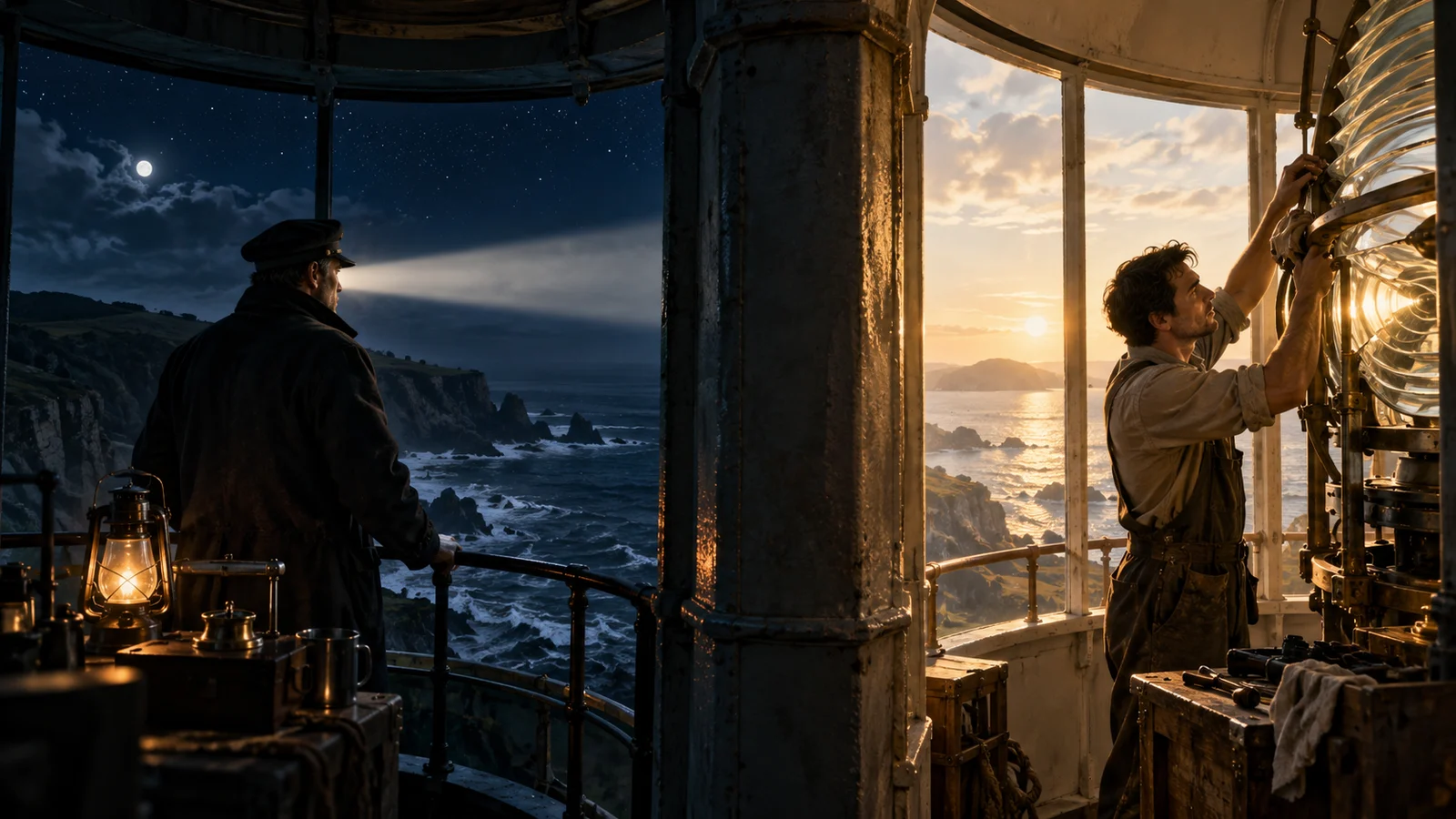
The sequence has a specific task: the person on watch that night discovers a circular mark on the light’s housing and consults an earlier maintenance recording to find out where it came from. The left panel shows the scene that night; the right shows footage recorded that afternoon. Viewers can compare the same detail, but they must not infer that the maintenance worker is helping remotely in real time.
First, choose one of three relationships for the split screen. Simultaneous scenes must occupy the same time span, preferably supported by a shared event. A comparison across different times must identify each panel’s time period and explain how the past footage enters the present narrative. A subjective association must establish whose association it is and whether its contents can serve as objective evidence. This example uses a comparison across different times. The right panel is a recording the watchkeeper is viewing, not a flashback visible only to the audience.
That decision limits the available information. The watchkeeper can learn about the past from the recording, but the worker in the recording cannot learn about the new problem that night. Even in a separate version with simultaneous scenes, being present at the same time would not automatically mean the characters could hear each other. Immediate responses still require an explicit communication channel.
2. Turn the timing agreement into an editing worksheet
Fill out the table before numbering the shots. Here, a “synchronization anchor” is evidence that aligns both images to the same event at the same moment. Similar colors or movements can create an echo; they cannot establish simultaneity on their own. For a sequence set at different times, explicitly write “none” and provide the timing evidence for each panel.
| Check | Left: watch that night | Right: afternoon maintenance recording |
|---|---|---|
| Time period | That night, while reviewing the recording | That afternoon, during a process that has already ended |
| Status of the footage | The present scene | An earlier record being played in the present |
| Synchronization anchor | None linking it to the original event on the right | Introduce it at the start as “Maintenance record: this afternoon” |
| Basis for comparison | A circular mark already exists on the housing | The worker leaves the mark in the same location |
| Sound source and listening path | Present room ambience and the watchkeeper’s speech | Speech and tool sounds in the recording, heard by the present character through the playback device |
| Supported inference | The watchkeeper recognizes that the mark dates from the afternoon | The recording supplies past information about the mark’s origin |
| Unsupported inference | Speaking can direct the person on the right | Actions on the right are changing the present scene on the left |
The distinction most easily missed in this table is between playback time and recording time. Hearing an old recording now does not mean the person recorded is speaking now. Preserving that distinction explains why the sound is audible in the scene that night without turning it into a two-way conversation.
In this example, the recording is used only to establish where the mark came from. It cannot also establish that the light remains exactly as it was that afternoon. Write down which judgments the old record supports under supported inferences, rather than leaving viewers to fill in the gaps.
3. Establish the timing before a misreading takes hold
Begin the edit with the left scene alone. The watchkeeper notices the circular mark and opens a recording identified as an afternoon maintenance record. Let viewers see the playback action before expanding into a split screen and bringing the maintenance footage into the right panel. The contrast between night and daylight is a supporting clue. It cannot explain the timing by itself, because viewers might interpret it as different lighting at different locations.
Once the split screen is established, the worker on the right says, “I’ll leave a mark here,” then makes the mark. On the left, the watchkeeper looks at that same spot, where the mark already exists that night. The left-side reaction follows information from the recording and conveys “I understand where it came from,” not “I am watching it appear right now.” The mark therefore must not suddenly appear on the left at the exact beat when the worker makes it on the right.
Introduce the sound through the playback device already established in the scene, then carry it into the split screen. You can adjust the recording’s sound quality to help distinguish it, but sound quality alone cannot establish that it comes from the past. Keep the present room ambience recognizable, and do not pair a tool sound on the right with an object vibrating on the left to create a single impact.
This takes a little opening time and sacrifices some of the crispness of cutting directly into two panels. In return, you can retain visual echoes later without repeatedly explaining the date. If the sequence must be very short, cut one pair of echoing actions if necessary, but retain the setup that identifies the recording.
4. Use two editing scripts to check the limits of causality
Write a second, fictional version with simultaneous scenes for comparison. Keep the watchkeeper on the left that night, but change the right panel to another worker’s location that same night. Establish a call between them. The person on the left asks the other person to check the mark; the person on the right hears the request, turns to look, and replies aloud. Here, “the request prompted the inspection” is a supported reading because the shared time period, information transfer, and response order are all established.
The problem appears if you replace the right-side material with the afternoon recording while keeping the same rhythm. The person on the left asks, “Can you check the mark?” and the person on the right happens to turn their head. It can look as though they are following an instruction. In the version set at different times, change the left-side line to “I’ll take another look at the earlier recording” and retain the action of opening or replaying it. The right panel continues its original sequence without functioning as an answer.
Compare the two scripts point by point. The simultaneous version permits questions and answers in both directions; the version set at different times permits only the present character to receive past information. A request in the simultaneous version can change what the other person does next. A choice in the version set at different times can change only how the record is viewed in the present. A shared score can connect the emotions of both panels, but do not suggest a shared live situation with an alert sound that both sides respond to.
These are checks on inferences supported by the script’s relationships, not measurements of audience comprehension. Smooth action matching can conceal an error, so “the edit flows well” is not a reason to consider the time relationship clear.
5. Apply the same agreement to interactive choices
The choices in this example are “Replay the mark segment” and “Return to tonight’s scene and compare.” The first presents the same earlier recording again. The second closes the right panel so the watchkeeper can examine details visible in the present. Neither path can make the afternoon worker perform an additional action because the player clicked, unless the work separately establishes narrative rules that allow the past to be rewritten.
When handing off the sequence for editing, append the entry and exit points for each choice to the agreement table. Check whether clues identifying the recording remain when the split screen reopens. Pay particular attention to paths that skip the opening or replay from the middle. If they do not show the initial playback action, supply the missing cue on re-entry rather than assuming viewers remember the first explanation.
For review, first ask someone who was not involved in the edit to describe when each panel takes place, who can hear whom, and what the choices change. Then record the differences between their understanding and the agreement. If the sequence still reads as live collaboration, first remove question-and-answer transitions and synchronized responses, then consider adding explanation. This table is intended for sequences whose time relationships should be clear. If you deliberately conceal the chronology, separately record when it will be revealed and which causal judgments viewers must not be required to make before that reveal.