How to Make It Clear When a Question Is for Someone Off-Screen
When two characters share the frame but a question turns to someone off-screen, identify the listener with a form of address, establish their location through eyelines and sound, then leave a clear opening for their reply. Use a dialogue addressee card to carry those cues into dialogue and storyboards.
Make it clear who the question is for before the third character answers
When a shot of two characters includes a question addressed to a third, put a listener cue at the start of the question, then reinforce it with the speaker’s orientation and the off-screen reply. One straightforward revision is to name the third character when first turning to them, have the speaker turn toward their established off-screen position, let the third character speak first, and only then let the other visible character react. The third character does not need to appear, but the question must make sense without the author’s notes.
Three things need to be distinguished: who is speaking, whom the line addresses, and who takes the next turn. A speaker label in the subtitles only helps identify the speaker; a voice coming from the right only helps locate its source. Neither, on its own, establishes whom the question addresses.
The watch repair shop scene below is a fictional teaching example, not a real user case, a tested result, or a DramaFork product feature. All dialogue, blocking, and review methods were devised to illustrate the issue.
Why a two-shot can send a question to the wrong person
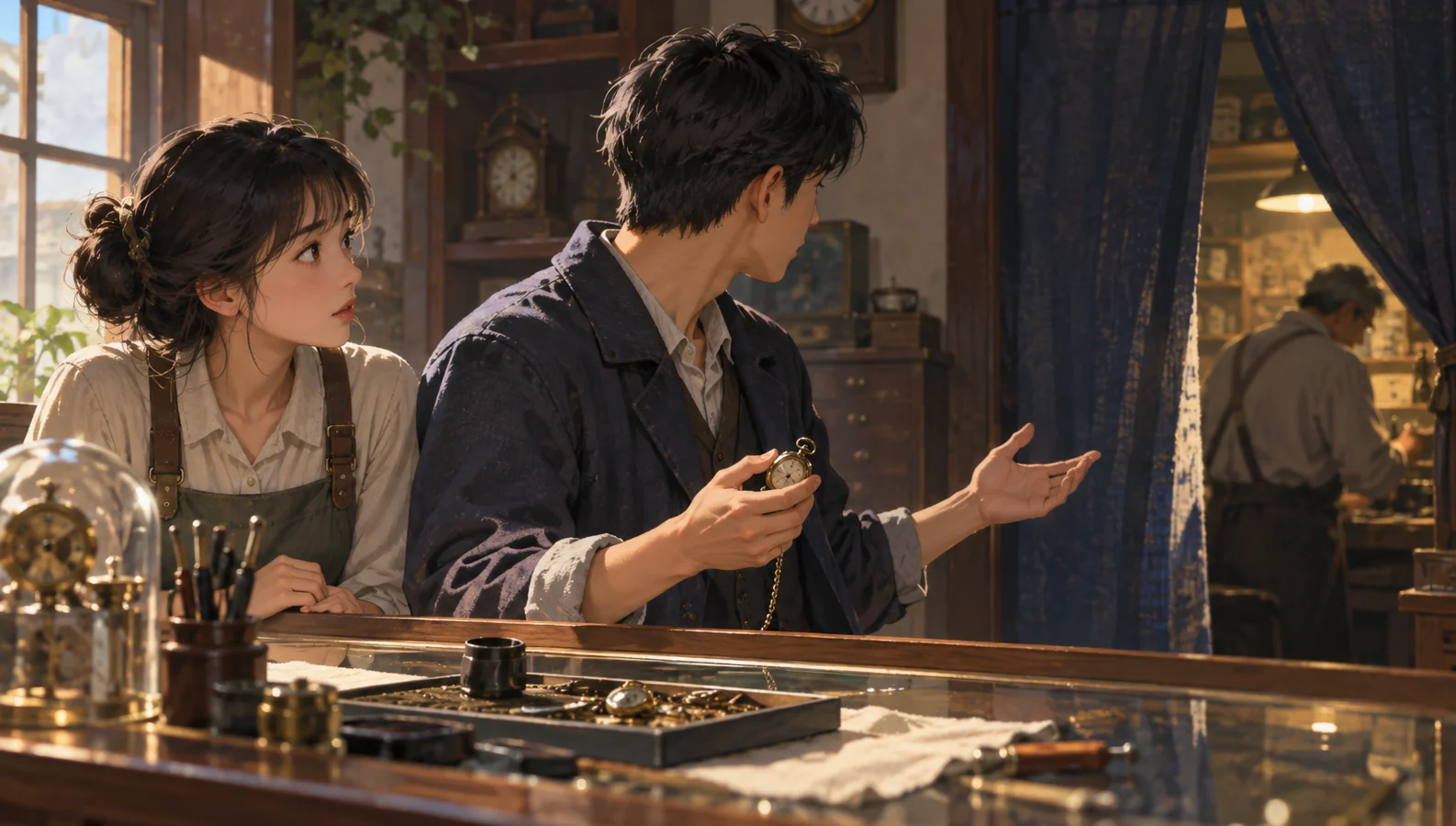
In this scene, Lin Zhou and A-He stand at the watch repair shop counter, both visible in the frame. A third character, Uncle Zhou, is counting parts behind a doorway curtain on the right. The previous shot has already shown him going in. Lin Zhou holds a pocket watch that has stopped and wants to ask Uncle Zhou whether he has opened its case cover.
The original draft has just three lines:
Lin Zhou looks at A-He: “Did you open it last night?” A-He looks up. Uncle Zhou, off-screen: “No. I didn’t touch it.”
The author knows Lin Zhou is asking Uncle Zhou, but the visible information points to A-He: Lin Zhou is looking at her, “you” has not been redirected, and her reaction immediately follows the question. Only when Uncle Zhou answers can viewers revise their understanding, and they might instead read his line as a sudden interruption.
The first fix should not be to give Uncle Zhou more explanation. The problem arises when the question is asked, not in the answer’s content. Even a longer reply such as “No, I was in the back room all last night” cannot restore the listener cue missing at the moment of asking.
State the revision goal specifically: by the time Lin Zhou finishes asking, the audience should already recognize Uncle Zhou as the person expected to answer. A-He can remain suspicious or tense, but her reaction should not function as an answer. This helps distinguish deliberate concealment from accidental confusion.
Use one addressee card to revise both dialogue and storyboards
Fill in the following card whenever dialogue shifts from someone in the frame to someone off-screen. It records what the audience can see and hear, not merely a list of characters.
| Field | Entry for this example |
|---|---|
| Questioner and intended listener | Lin Zhou asks Uncle Zhou |
| Evidence of the listener’s location | The previous shot shows Uncle Zhou going behind the curtain on the right |
| Identification within the question | Begin by saying “Uncle Zhou” |
| Questioner’s action | Look away from A-He and turn toward the curtain |
| Voice location | Uncle Zhou answers from behind the curtain, maintaining continuity with the previous shot |
| Opening to respond | Once Lin Zhou finishes, Uncle Zhou speaks first; A-He reacts afterward |
| Risk of misreading | A-He looks up or opens her mouth first, as if preparing to answer |
Use the card to break the original draft into three consecutive beats, all of which can be staged while retaining the two-shot:
Panel 1: Redirect the question. Lin Zhou lowers the pocket watch, shifts his gaze from A-He to the curtain on the right, and says, “Uncle Zhou, this watch—did you open it last night?” Naming him and turning toward him happen early in the question. Avoid waiting until the entire line is over to add a look toward the curtain.
Panel 2: Leave room for the reply. After asking, Lin Zhou keeps facing the same direction. A-He continues looking at the pocket watch without opening her mouth. Uncle Zhou’s voice comes from behind the curtain: “I didn’t open it. I only replaced the watch chain.” Hold off on a close-up of A-He here, allowing Uncle Zhou to finish his reply first. State replacing the chain and opening the case cover separately, preserving the distinction between his having handled the watch and his denying that he opened it.
Panel 3: Let the bystander react. Only after Uncle Zhou finishes does A-He look toward the curtain, then down at the watch in Lin Zhou’s hand. Her expression conveys her suspicion without competing with the cue for who should answer.
“Voice location” on the card does not mean you must use an obvious left-right stereo effect. The vocal quality and sense of space associated with being behind the curtain can work with the image, but the name and orientation cues still need to hold up independently. If a storyboard changes the camera position, rewrite the curtain’s location in the new frame instead of automatically retaining “on the right.”
What cues can you use when naming someone feels awkward?
A form of address is not needed in every line. If Uncle Zhou has already answered several consecutive questions and Lin Zhou is still facing the curtain, the next line can simply be, “Then what about the scratch on the case cover?” Reassess whether the addressee is clear enough whenever the intended listener changes or another person’s dialogue intervenes.
If a character cannot naturally use someone’s name, use an established form of address, such as “sir” when addressing the watchmaker. This only works if one person present fits that form of address; if two craftsmen present are addressed that way, it remains ambiguous. Another option is, “You behind the curtain—I’m asking you.” But that phrasing suggests distance or provocation, so do not casually alter the characters’ relationship merely for clarity.
If the story needs to conceal the third character’s identity for a while, first let a voice behind the curtain say, “I’m the one who replaced the watch chain.” Lin Zhou then turns that way and asks, “Did you open the case cover too?” This reveals the third character’s presence early, making it suitable for scenes that conceal identity but not presence. If even their presence must remain secret, you cannot also require the audience to identify the listener immediately and accurately. You must deliberately choose when to reveal that information.
Another option is to insert a brief shot of the curtain or the questioner in profile. This can help when the turn is not noticeable enough in the two-shot. But a shot of the curtain with no one visible supplies no identity information on its own; it still needs to connect to an earlier location cue or a voice. The extra shot directs attention. It cannot replace missing spatial setup.
Find failure points with three ways of reading the scene
Review in two steps. First, show a reader only the revised scene, including the necessary preceding shot. Do not provide the addressee card, revision goal, or explanatory notes. Pause after the question but before Uncle Zhou answers, ask, “Who is this question for, and what tells you that?”, record the judgment, and then continue. Do not disclose the expected answer beforehand, or you may mistake remembering the setup for understanding the shot.
Next, show the completed addressee card and compare the cues the reader identified with the intended design, item by item. Then discuss whether the dialogue feels natural and the response order is clear. The card supports explanation and troubleshooting; it must not become a prompt for the initial comprehension check.
You can manually review the scene under three conditions. If the same reader sees them in sequence, later judgments may be influenced by earlier information and should not be treated as independent first-impression results:
- Read only the dialogue: After “Uncle Zhou” is spoken, is there still another character with the same name or form of address? If so, use a form of address that distinguishes them.
- Look at the images and subtitles: Even without hearing the direction of the voice, do the head turn and form of address connect? If the subtitle has been reduced to “Did you open it?”, retain the essential form of address.
- Watch the scene continuously: Does the first conspicuous action after the question look like someone taking the next turn? If A-He inhales and opens her mouth first, adjust the action order or explicitly make her jumping in part of the story.
You can deliberately have A-He think the question is for her, but write in the correction: “I wasn’t asking you. Uncle Zhou, I’m asking about this watch.” The misunderstanding then becomes a character action that the audience sees being corrected. If nobody ever corrects it, yet the story later proceeds as though Uncle Zhou had clearly been addressed, the ambiguity enters the chain of cause and effect.
This card checks only whom the dialogue addresses and the order of responses. It does not determine whether characters are lying, nor can it guarantee that every viewer will interpret the scene the same way. Before handing over the draft, retain the original line, revised line, and corresponding panel number. If a later edit removes a form of address, changes the camera position, or brings the bystander’s reaction forward, return to the same card and check again. Completion means every change of addressee has an identifiable listener cue; the third character does not have to appear on-screen.