• Home
  • Blog
  • Gallery
  • Pricing
  • Home
  • Blog
  • Gallery
  • Pricing
Start creating

Creator blog

Better stories start hereBetter stories start here

Discover practical AI tools, interactive storytelling methods, and production lessons—from the first idea to a story people can play.

DRAMAFORKStories · Craft · Possibility
Topics
AllCreation tutorialsInteractive narrativeGetting startedGalgame Route DesignVisual Novel ProductionInteractive Fiction DesignNarrative Design for Interactive Film GamesInteractive Film AccessibilityInteractive Film WorkflowInteractive Game BasicsInteractive Film Presentation and DeliveryInteractive Film LocalizationInteractive Film ProductionNarrative MechanicsCreative CollaborationGetting startedFictional Case StudyStory LocalizationMobile and AccessibilityActing and StagingExploring Time and SpaceRelationships and GroupsResources and ConstraintsInformation and CommitmentsProduction PracticeProduct workflowChoosing tools
25 articles

Editorial / 01

Latest articlesLatest articles

Practical methods for narrative structure, visual production, and everything in between.

Cinematic editorial illustration: at the exit of a seaside boat repair shed, an adult female boat repairer holds her own suitcase while the adult protagonist stands to one side, speaking earnestly.Topic selection
Galgame Route Design2026.10.13

Who Decides at the Climax of a Galgame Character Route? Let Players Offer Support and Characters Make Their Own Choices

Separate the final choice in a character route into three layers: the protagonist decides what support he is willing to offer, both people negotiate shared arrangements, and the character decides the direction of her own life. Use a climax decision ownership table to replace “let her go or let her stay” with choices whose consequences each person takes responsibility for.


DramaFork Editorial Team18 min read
Continue reading

The next move is yours

From a story to a playable world.From a story to a playable world.

Do not wait for every video to be finished before testing the story. Build the characters, rules, and branches first, then let real choices guide what you make next.

Start with one story decision

Try a playable example

From a story to a playable world.

Create interactive narrative games with DramaFork: connect scripts, characters, shots, and choices into a playable first version.

Explore & play

  • Explore gallery
  • Interactive film
  • Text game
  • Character IP
  • Rankings
  • Works index

Create & collaborate

  • My creations
  • Film studio
  • Text-game studio
  • Character studio
  • Creator partnership

Reading room

  • Creator blog
  • Story topics
  • Article archive

Story guides

  • Interactive storytelling
  • Making interactive films
  • Designing text games
  • Character and worldbuilding

Plans & credits

  • Pricing
  • Credits

Policies & support

  • Privacy
  • Terms
  • Cookies
© 2026 DramaFork/DramaFork · Interactive narrative games
Press Enter to send, or drag away and release.
Cinematic editorial illustration: a single stargazing platform is softly divided into two situations.
Galgame Route Design2026.10.13

After an Optional Galgame Date Is Skipped, How Can Later Dialogue Avoid Assuming Greater Closeness?

List the permission to use a nickname, the shared coordination cues, and the promises established during an optional date, then revise later dialogue to reflect what actually happened. A route that skips the date can build closeness in a new scene, but it cannot be rewritten to share the same memories.

DramaFork Editorial Team18 min read
Continue reading
Cinematic editorial illustration: beside an outdoor stage at dusk, adult collaborators carry instruments, adjust scenery, and steady supports, their actions connected.
Galgame Route Design2026.10.13

How Group Activities Build Relationships in a Galgame Common Route Without Everyone Taking Turns Showing Affection to the Protagonist

To bring a group activity to life, let one character’s decision change another’s work before bringing in the protagonist. Using fictional preparations for a community outdoor performance, this interaction-weaving worksheet turns a series of affectionate gestures into a shared undertaking with practical dependencies, trade-offs, and natural opportunities for one-on-one conversation.

DramaFork Editorial Team18 min read
Continue reading
Cinematic editorial illustration: an empty stage remains stable at the center of an old theater, surrounded by translucent memories of adult characters moving props away, inspecting and repairing seats, and saying goodbye alone, showing different experiences of the same place.
Galgame Route Design2026.10.13

Conflicting Backstories in Galgame Routes: Changed Facts or Changed Interpretations?

Break the past into verifiable propositions, then distinguish shared facts, character accounts, and explicit differences between world versions. Use a cross-route backstory review table to establish how the old theater suspended performances for repairs while preserving personal experiences surrounding the funding dispute and leaving with family.

DramaFork Editorial Team19 min read
Continue reading
Cinematic editorial illustration: at dawn by a ship’s cabin doorway, an adult marine cartographer puts away nautical sketches with no text while her adult partner stands on the dock and hands her a coat for the journey.
Galgame Route Design2026.10.13

How Galgame Epilogues Can Preserve Personal Aspirations: Don’t Give Every Character the Same Life

An epilogue need not complete a character’s life, but it should give the personal aspirations established in the main story a next step. Use an aspiration continuity card to bring existing goals, present choices, relationship arrangements, and unresolved matters into a single glimpse of the future.

DramaFork Editorial Team17 min read
Continue reading
Cinematic editorial illustration: at a pier on an island about to be vacated, two adult lovers stand side by side, looking toward boxes of household belongings being moved.
Galgame Route Design2026.10.13

Galgame Tragic Endings: Explain the Loss Without Making Love a Mistake

A separation that follows a confession is not necessarily caused by it. Use a tragic-outcome attribution checklist to distinguish actual causes, prior setup, character self-blame, and what the narrative establishes. Then revise the sentences connecting events so the tragedy retains its emotional force and its causes remain consistent with the story so far.

DramaFork Editorial Team19 min read
Continue reading
Cinematic editorial illustration: in soft morning light outside a seaside station, two adult lovers quietly say goodbye.
Galgame Route Design2026.10.13

Galgame Endings: Parting While Still in Love—Show Conflicting Futures Without Denying the Love

For an ending where two people still love each other but part ways to feel earned, show the lives they want, the arrangements they have seriously considered, and the costs each cannot accept. A five-column farewell draft connects their shared history, their decision to end the relationship, and where they go afterward.

DramaFork Editorial Team19 min read
Continue reading
Cinematic editorial illustration: an adult stage worker independently organizes her portfolio in the center of a rehearsal room, while the adult protagonist and other adult companions help with lighting and props from their respective positions.
Galgame Route Design2026.10.13

When Galgame Characters Face Life Difficulties: Help Without Romantic Conditions

Define the conditions for practical support separately from the conditions for romance, so turning down a confession does not automatically become a punishment of losing help. Use a support-and-romance outcomes table to rewrite a fictional adult stage worker’s career-change storyline while preserving the helper’s boundaries and disappointment.

DramaFork Editorial Team19 min read
Continue reading
Cinematic editorial illustration: two adult partners at a kitchen table in morning light, sorting everyday belongings while discussing something seriously; a camping backpack sits on one side and art supplies on the other.
Galgame Route Design2026.10.13

What to Write After a Successful Galgame Confession: Move the Character Route Forward with New Problems in the Relationship

After a successful confession, the story can turn to everyday matters the couple must handle together. A fictional example involving mismatched days off shows how to replace repeated declarations of love with discussions shaped by preferences, trade-offs, and consequences—and provides a reusable post-confession story progression card.

DramaFork Editorial Team19 min read
Continue reading
Cinematic editorial illustration: an adult protagonist stands alone at the entrance of a small studio about to open, holding an unmarked portfolio and stepping across the threshold of his own accord.
Galgame Route Design2026.10.13

How Can a Galgame Protagonist Grow Across Routes Without Just Becoming Someone Else’s Ideal?

Give the protagonist a shared underlying struggle, let different relationships challenge their thinking, and build each turn around a decision they carry through themselves. A cross-route growth table helps distinguish self-directed change from pleasing a partner, with two viable paths: presenting work publicly and asking clearly for help.

DramaFork Editorial Team18 min read
Continue reading
Cinematic editorial illustration: in a bookbinding studio, an adult book designer and binder lays out a text-free prototype bearing revision marks as the adult protagonist slowly places his usually hidden sketch portfolio on the table.
Galgame Route Design2026.10.13

Why a Galgame Protagonist Falls for Someone: Ground Attraction in Concrete Experiences Readers Can Revisit

An unconvincing confession does not necessarily mean the love interest lacks charm. Her actions may simply never have become meaningful to the protagonist. Link his existing concern, what he sees, his initial interpretation, a later reinterpretation, and the details his confession recalls to move from “she’s wonderful” to “why I want to be closer to her.”

DramaFork Editorial Team18 min read
Continue reading
Cinematic editorial illustration: an adult naval architect shows an adult protagonist how the parts of a model hull connect inside a workshop.
Galgame Route Design2026.10.13

Galgame Routes in Any Order: Giving Each Route Its Needed Context

Treat the current character route as the player’s first choice, then work backward from key actions to the facts needed to understand them. Use a standalone-route context table to establish the shared workshop’s rules while leaving the reason for a character’s departure to another route.

DramaFork Editorial Team19 min read
Continue reading
Cinematic editorial illustration: on an island at dawn, a distant central lighthouse lights up while nearby homes retain their own warm lights.
Galgame Route Design2026.10.13

How a Galgame True Ending Can Complete the World Without Making Other Routes Wrong

A final chapter can explain why an island moves, but that does not give it grounds to decide whose love deserves to survive. Use a true-ending meaning-retention table to separate facts that need correcting from commitments that still hold, then revise overreaching endings sentence by sentence.

DramaFork Editorial Team18 min read
Continue reading
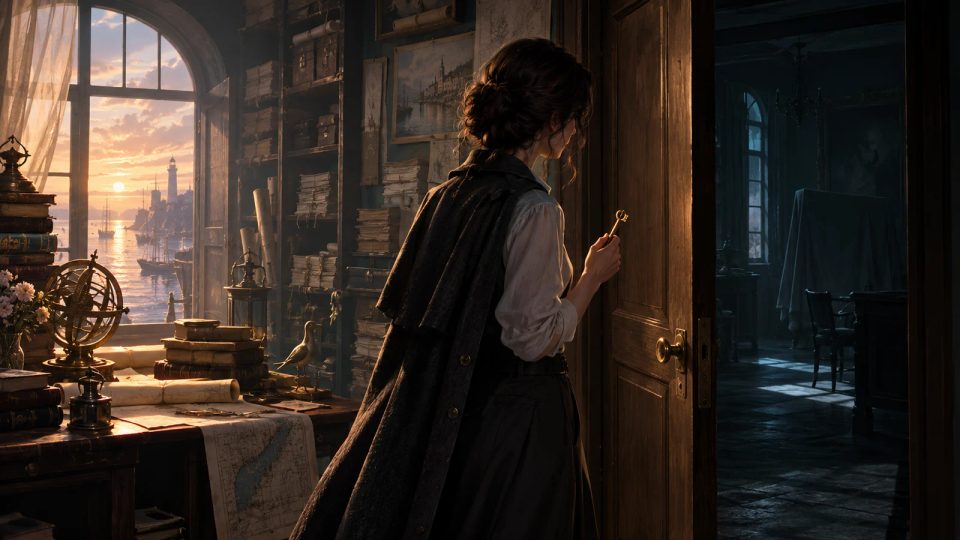
Cinematic editorial illustration: in a harbor archive with layered spaces, a wooden door stands half open in the foreground, leading to an unlit room.
Galgame Route Design2026.10.13

Must You Finish One Galgame Route Before Starting Another? Reviewing the Narrative Case for Route Locks

When reviewing a route prerequisite, first identify the decision readers might misinterpret if they enter early, then check whether the target route can supply the missing context. A fictional harbor story and a route-lock review table help distinguish essential reading dependencies, recommended reading orders, and background-based restrictions that can be removed.

DramaFork Editorial Team19 min read
Continue reading
Cinematic editorial illustration: in a community garden, an adult protagonist and an adult longtime friend plant together from opposite sides of a flower bed, while the protagonist’s adult partner sorts gardening tools nearby.
Galgame Route Design2026.10.13

Can You Stay Friends with Other Characters After a Galgame Route Locks? Making Later Encounters Clear

Old friends can still work alongside the protagonist after a route locks. A six-field scene card connects their existing friendship, current agreements, and actions in the scene, preserving their closeness without hinting at a route change the story will never deliver.

DramaFork Editorial Team17 min read
Continue reading
Cinematic editorial illustration: an adult photographer and an adult protagonist carry equipment onto a mountain trail, walking side by side at a natural distance.
Galgame Route Design2026.10.13

Does Entering a Character Route in a Galgame Mean You’re Dating? Separating Route Locks from Romantic Commitment

Entering a character route can simply mean that the story begins to focus on one person. It does not automatically mean the two characters are dating. Use a route-lock clarification card to record the narrative focus, which other routes close, and what establishes the relationship, so players know exactly what they have agreed to.

DramaFork Editorial Team18 min read
Continue reading
Cinematic editorial illustration: beside a riverside bench at dusk, two adult characters leave space between them.
Galgame Route Design2026.10.13

Galgame Romance at Different Speeds: Writing Room to Wait or Step Back

A confession does not mean both characters are ready for a relationship. Track what each person expresses, whether they are ready, and what contact they welcome in a two-person relationship pacing chart. Give continuing, waiting, and stepping back concrete consequences, with room to revisit the conversation when someone changes their mind.

DramaFork Editorial Team18 min read
Continue reading
Cinematic editorial illustration: two adult neighbors steady a picture frame together in an apartment hallway, its back facing outward, then naturally release it while maintaining a comfortable distance, showing everyday friendly cooperation.
Galgame Route Design2026.10.13

Galgame: Helping Doesn’t Mean Romantic Interest—Let Friendly Choices Keep Their Meaning

Track actions, expressed intent, and a character’s interpretation separately, then require an explicit expression of romantic interest before opening a romance route. A fictional example about carrying a picture frame shows how to rewrite helping choices, clarifications after misunderstandings, and later invitations so players can continue the story kindly without expressing romantic interest.

DramaFork Editorial Team18 min read
Continue reading
Cinematic editorial illustration: outside a newly renovated small theater, several adult collaborators head their separate ways while the protagonist, carrying drafting tools, looks back at the brightly lit stage.
Galgame Route Design2026.10.13

Galgame: Writing a Complete Common Route Ending When No Character Route Begins

Even when no character route begins, the common route’s shared experiences deserve a conclusion. Use a no-character-route ending closure sheet to account for the shared undertaking, existing relationships, promises never made, each character’s next destination, and the protagonist’s final action—giving a path without romance an ending of its own.

DramaFork Editorial Team19 min read
Continue reading
  1. 1
  2. 2

Blog categories

  • All500
  • Creation tutorials40
  • Interactive narrative60
  • Getting started11
  • Galgame Route Design25
  • Visual Novel Production25
  • Interactive Fiction Design25
  • Narrative Design for Interactive Film Games25
  • Interactive Film Accessibility10
  • Interactive Film Workflow10
  • Interactive Game Basics10
  • Interactive Film Presentation and Delivery10
  • Interactive Film Localization10
  • Interactive Film Production10
  • Narrative Mechanics11
  • Creative Collaboration11
  • Getting started1
  • Fictional Case Study10
  • Story Localization10
  • Mobile and Accessibility10
  • Acting and Staging10
  • Exploring Time and Space10
  • Relationships and Groups10
  • Resources and Constraints10
  • Information and Commitments10
  • Production Practice59
  • Product workflow34
  • Choosing tools33

From a story to a playable world.

Start with one story decision

Create a project