• Home
  • Blog
  • Gallery
  • Pricing
  • Home
  • Blog
  • Gallery
  • Pricing
Start creating

Creator blog

Better stories start here

Discover practical AI tools, interactive storytelling methods, and production lessons—from the first idea to a story people can play.

DRAMAFORKStories · Craft · Possibility
Topics
AllFictional Case StudyCreative CollaborationStory LocalizationMobile and AccessibilityActing and StagingNarrative MechanicsExploring Time and SpaceRelationships and GroupsResources and ConstraintsInformation and CommitmentsProduction PracticeProduct workflowInteractive narrativeCreation tutorialsChoosing toolsGetting started
10 articles

Editorial / 01

Latest articles

Practical methods for narrative structure, visual production, and everything in between.

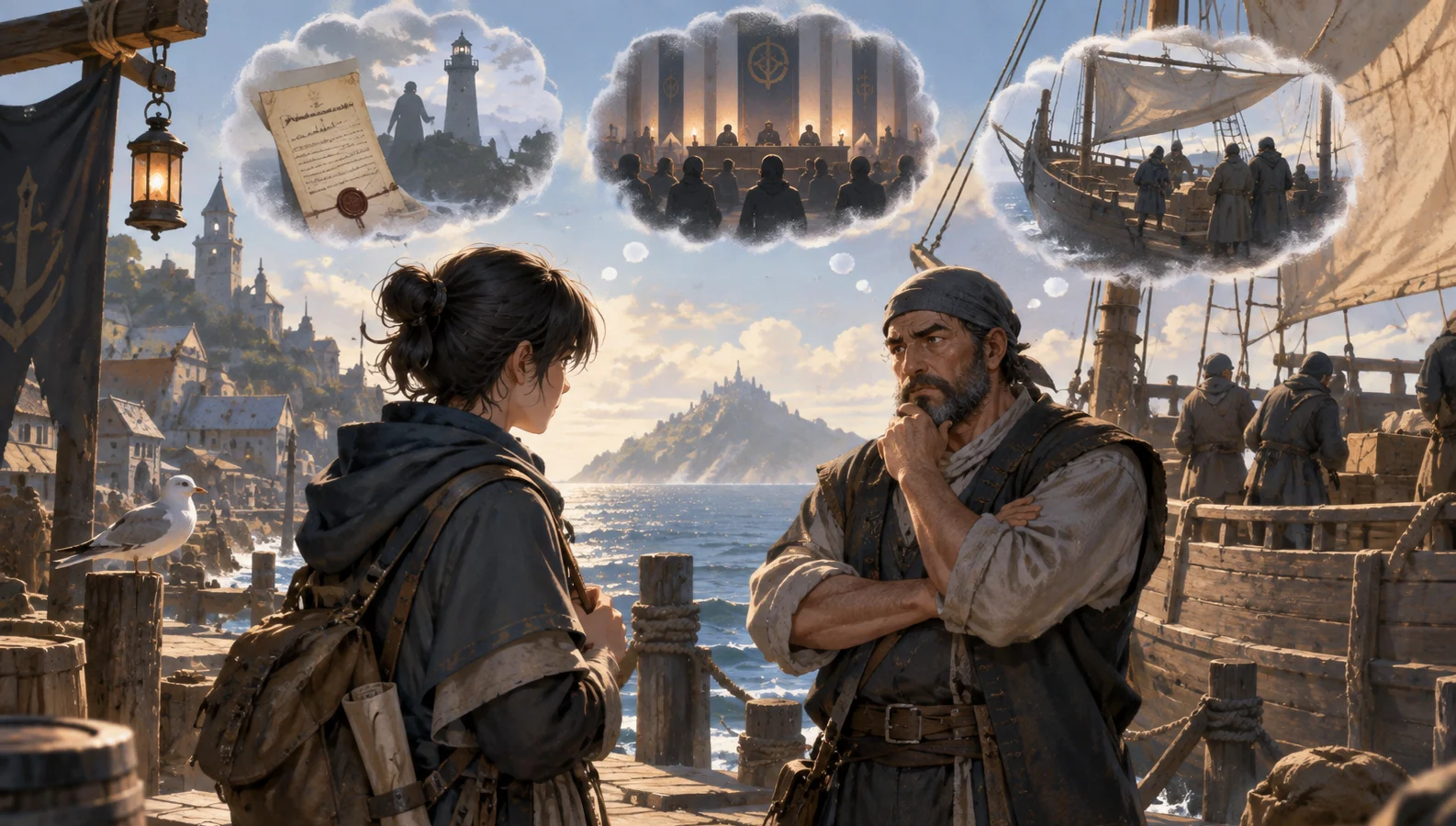
When an Option Is Disabled, Explain Whether Its Conditions Can Change — original editorial cover illustrationTopic selection
Narrative Mechanics2026.10.07

When an Option Is Disabled, Explain Whether Its Conditions Can Change

When “Ask to borrow a boat for the voyage” is grayed out, players need to know whether they can meet the requirements now, must advance the story, or have lost the opportunity for this playthrough. Three types of disabled-option copy and a condition card clarify the reason, available actions, and exactly what has become unavailable.


DramaFork Editorial Team19 min read
Continue reading

The next move is yours

From a story to a playable world.

Do not wait for every video to be finished before testing the story. Build the characters, rules, and branches first, then let real choices guide what you make next.

Start with one story decision

Try a playable example

From a story to a playable world.

Start with one story idea, then shape scripts, characters, shots, and branches into a playable first version.

Product

  • Pricing
  • Credits guide
  • Capabilities
  • Workflow
  • Examples
  • FAQ

Explore

  • Playable gallery
  • Creator blog
  • Creator partnership

Legal

  • Privacy
  • Terms
© 2026 DramaFork/AI interactive story studio
Press Enter to send, or drag away and release.
How Can Players Make Informed Choices Without Reading Chapter Supplements? — original editorial cover illustration
Narrative Mechanics2026.10.07

How Can Players Make Informed Choices Without Reading Chapter Supplements?

Keep action requirements, known costs, and the limits of uncertainty at the point of choice; leave history and motivations to the archives. Use an information-tier table to check whether players can still explain what they are taking on after skipping every supplement.

DramaFork Editorial Team19 min read
Continue reading
How can players discover hidden endings without trying every possibility? — original editorial cover illustration
Narrative Mechanics2026.10.07

How can players discover hidden endings without trying every possibility?

Build three layers of clues for a hidden ending: establish that another outcome is possible, give players reasons to take relevant actions, then use a low-spoiler recap grounded in what their current path has revealed to narrow their next attempt. A two-condition ending at an old clock tower illustrates a reusable clue-chain table.

DramaFork Editorial Team20 min read
Continue reading
How Can Choosing the Same Stance Twice Do More Than Repeat the Previous Response? — original editorial cover illustration
Narrative Mechanics2026.10.07

How Can Choosing the Same Stance Twice Do More Than Repeat the Previous Response?

When a player avoids a public argument twice, the second response should build on the first agreement and turn that continued stance into an actionable next step. Use the three-beat progression card and its supporting checks to distinguish a consistent strategy from a stalled story.

DramaFork Editorial Team19 min read
Continue reading
An Apology, an Alarm, and Small Talk All Qualify. Which Comes First? A Table for Checking Priority Conflicts — original editorial cover illustration
Narrative Mechanics2026.10.07

An Apology, an Alarm, and Small Talk All Qualify. Which Comes First? A Table for Checking Priority Conflicts

Exclude blocked segments before comparing priorities. Define rules for ties, delays, and cases where nothing is available. Use a review table and round-by-round walkthrough to distinguish handling an alarm from clearing it, track waiting lines, and establish that small talk requires a completed apology and a resolved misunderstanding. Acceptance of the apology is not an additional condition.

DramaFork Editorial Team19 min read
Continue reading
Can Randomness Change More Than Decoration? Decide Which Facts Are Off-Limits — original editorial cover illustration
Narrative Mechanics2026.10.07

Can Randomness Change More Than Decoration? Decide Which Facts Are Off-Limits

Weather can change investigation routes and their costs, but it cannot casually change who witnessed the incident. Use a randomness boundary table to define fixed facts, variable conditions, and presentation variations, including when each is determined and which later scenes it can affect.

DramaFork Editorial Team17 min read
Continue reading
How should writing responsibilities be divided between one-time and recurring scenes? — original editorial cover illustration
Narrative Mechanics2026.10.07

How should writing responsibilities be divided between one-time and recurring scenes?

A welcome ceremony establishes a one-time change in membership status; repair shop conversations respond to repeat visits. Two scene responsibility cards clarify eligibility, repeatable content, lasting outcomes, and interruption recovery, preventing duplicate tokens, repeated introductions, and relationship resets.

DramaFork Editorial Team18 min read
Continue reading
Let Players State a Hypothesis Before Solving the Puzzle: Adding Prediction-Based Actions to Investigations — original editorial cover illustration
Narrative Mechanics2026.10.07

Let Players State a Hypothesis Before Solving the Puzzle: Adding Prediction-Based Actions to Investigations

When a player thinks a bell sound came from another tower, first limit the test to the next bell sound, state what they expect to see, and spend one investigation turn observing. A test card turns a guess into an action that can lead to retaining or rejecting a hypothesis, or deferring judgment.

DramaFork Editorial Team18 min read
Continue reading
Optional Branches Must Not Withhold Essential Main-Quest Information: Skip the Harbor Chat and Still Complete the Quest — original editorial cover illustration
Narrative Mechanics2026.10.07

Optional Branches Must Not Withhold Essential Main-Quest Information: Skip the Harbor Chat and Still Complete the Quest

Keep essential facts accessible through the main quest, and leave character motivations and relationship rewards to optional branches. Use an information allocation table covering essential facts and background to check whether players who skip the harbor chat can still find the destination, understand the rules, and complete the delivery.

DramaFork Editorial Team18 min read
Continue reading
How Do You Write Entry Conditions, Exit Outcomes, and Cooldowns for Event Cards? — original editorial cover illustration
Narrative Mechanics2026.10.07

How Do You Write Entry Conditions, Exit Outcomes, and Cooldowns for Event Cards?

Use five traveling-market event cards to separate entry checks, outcome resolution, and reappearance, then walk through the turns to check priority, first-time rewards, and expiration at closing time.

DramaFork Editorial Team19 min read
Continue reading

Blog categories

  • All301
  • Fictional Case Study10
  • Creative Collaboration10
  • Story Localization10
  • Mobile and Accessibility10
  • Acting and Staging10
  • Narrative Mechanics10
  • Exploring Time and Space10
  • Relationships and Groups10
  • Resources and Constraints10
  • Information and Commitments10
  • Production Practice59
  • Product workflow34
  • Interactive narrative49
  • Creation tutorials19
  • Choosing tools33
  • Getting started7

From a story to a playable world.

Start with one story decision

Create a project