How Can Players Make Informed Choices Without Reading Chapter Supplements?
Keep action requirements, known costs, and the limits of uncertainty at the point of choice; leave history and motivations to the archives. Use an information-tier table to check whether players can still explain what they are taking on after skipping every supplement.

Classify information by its role in decisions before deciding where it belongs
For reading to be genuinely optional, players must still know what action a button will perform, what its known costs are, and which outcomes remain uncertain after closing every archive. Archives can deepen understanding, but they cannot be the only place this information appears.
Two kinds of “not knowing” need to be distinguished here. Not knowing why the gatekeeper dislikes the council can preserve a character mystery. Not knowing that pressing the broadcast button will reveal your location may directly change your willingness to act. Putting the latter only in a worldbuilding archive and labeling it “optional reading” beside the button does not make the reading genuinely optional.
Consider three tiers. Tier 1 is essential action information and appears directly at the current point of choice. Tier 2 supports decision-making with evidence details or explanations of characters and can be expanded for further reading. Tier 3 provides additional background through history, terminology, and culture. Classify individual sentences, not entire documents. Within a single archive, the history of an institution may be Tier 3, while one sentence describing a current restriction is Tier 1.
To decide whether a sentence must move into the choice scene, ask: without it, would players misunderstand the action’s target, the conditions under which it is available, the known losses, or the scope of risk? If so, put it back into the scene first. Do not leave it in the lore collection merely because it reads like worldbuilding.
Build an information-tier table from “Fog Harbor Broadcast Station”
The following “Fog Harbor Broadcast Station” is a fictional teaching example, not a real user case, a tested result, or a product feature. All rules exist solely to demonstrate information classification.
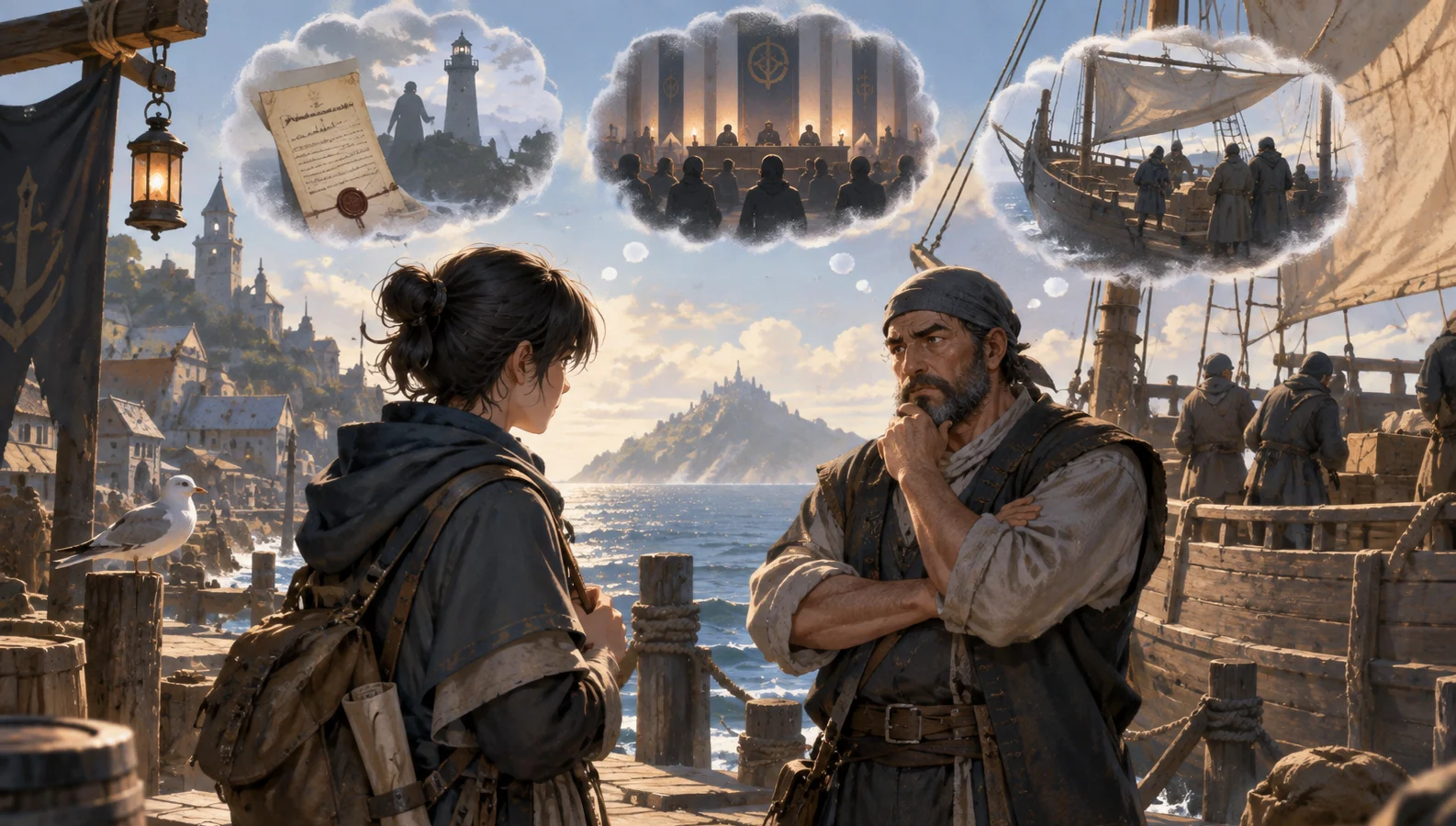
The protagonist needs to contact a partner they have become separated from before the patrol begins. The old broadcasting equipment can immediately send a message across the entire harbor, but it will reveal the transmitting station’s location and drain the station’s only remaining battery. Sending a messenger requires no broadcast battery, but delivery before the patrol cannot be guaranteed. The station also contains the Old Harbor Communications Chronicle, which explains the origins of the broadcasting system.
The decision at this point is “whether to trade location exposure and a battery for immediate transmission,” not “whether to remember Old Harbor history.” That distinction lets you complete the handoff table below. For another chapter, keep the column headings and replace the entries sentence by sentence.
| Information item | Information tier | Placement | Problem if removed |
|---|---|---|---|
| The broadcast reaches the entire harbor; it is not a private conversation | Tier 1: essential action information | Explanation before the choice | Misunderstanding who receives the message |
| Broadcasting reveals the station’s location and drains the battery | Tier 1: essential action information | Beside the broadcast option | Underestimating known costs |
| The messenger may not arrive before the patrol | Tier 1: essential action information | Beside the messenger option | Assuming the alternative carries no risk |
| Whether anyone will come after the location is exposed is unknown | Tier 1: essential action information | In-scene explanation | Treating a possible outcome as a guarantee |
| The partner once taught the protagonist to repair the broadcasting equipment | Tier 2: decision-making support | Expandable recollection | Losing a layer of emotional understanding |
| The broadcast tower was originally used for festivals | Tier 3: additional background | Communications chronicle | Losing a piece of local history |
The last column is particularly important: it requires editors to explain the specific misunderstanding that removing information would cause, rather than assign tiers according to length or preference. If a background detail later becomes the password for opening a door, it must be reclassified at that point.
Turn the table into in-scene text while preserving suspense
The in-scene text for this example could read:
The patrol is about to begin. Broadcasting can send a message across the entire harbor immediately, but it will reveal this station’s location and drain the last battery. Whether anyone will follow the signal here is currently unknown. A messenger needs no battery, but may not deliver the message in time.
Option 1: Activate the broadcast
Option 2: Send a messenger
Further reading: Old Harbor Communications Chronicle — learn how the broadcasting system began.
This reveals the rules of the action and the known trade-offs. It does not promise that the partner will hear the message or reveal in advance who will track the signal. Players can prioritize speed or preserve the battery and keep their location hidden; both choices can rest on the information already provided.
The archive itself can still be engaging. For example, it could describe how festival broadcasts evolved into a patrol network, helping players understand why this city ties communication to control. But if the archive says that “radio intercept operators can locate the transmitting station,” a corresponding warning must already appear in the scene. Readers should not have to deduce a crucial cost from a historical passage.
Essential information need not all be squeezed into one block of text. Dialogue can establish urgency, a close-up of a prop can show that only one battery remains, and text beside the option can summarize what will be consumed. However, showing the battery alone does not explain that broadcasting will drain it. The handoff should specify which shot or text conveys each sentence’s information, and the choice should retain a brief summary players can review.
Remove the archive to check for three common failures
When reviewing a draft, first duplicate the chapter script, remove all optional reading entry points and archive text, and examine only the choice scene. Try completing four sentences: “What I am going to do is…” “What I will definitely give up is…” “What remains uncertain is…” “The cost of the other option is…” This is an editorial checking method, not a result already validated with users.
The first failure is hiding rules. After the chronicle is removed, the scene says only that “broadcasting may attract attention,” while the actual rule is that it will definitely reveal the station’s location. Correct this by explicitly stating that the location will be exposed and leaving “whether anyone will arrive” unknown. Vague wording cannot substitute for an established mechanic.
The second failure is uneven information. Listing every loss beside the broadcast button while describing the messenger only as “a safe way to make contact” makes the latter look cost-free. Add the uncertainty around delivery time, without forcing both descriptions to have the same word count.
The third failure is creating pressure through the reading entry point. “Important secrets: we recommend reading in full before choosing” makes players suspect the summary is withholding something. The entry point should explain what the supplementary content covers. If reading it in full is truly necessary to understand the action, move the relevant passages into the main flow and acknowledge that they are not optional.
After completing the removal check, restore the archive and compare it sentence by sentence. Any newly added restriction on the current action must also appear in the scene. Any statement that contradicts the summary must be investigated to establish whether it reflects a character’s mistaken judgment or an omission in the text. Do not leave players to explain it away for the author.
Set boundaries for deduction, lengthy rules, and reading rewards
If a decision has so many necessary conditions that a short summary cannot represent them accurately, introduce the rules across earlier mandatory scenes and recap them at the choice. Alternatively, reduce the number of actions available at once. An explicitly required reading passage is appropriate only when understanding complexity is itself the chapter’s task. Do not keep compressing crucial restrictions just to retain an “optional” label.
Deduction chapters can ask players to distinguish true from false information in the materials and assess whether characters are trustworthy. But distinguish “unknown conclusions from evidence” from “unknown rules of action.” Players may not know whether the radio intercept operator has lied, but they should know that the broadcast reaches the entire harbor. If a piece of evidence is indispensable to the current deduction, it is not purely additional background.
Reading rewards can offer deeper insight into motivations, a new interpretation of an earlier scene, or a recognizable allusion in dialogue. If a reward instead becomes a hidden requirement for the only button that avoids a loss, reconsider the promise that players can decide without reading. Reading more can enrich understanding; skipping it should not leave players discovering afterward that they never even saw the whole question.
At handoff, keep the information-tier table, in-scene text, and four answers from the removal check together. All three must correspond to the same version. The next time a worldbuilding rule changes, first check whether it alters the conditions or costs of the current action, then decide whether to update the summary. The boundary of optional reading needs to be maintained along with the chapter.