Choosing Without Enough Evidence: Make Uncertainty Clear with Choice Cards
Why a space station door has failed can remain unanswered for now. What players base their actions on, and where they can still stop, must be clear. A choice card covering confirmed facts, unknowns, and action boundaries turns guesses about a fault into reasoned decisions. A door that has not moved does not prove a command was not executed; a receipt confirms only what its record supports.
Give Players Reasons to Act Before Explaining the Fault
When writing choices with insufficient evidence, give players three things first: what has been observed, which questions remain unanswered, and where each action can still be stopped or changed. Explanations after a choice should connect to that information. They do not need to prove that the player guessed the cause correctly.
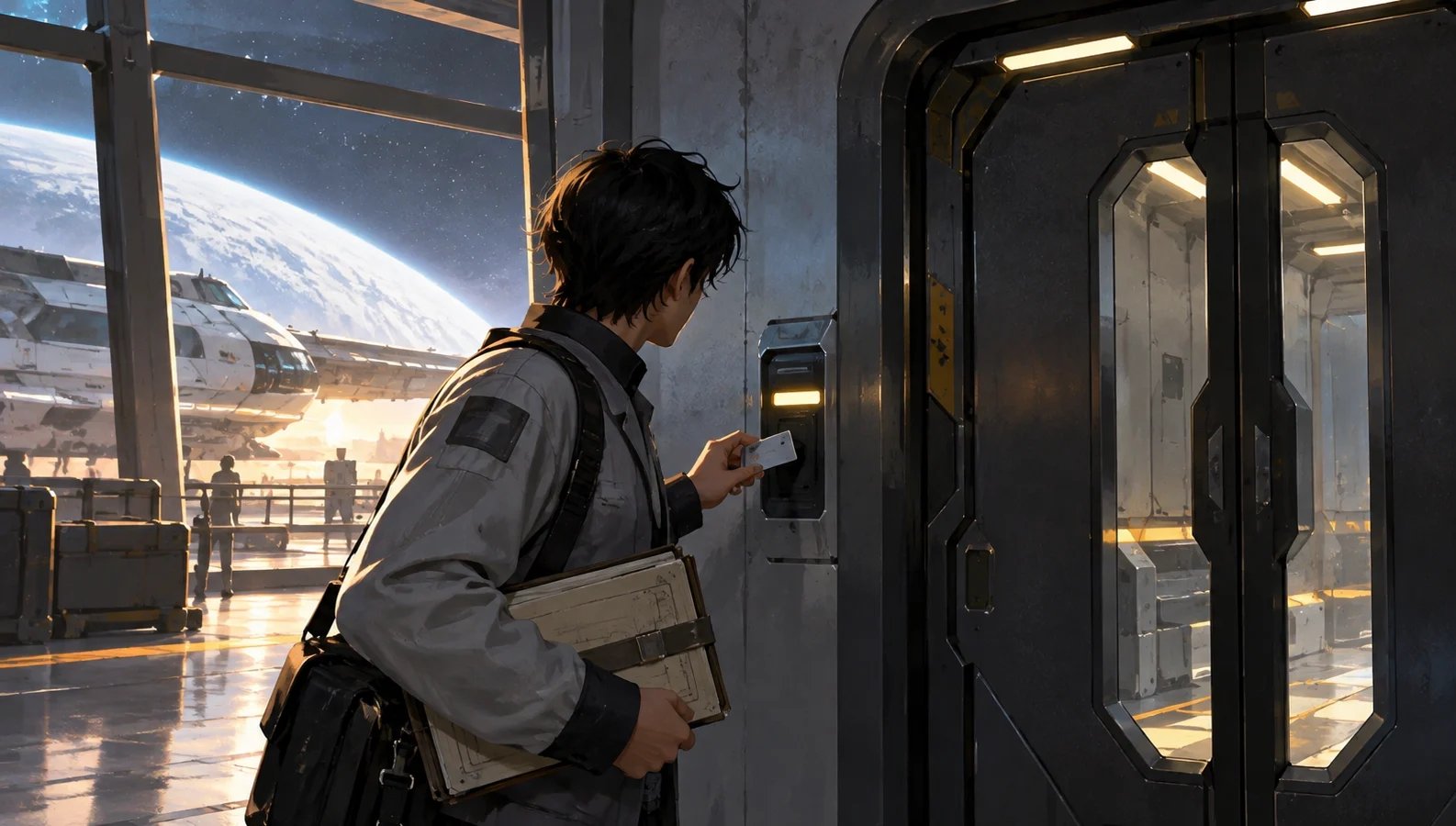
This article uses an original fictional teaching example, “The Late Access Code”: space station archivist Lin Che must deliver a paper navigation chart to a handoff bay before a shuttle departs, but an access door fails along the way. The characters, rules, and branches are original fictional creations, not real user cases, test results, or product features. They do not correspond to the operation of real equipment.
Even when the chance of success cannot be estimated, options can still be compared: how much room to act each action leaves, which opportunities it gives up, and which questions it can resolve. There is no need to assign probabilities to unknowns.
Separate Observations, Explanations, and Deadlines
After Lin Che swipes a card, the screen displays “Request received,” but the door does not move. The attendant on the communicator says, “It might just be a display delay,” but cannot see the doorway. The transport schedule board shows two countdown units remaining before the handoff deadline.
The screen text and the door’s position are confirmed. Whether the command was received at the door, and whether it was executed, are not. “Request received” does not mean “Lock released”; the door’s failure to move is also insufficient to prove that the command was not executed. The attendant offers just one possible explanation. The countdown comes from the transport schedule and has no bearing on the cause of the fault.
The complete fictional timing rules must appear before the choice: checking a receipt takes one unit; the side-corridor route takes two units in total, from departure through completion of the handoff. A local release request can be attempted only once, takes one unit, and cannot be withdrawn after submission. That unit includes request processing and, if the door opens in time, passage through it and the handoff. The handoff bay is immediately beyond the door, and finishing at the end of the unit still counts as on time. If the door does not open in time, this plan cannot complete the handoff. Terminal prompts and route signs can present these rules. They are not real-world timing data and do not guarantee that the request will succeed.
The author may keep two provisional hypotheses: “The command did not reach the door” and “The command was received at the door but was not executed.” In the latter case, execution status still requires evidence. These are not an exhaustive list of faults, and they do not rule out the possibility that the command was executed while the door still failed to move. If the available clues cannot rank these hypotheses, do not write “It is probably the first one,” or substitute a character’s confidence for evidence.
A Reusable Choice Card: Three Core Types of Information
The choice card covers three types of information: confirmed facts, unknowns, and actions with their boundaries. The table below records them in two columns. At the same decision point, only the first two rows can be shared across options; the remaining rows must be filled in for each action. Shared information must also be updated after feedback arrives. When presenting the card to players, it can be condensed into dialogue and button descriptions.
| Field | Entry for This Example |
|---|---|
| Confirmed facts | The screen says the request was received; the door has not moved; two units remain for the handoff |
| Unknowns | Whether the command was received at the door; whether the command was executed; why the door has not moved |
| Action and withdrawal boundary | Check the local receipt: another option can be chosen after reading ends, but the unit spent is not restored |
| What the action can answer | Whether there is a receipt record at the door corresponding to this card swipe; it cannot confirm that the command was executed or that the door will open |
| Stop condition | End when a receipt or “Record unavailable” appears; do not retry automatically |
| What will be lost | Only one unit will remain, so the side corridor can no longer lead to an on-time handoff |
| Next decision | Keep waiting, attempt a local release, or accept missing the handoff; whether waiting can still meet the deadline remains unknown |
The action field can also describe irreversible actions, such as “Local release: can be abandoned before submission; cannot be withdrawn afterward.” “Reversible” must refer to something specific: being able to end a read does not mean time is restored; being able to return to the starting point does not mean the shuttle is still waiting. Simply labeling an action “Can be undone” conceals its losses.
The template can be condensed into one sentence: I have confirmed ____; I still do not know ____; I will now do ____, which can establish ____; I can still stop at ____, but after ____ I cannot withdraw; even if I stop, ____ will not be restored. If there is no investigative purpose or no stage at which withdrawal is possible, say so plainly.
How One Card Supports Three Different Decisions
Lin Che has three possible actions. “Check the receipt” spends one unit for a chance to narrow the unknowns, but the record may be unavailable. “Take the side corridor now” completes the handoff within the previously stated total of two units without investigating this door. “Submit a local release request” spends one unit trying to use the original route; acceptance of the request does not guarantee that the door will move.
The three actions serve investigation, an on-time delivery, and an attempt to use the original route, respectively. The side corridor is a known route, but it cannot also answer questions about the fault. To give investigation narrative value, establish in advance that Lin Che also needs to leave a record of the anomaly. Do not introduce a penalty for failing to investigate only after the player has chosen the side corridor.
Consider the receipt-checking branch: the feedback says “Receipt record exists at the door,” with a timestamp matching the recent card swipe. The confirmed facts can now include that this command was received at the door, and the question of receipt can be removed from the unknowns. Whether the command was executed, and why the door has not moved, must remain. The receipt record does not prove “Received but not executed,” much less identify the cause of the fault. Feedback could read: “The receipt time matches your card swipe. The door still has not moved, and the handoff countdown has dropped by one unit.”
One unit now remains, so taking the side corridor can no longer get Lin Che to the handoff on time. A local release still leaves open the possibility of an on-time handoff because passage and the handoff after a timely opening were already included in that unit. It does not guarantee that the door will open in time. Continuing the attempt means accepting that submission cannot be withdrawn; stopping means declining that commitment. Neither decision requires a claim that it has a greater chance of success. Its rationale comes from the goals and boundaries at that moment.
Give Complete Consequences Even When No Information Is Gained
In another possible branch, the receipt displays “Record unavailable.” This is not evidence that “The command was not received at the door” or “The command was not executed,” nor does it prove that the attendant lied. The only addition to the confirmed facts is “The record could not be read on this attempt.” The existing questions about the fault must remain.
After an unsuccessful investigation, still show the remaining unit and the available actions: the side corridor cannot reach the destination on time, a local release can still be attempted under the conditions above, and the outcome of waiting remains unknown. Do not write as though the read never happened, or quietly refund the time so that investigating first always has the advantage. Failing to find the cause can be a valid consequence, provided the possibility of an unavailable record was disclosed beforehand.
Also avoid using the ending to judge the earlier decision in hindsight. If the original door opens on its own after the player takes the side corridor, that establishes only that it opened later. It does not prove that taking the detour was foolish at the time. Without grounds for waiting that could have been recognized beforehand, “If only I had waited a little longer” can express a character’s attitude, but cannot serve as the author’s conclusion.
Check Backward to Keep Explanations Within the Evidence
After writing, hide the ending and look only at the information available before the choice. Complete “I choose this because…” for each option. If the only answer is “The author will reward me,” add the missing goals, constraints, or action boundaries. If the reasons are identical, merge the options or change the opportunities they preserve.
Then read only the feedback: are newly confirmed facts supported by observations? Do unresolved questions remain among the unknowns? Has “The door has not moved” quietly become “The command was not executed,” or “Received” become “Executed”? Have words such as “As expected,” “Definitely,” or “A safe bet” promoted guesses to facts? Also check that the timing covers arrival and completion of the objective, not just submission.
These cards suit decision points that compare information and room to act. They need not be applied to every line of emotional dialogue. When a story needs an irreversible decision, state the commitment boundary honestly. If every option lacks a basis, a distinct commitment, and recognizable consequences, a card cannot rescue a blind choice. First add information that supports a decision, or turn the moment into narration that does not require the player to judge.