Translate Hesitation in Interactive Film Subtitles: Do Not Rewrite the Evidence Behind a Choice
A witness’s hesitation is neither proof of concealment nor automatically disposable filler. Mark factual corrections, attitude and removable redundancy, then use review questions in five languages to check that subtitles have not made the player’s judgment for them.
Introduction
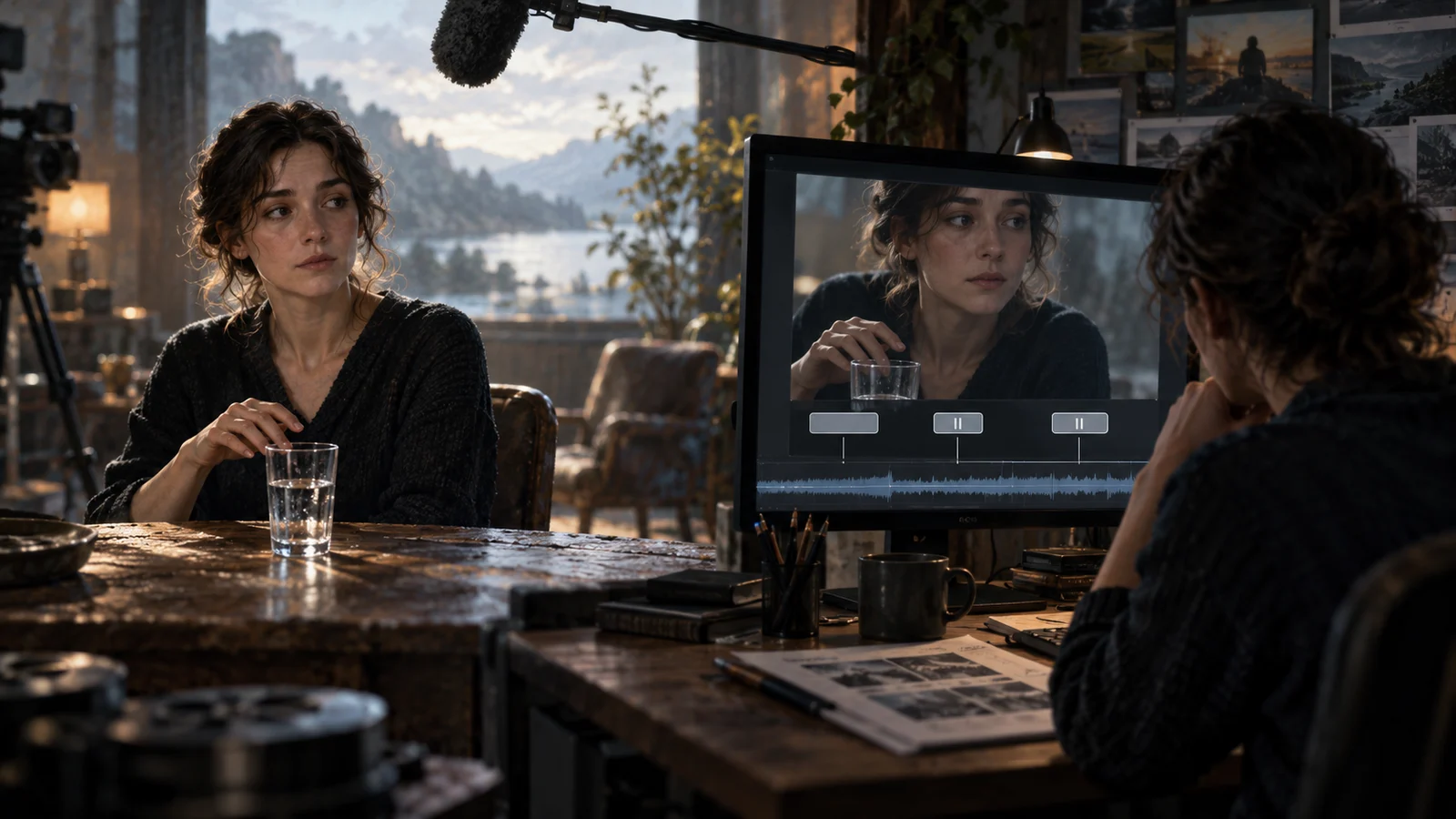
When translating a witness’s hesitation in an interactive film, first preserve what they said, how they know it and how certain they are; then decide which sounds to cut. Do not turn every pause into an ellipsis or smooth a self-correction into an affirmative statement. The deliverable should be a pause-review card connected to a choice node, not just a polished subtitle line.
1. Does the pause change a proposition, attitude or only duration?
This article divides pauses into three narrative functions for line-by-line editorial judgment. It is an original working method, not a universal linguistic standard. One sentence may belong to two categories; record the most serious effect of deletion first.
| Category | Question to ask | Editing action |
|---|---|---|
| Fact-related pause | Does the surrounding speech correct a person, time, action or information source? | Preserve the correction; do not retain only the first half |
| Attitude pause | The proposition is unchanged, but does the pause show hesitation, resistance or difficulty speaking? | Preserve necessary uncertainty without explaining its cause for the character |
| Removable redundancy | Would removal leave factual content, certainty and speaking stance unchanged? | Compress repeated syllables, then check for conflict between performance and subtitle |
“Fact” here means the proposition advanced by the dialogue, not that the witness is telling the truth. “Attitude” is not a lie-detection clue either: hesitation may arise from remembering, choosing words or relationship pressure. Preserve observable hesitation without inventing “she said guiltily.”
Start by writing a meaning summary without pause punctuation. If it needs “corrects herself,” “only heard” or “is not certain” to be accurate, the original contains a relationship that must not be lost. Silence duration alone usually cannot convey those relationships fully.
2. How a fictional witness’s correction affects a choice
The Rainy-Night Duty Room is a fictional teaching example, not a real user case, tested result or product feature. Witness A Lan stands outside the closed duty-room door; the player will later choose “Ask about the sound’s source” or “Ask which way the person left.”
A Lan says, “I saw... no, I heard Old Zhou leave.” She adds, “His footsteps, I... should recognize them.” Asked where she was, she answers, “I was, um, right outside the door.” The shot shows only her looking down and supplies no reason for her hesitation.
The first line is fact-related: she withdraws visual witnessing and substitutes an auditory judgment. The second carries both attitude and degree of certainty: “should” limits confidence in identification. The third line’s “um” may provisionally count as redundancy, but check the audio for any special emphasis or resistance it carries.
The proposed cut “I saw Old Zhou leave” directly changes the information source. “I heard Old Zhou leave. I recognize his footsteps” corrects the source but makes recognition more certain. “She is afraid to admit she saw Old Zhou” adds a motive absent from the scene.
One version can retain “I saw... no, I heard Old Zhou leave.” “His footsteps, I... should recognize them.” “I was right outside the door.” This still lets the player doubt or trust her and leaves a reason to question the auditory basis. That is a design explanation, not a claim of improved player choices.
3. Put revision reasons in a reusable review card
Deliver the card with the dialogue so later editors know what can be shortened. The table is both a field template and a completed example for the first line; replace its right column for other nodes.
| Field | Entry in this example |
|---|---|
| Dialogue and choice node | Testimony outside the door; ask sound source / ask departure direction |
| Original line and pause | I saw [pause] no, I heard Old Zhou leave |
| Content that must survive | Withdraw “saw”; replace it with “heard”; the person is Old Zhou |
| Category and reason | Fact-related; removing the correction turns it into eyewitness testimony |
| Permitted compression | Repeated initial sounds carrying no additional meaning |
| Subtitle candidate | I saw... no, I heard Old Zhou leave |
| Pending confirmation | Whether image and audio sufficiently distinguish self-correction from interruption |
| Rejection conditions | Still reads as seeing it firsthand, or merely as an unfinished sentence |
Ask another editor to restate the testimony from the candidate subtitle alone, then compare it with the original scene. They should say “First claims to have seen, then changes to heard,” not just “Old Zhou left.” Agreement supports only that sentence’s semantic check, not the effectiveness of the whole experience.
If space requires a shorter version, offer “I didn’t see it; I heard Old Zhou leave.” It preserves the correction but recasts a spontaneous change of wording as a complete explanation, changing the performance impression. Record that cost for the responsible person to weigh against the scene’s needs rather than calling it lossless compression.
4. What to ask in each of five languages
Five-language review does not demand equal numbers of ellipses. It demands the same testimony boundaries in every version. These are questions for the relevant language reviewers, not validated translations or claims that any language has only one way to express them.
| Language | Required review question in this example |
|---|---|
| Simplified Chinese | After removing “I...,” does “should” still clearly limit recognition of footsteps rather than qualify the act of leaving? |
| English | Does the self-correction clearly withdraw visual witnessing? Has compression turned it into direct confirmation of departure? |
| Japanese | If the subject is omitted or the sentence ending changes, can readers still distinguish who left from who is uncertain about recognition? |
| German | After reordering words or splitting subtitles, might readers first treat the uncorrected “saw” as complete testimony? |
| Spanish | Does the wording of hesitation add fear, refusal to answer or defense of the other person? |
Beyond these five columns, check together who the person is, the sensory source, what is withdrawn and how much certainty remains. Do not approve merely because a back-translation is “close enough.” It can expose information drift without necessarily revealing a tone change in the target language.
Each language should include a Chinese meaning note, such as “Preserve the correction without explaining its cause,” confirmed by a target-language reviewer. When views differ, locate the issue in context and on the review card rather than deciding solely on which translation sounds smoother.
5. Prioritize cuts and know when to return a subtitle for clarification
First remove clearly redundant material, then compress repeated constructions, and finally discuss subtitle splitting and display timing. Do not start by cutting short words such as “should,” “no” and “only heard”: they may control the sentence’s evidentiary strength despite occupying little space.
Splitting into two subtitles is an alternative, but if the first displays only “I saw Old Zhou leave” and the second retracts it, check whether the choice opens before that correction. If the player can commit then, eventually showing both subtitles is insufficient. Raise the node-timing issue for the production team to decide how to adjust it.
Another failure is adding an ellipsis to every breath, making steady testimony appear suspicious throughout. Conversely, treating a pause caused by an interruption as a voluntary self-correction changes the relationship between characters. Punctuation must fit the scene, not a universal “hesitation style.”
If audio, context or speaker information is missing, state the gap on the card and return it for confirmation rather than inventing thoughts. Before delivery, ask whether someone reading only the subtitles still has reason to ask, “Did you actually see it or hear it?” If polishing erases that question, recheck the fact-related pause.