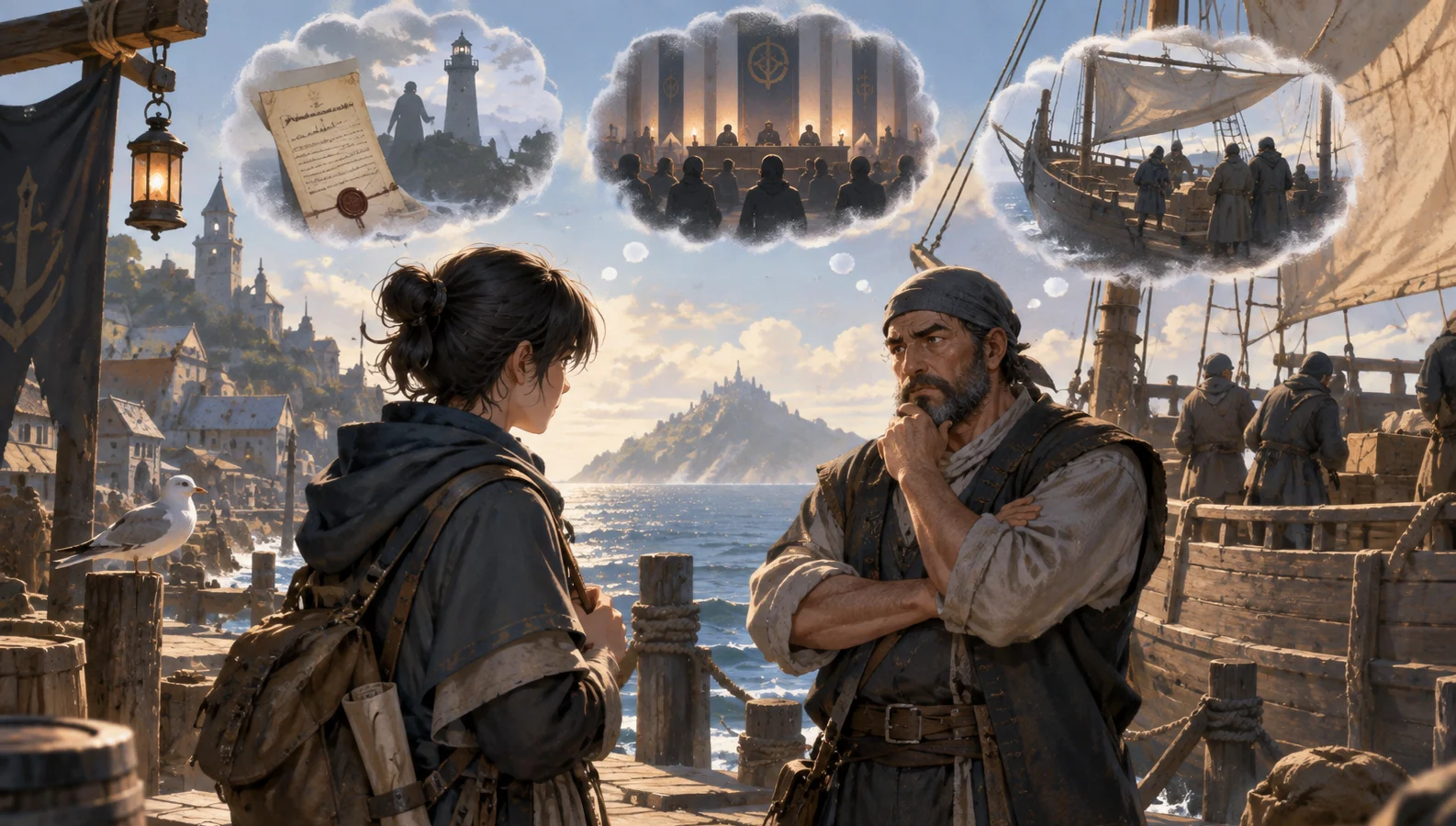
Let Players State a Hypothesis Before Solving the Puzzle: Adding Prediction-Based Actions to Investigations
When a player thinks a bell sound came from another tower, first limit the test to the next bell sound, state what they expect to see, and spend one investigation turn observing. A test card turns a guess into an action that can lead to retaining or rejecting a hypothesis, or deferring judgment.
First, Make “the Other Tower” a Testable Claim
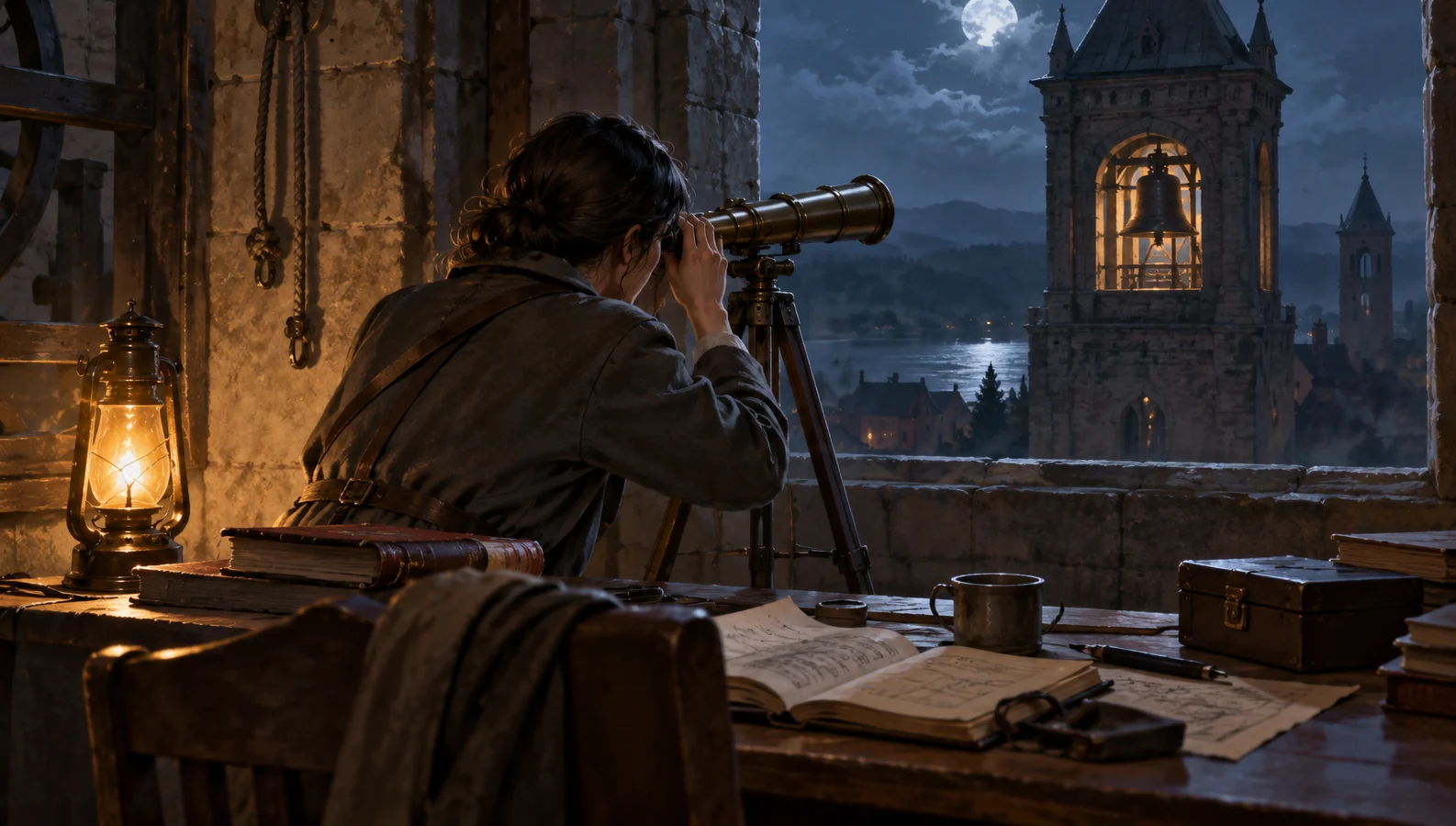
A player believes the bell sound came from another tower. The smallest next step could be to stay where they are, use the telescope already available to watch that tower’s bell hammer, and wait for the next bell sound. Before acting, have them complete this sentence: “If the next bell sound I hear is produced by that bell being struck, I should see the hammer strike it within the agreed observation window.”
This tests the source of the next bell sound. Even if that explanation is rejected, it does not justify withdrawing the explanation for the sound heard a moment ago, unless there is separate evidence that both were produced by the same mechanism. This example makes no such assumption.
Traveling opens a new scene but may not provide more grounds for judgment; observing from a fixed position answers one narrow question. The design priority is to agree in advance on which results would change the player’s judgment. Alongside looking for supporting clues, specify “what would make me withdraw this claim.”
A Fictional Scene: The Bell Sounds, but Is the West Tower Ringing?
The example below, Night Shift at the Twin Towers, is an original fictional teaching scenario. Its setting, rules, and outcomes were created for explanation. It is neither a real user case nor evidence of tested results, and it does not represent any product feature.
An investigator stands in the East Tower’s duty room, hears a bell sound, and discovers that the East Tower’s bell rope has been removed. The West Tower is visible through the window, and a telescope is already on the desk. The player suggests, “The sound came from the West Tower.” The missing rope raises a question; it does not rule out other ways for the East Tower to produce sound.
The script must disclose the observation rules beforehand: the West Tower’s bell chamber is unobstructed, and the hammer’s entire movement is visible; this bell can only be rung by that hammer, and the movement is large enough to see. The observation window covers the period when the strike would have to occur if this bell produced the next sound. These are fictional puzzle rules, not an acoustic assessment of real bell towers.
First, narrow the player’s meaning: “Let’s test whether the next bell sound is produced by this visible bell in the West Tower being struck, rather than by some unknown device inside the tower.” Watching the hammer can test the former claim. It cannot rule out every sound source in the West Tower or retrospectively establish the source of the previous sound.
The scene offers “Watch the West Tower’s bell hammer and wait for the next sound” and “Inspect the East Tower’s bell for other ways it could produce sound.” They answer different questions, and both advance the investigation. Do not frame the latter as “doubting your own reasoning,” turning a choice of method into a judgment about attitude.
A Prediction Test Card You Can Reuse Directly
Fill out this card before writing the outcome branches. Use it to organize story nodes, or adapt it into the player’s investigation notes.
| Field | Twin-Tower Example |
|---|---|
| Hypothesis | The next bell sound heard will be produced by the hammer striking the visible bell in the West Tower |
| Prediction | A hammer strike will be visible within the observation window covering the period when the strike producing that sound would occur |
| Action | Stay in the duty room, observe continuously through the telescope, and wait for the next bell sound |
| Cost | Spend one investigation turn; use up no items and close off no other investigation options |
| Validity conditions | Cover the entire agreed window, keep the hammer and bell clearly in view throughout, and maintain uninterrupted attention |
| Rejection condition | The next bell sound occurs, but a valid observation shows no hammer strike |
| Retention condition | A strike is seen; provisionally retain the hypothesis about this sound’s source and continue investigating how the sound corresponds to the strike |
| Invalidity conditions | An obstruction, a missed window, or no bell sound before observation ends; defer judgment |
The general template is: “I think event ____ is produced by ____; if so, under conditions ____, I should observe ____; I am willing to spend ____ to do ____; if I see ____, I will withdraw or narrow my judgment; if the observation is incomplete, I will record the result as unknown.”
The cost should be visible before the click. In this example, one turn changes only the order of investigation; it does not secretly trigger a bad ending. If the game has a countdown, explain which window of opportunity waiting uses up. In a pursuit scene, the same action may no longer be a low-cost test.
Validity conditions are especially important. Failing to see clearly and clearly seeing that something did not happen are two different states of evidence. Write separate feedback for each so that an obstructed view does not become counterevidence.
A Complete Run: Let Rejection Lead to Another Action
Under this example’s preset conditions, the player first confirms the prediction: “If the next sound is produced by this bell in the West Tower being struck, I should see a strike within the agreed window.” The scene then shows the entire bell chamber continuously throughout that window. The next bell sound is heard, but the hammer remains still.
Feedback has three layers. First, report the observation: “Throughout the complete observation window covering this bell sound, the West Tower’s hammer did not strike the bell.” Next, update the judgment: “This contradicts the prediction. The explanation that this sound was produced by this bell in the West Tower being struck should be withdrawn.” Finally, return the choice of action to the player: “Inspect the East Tower’s bell, or look for other sound-producing devices.”
Do not simply announce, “The truth lies in the East Tower.” Rejecting one explanation for how the West Tower could produce sound does not prove that this sound came from the East Tower, nor does it resolve the source of the bell sound heard before observation began. Notes should retain the specific event tested, the original hypothesis, and the reason for withdrawing it, so players can review how their judgment changed.
Write the alternative result in advance too: if a strike is seen, the most you can say is “consistent with the prediction.” The strike and a sound elsewhere might both be triggered by the same time signal. The same visible action could therefore occur even when the source hypothesis is false. If the script permits this explanation, further investigation is necessary; simultaneity cannot be treated as proof of causation.
The third branch is failed observation, such as a flock of birds obscuring the bell chamber. Feedback should say, “No valid observation was obtained this time,” and allow the player to retry or investigate the East Tower instead. A retry tests the bell sound heard on that new attempt; it does not automatically supply evidence for the missed event. Do not deduct reasoning points or substitute “Looks like you guessed wrong” for evidence.
Alternative Methods, Limits of the Test, and Submission Checks
If the telescope has not yet appeared, the player can ask the attendant present, “Did the West Tower’s hammer move just now?” The subject now becomes the earlier event, and the reliability of the testimony must be assessed. Do not enter that testimony as an observation of the next bell sound. A character who was not in a position to observe cannot provide a definite answer. Going directly to the West Tower is also an option, at a higher cost, and is appropriate when observation from the current position cannot distinguish between explanations.
The worst test returns only “A bell sounds in the distance,” regardless of what happens. It adds a click without providing an observation that can be compared with the prediction. Another failure is introducing a hidden hammer only after observation, invalidating what was established as counterevidence. If an alternative mechanism belongs to the puzzle, first provide a detectable reason for suspicion and narrow the conclusion accordingly.
Before submission, write down the observation that must occur if the hypothesis is true. Then write a result that follows the disclosed rules and is sufficient to reject it, and check whether the feedback distinguishes between the two. To compare another explanation, specify that explanation and the conditions under which it can be distinguished. Not every situation in which the hypothesis is false must produce a different observation: a shared triggering signal could still yield a result consistent with the prediction.
Next, add an obstruction and check whether the result can become “unknown.” Remove the line stating the conclusion and check whether players can understand the reason for withdrawal from the disclosed rules. Verify that the hypothesis, observation, and conclusion all refer to the same event. If any check fails, fix the testing procedure first.
Not every guess is suitable for immediate testing. Claims about motives, long-term plans, or unrepeatable events often allow only a gradual accumulation of support. A prediction card can still help, but the conclusion should be “provisionally more credible” or “still open to doubt.” Let each action answer only the questions it can answer, so investigation does not deteriorate into clicking every button to guess the author’s answer.