How to Design Interaction for a Fictional Hearing: Let Players Distinguish Testimony, Claims, and Evidence
To make the interaction of a fictional hearing revolve around argumentation, you can first distinguish testimony, claims, and evidence, then design source questioning, alternative explanations, and acknowledgment of insufficiency. This way players can compare why materials support or fail to support a certain conclusion. Below, The Bell Tower Repair Hearing is used to demonstrate; this is a teaching example of an架空 social drama and has nothing to do with real legal procedures.
Introduction
To make the interaction of a fictional hearing revolve around argumentation, you can first distinguish testimony, claims, and evidence, then design source questioning, alternative explanations, and acknowledgment of insufficiency. This way players can compare why materials support or fail to support a certain conclusion. Below, The Bell Tower Repair Hearing is used to demonstrate; this is a teaching example of an架空 social drama and has nothing to do with real legal procedures.
First Distinguish the Three Layers of Material
Testimony is what a person says out loud, a claim is a conclusion that one party hopes will be adopted, and evidence is something that can be repeatedly examined independently of the speaker. If the three are mixed together, players can only judge who is more credible based on tone.
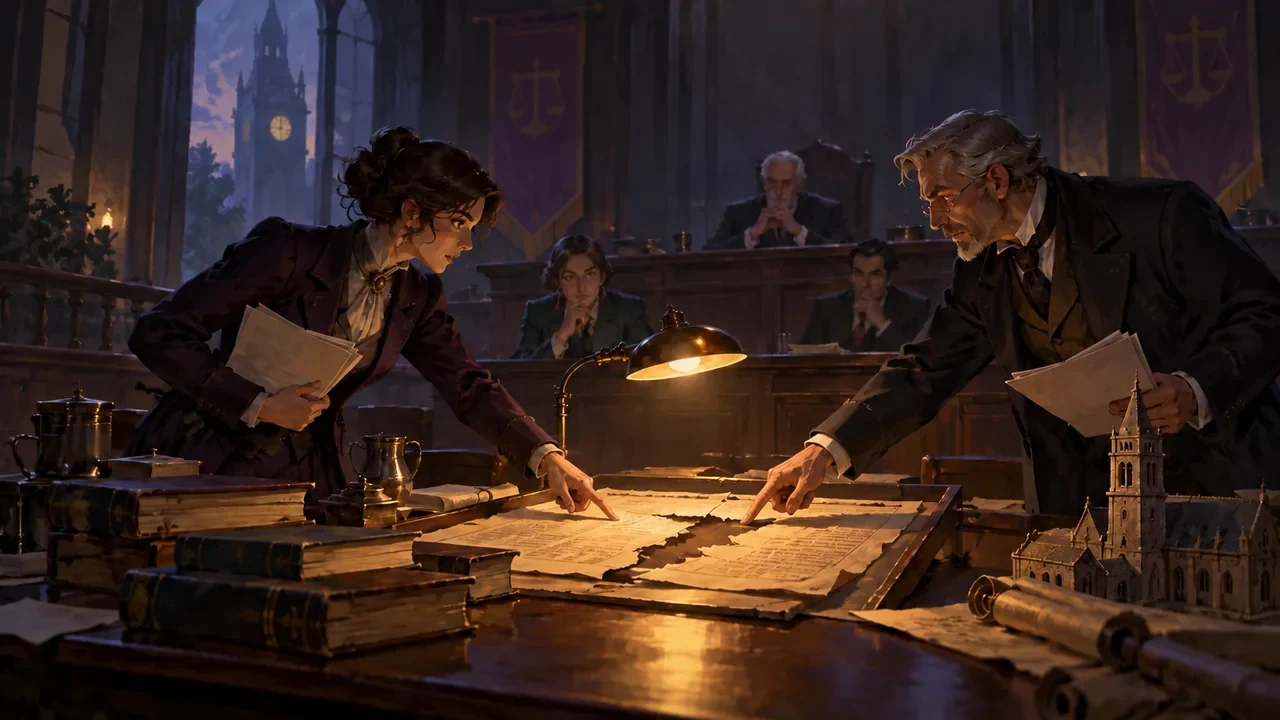
The Bell Tower Repair Hearing is set in the fictional city-state "Grey Harbor," where cracks appear in the bell tower during the rainy season. The three materials are as follows, all fictional teaching examples:
| Material | Type | Key Content | Known Limitations |
|---|---|---|---|
| Testimony of stonemason Lorn | Testimony | Says the crack appeared in March, and that he only did outer-wall patching | He did not enter the inner shaft and could only see the outer wall |
| Remaining pages of the repair ledger | Evidence | Records two expenditures for "inner shaft timber supports," dates blurry | Pages missing, handler's signature covered by water stains |
| Claim of bell keeper Miya | Claim | Claims the crack was caused by vibrations last winter | She was outside the tower that night and did not record the time of the vibrations |
Note that Miya's passage is a claim, not evidence. If players treat her status as authority, they will skip questioning.
Two Rounds of Examination, Each Round Does Only One Thing
The first round asks about source: where did this sentence come from, who had the opportunity to see it, and where was it recorded. The second round asks about alternative explanations: what other statements can the same material also support. During the examination, characters should actively acknowledge the parts they cannot see, rather than hiding gaps in the material inside a conclusion.
Reusable examination template:
- Did you see it with your own eyes, or did you hear it repeated by someone else?
- Who wrote this record, and which level was he on at the time?
- Besides your explanation, what else can this material show?
- Is there any part you cannot confirm?
Corresponding two-round dialogue examples for The Bell Tower Repair Hearing:
First Round (Source)
Player: Lorn, you say the crack appeared in March. Did you see it with your own eyes? Lorn: I saw it the day I patched the outer wall. I did not go into the inner shaft; that was the timber support workers' business. Player: Do you know who handled the "inner shaft timber supports" in the ledger? Lorn: No. I only know that the outer-wall plaster was mixed by me.
Second Round (Alternative Explanation)
Player: Miya, the remaining ledger pages can also show that someone entered the inner shaft before March. Does your vibration claim still hold? Miya: I admit the part that does not hold—I did not record the time of the vibrations. But the remaining pages cannot prove the timber supports were done in March; the date is covered by water stains. Player: So you are making a claim, not giving testimony. Miya: Right, this is my claim, not something I saw.
What Miya admits here is "I did not record it," which is the character's self-correction, not a new world fact. The limitation that the ledger date is blurry does not change from beginning to end, and players cannot make it become clear by questioning.
Let the Verdict Read Only Materials That Have Appeared
The closing text should not write "truth," but "basis." The same batch of materials can lead to two closings with different reasons, depending on how far the player has questioned.
Closing A (the player questioned the source but did not question alternative explanations):
Adopt Lorn's outer-wall testimony and the remaining ledger pages. Determine that the crack appeared no later than March, and that the handler of the inner shaft timber supports is unknown. Miya's vibration claim is not adopted due to the lack of a time record.
Closing B (the player questioned alternative explanations):
Adopt Lorn's outer-wall testimony. The date on the remaining ledger pages is unclear, insufficient to determine the time of the timber supports. Miya's vibration claim and the remaining pages can coexist, but neither has an independent time record, and the verdict makes no determination on the cause of the crack.
Both closings can only cite materials that have appeared. The blurry ledger date is a limitation players can see when they open the remaining pages, and no route can ignore it. The questioning path can change which arguments players focus on checking, and how the closing states its reasons; it cannot make known limitations disappear out of thin air. If characters provide only vague materials, uncertain conclusions should be preserved, and a definite truth must not be manufactured just to reward asking one more question.
Completion Check
After writing a hearing, use this table for self-check:
| Check Item | Passing Standard |
|---|---|
| Material layering | Each material can be marked as testimony, claim, or evidence |
| Source can be asked | Players can ask "who saw it, who recorded it, on which level" |
| Alternative explanations | At least one material can be shared by two accounts |
| Acknowledgment of insufficiency | At least one character actively states the part he or she cannot see |
| Verdict basis | The closing text cites only materials that have appeared and adds no new facts |
| Limitations unchanged | Limitations such as blurry dates and missing pages are not eliminated by questioning throughout |
If a material serves as both evidence and claim, split it first; if a round of examination can only ask "are you sure," it means the source information has not been laid out enough. When AI-generated character responses are involved, prompt constraints do not guarantee that every output will uphold these limitations, and manual checking is needed to see whether the response adds past events that were not provided.
Next step: pick a hearing you are writing, relist the existing materials according to the three layers, delete all sentences that cannot be categorized, and then write two closings that cite only the listed materials.