How Do Detective Stories Let Players Discover Contradictions in Testimony Instead of Waiting for the Protagonist to Announce the Answer?
Conclusion first: put "comparable facts" up front, and let actions at the same time and same place constrain each other, so players can point out contradictions themselves. The protagonist does not need to announce the answer, only to confirm or ask follow-up questions after the player points it out. Below, a fictional teaching example, "The Seven Minutes the Exhibition Hall Went Dark," walks through the full process.
Introduction
Conclusion first: put "comparable facts" up front, and let actions at the same time and same place constrain each other, so players can point out contradictions themselves. The protagonist does not need to announce the answer, only to confirm or ask follow-up questions after the player points it out. Below, a fictional teaching example, "The Seven Minutes the Exhibition Hall Went Dark," walks through the full process.
1. Present the facts first, then the testimony
Many mystery drafts hide clues inside testimony, and readers have to guess the author's wording. A more stable approach is the reverse: first give a public timetable, then let the testimony check against it.
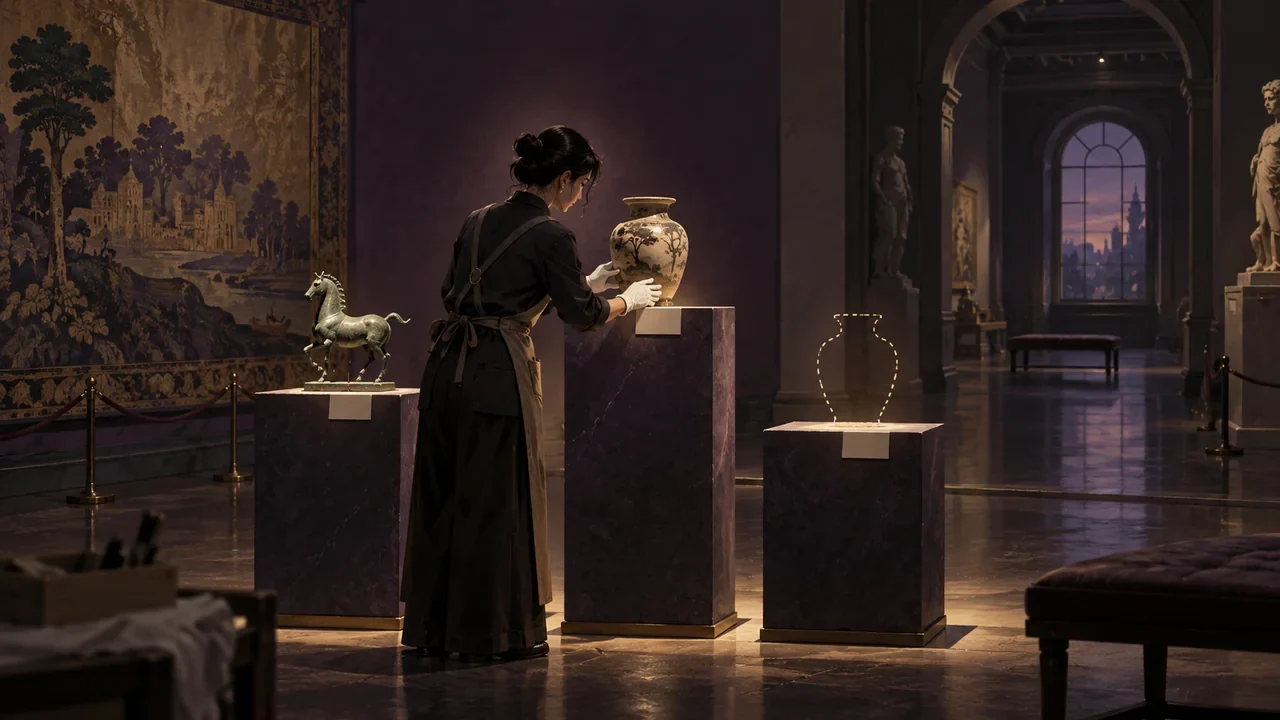
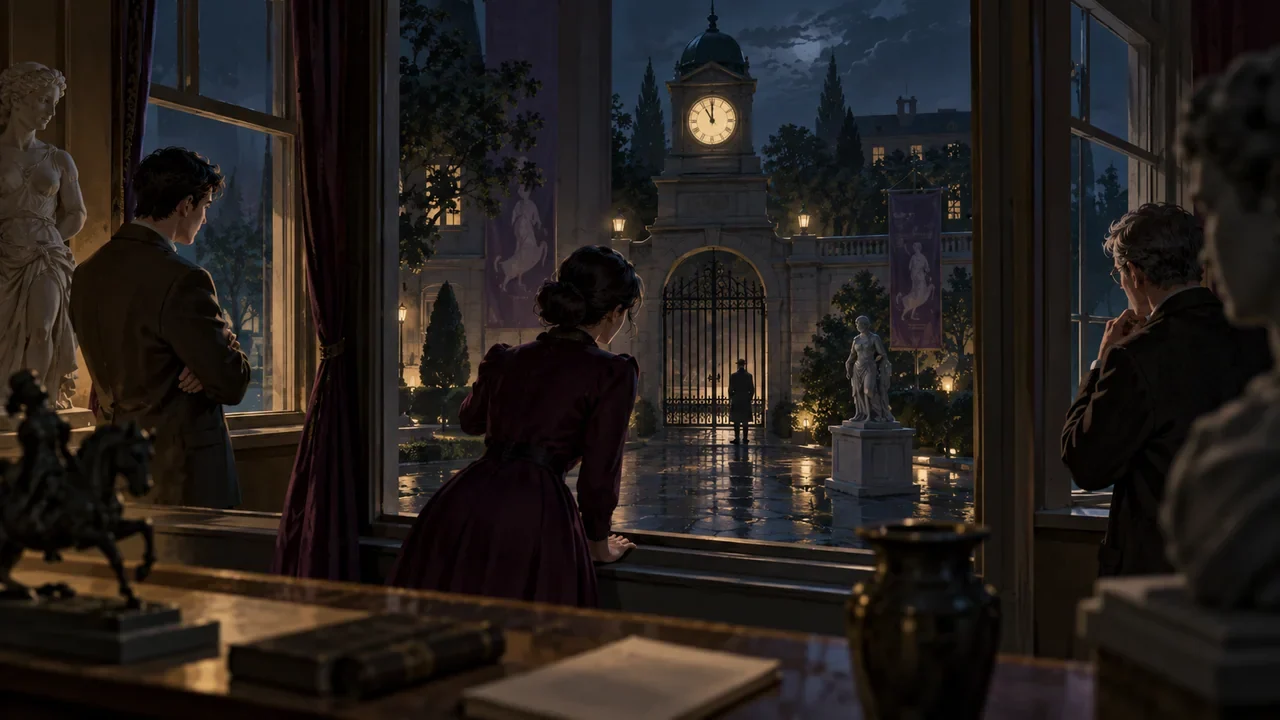
"The Seven Minutes the Exhibition Hall Went Dark" is set as follows: an art museum exhibition hall loses power from 21:00 to 21:07, and power is restored seven minutes later. The exhibition hall has only two entrances and exits: the north gate leads to the front hall, and the south gate leads to the storage corridor. Three people are present that night: docent Lin Che, security guard Zhou Mu, and sponsor representative Su Yao.
The public timetable is given to the player first. In this fictional example, the power outage record and the entrance record have already been aligned to the same clock, and 21:09 clearly refers to crossing the north gate, not walking to the center of the exhibition hall:
| Time | Event |
|---|---|
| 20:55 | Su Yao enters the exhibition hall and stands in front of the painting on the east wall |
| 21:00 | The exhibition hall lights go out, and emergency lights come on |
| 21:00–21:07 | The exhibition hall is in a power outage state |
| 21:07 | The lights are restored, and Su Yao is still near the east wall |
| 21:09 | Zhou Mu enters the exhibition hall through the north gate |
Only after the above records appear does the player have a baseline for comparison. The timetable only says Su Yao is near the east wall; it does not prove that she never moved during that period. It only records that Zhou Mu crossed the north gate at 21:09; it does not prove where he had been before that. The unrecorded parts can still be questioned, and they cannot be treated as facts the author has already confirmed.
2. Three testimonies, each complete but interlocking
Do not write testimony as fragments; each one must be able to stand on its own, so that contradictions surface.
Lin Che's testimony: "When the lights went out at 21:00, I was on the inside of the north gate. Afraid someone would wander around, I guarded the doorway. I did not leave during the whole seven minutes, and I did not see anyone go out through the north gate. At 21:07 the lights came on, and Su Yao was still over by the east wall."
Zhou Mu's testimony: "During the power outage I was in the front hall, and I heard footsteps in the exhibition hall, as if moving from the direction of the south gate toward the north. Only after the lights came on at 21:07 did I enter through the north gate, and at 21:09 I reached the center of the exhibition hall."
Su Yao's testimony: "After the lights went out, I stood in place without moving. About two minutes later, I heard someone speaking in a low voice over by the north gate. After that I waited until the lights came on."
All three testimonies are given in full first. Mark separately each character's claimed position, time point, and method of observation, then compare them with the public record. One clear time conflict can be found, and several doubts that are not yet enough to determine truth or falsehood will also emerge; do not mix the two categories together.
3. Make contradictions pointable, not guessable
The clear conflict is that Zhou Mu says he crossed the north gate at 21:07, while the public record says 21:09. The two use the same clock and point to the same action, so they cannot both be true. The player can ask him to explain the two-minute discrepancy, but still cannot directly determine whether it is a lie, a misremembering, or a problem with the record.
Su Yao hearing someone speaking in a low voice at the north gate does not contradict Lin Che standing at the north gate, because the speaker could be Lin Che. What it provides is an entry point for questioning: "Was that you speaking?" Do not write them as a conflict merely because the two testimonies involve the same location.
Zhou Mu hearing footsteps from the front hall and judging the direction is also an observation awaiting verification. If the author has not provided the state of the door or the sound conditions, then one cannot assert that he definitely could not hear it. You can ask him what basis he used to judge the direction, and only when the answer conflicts with already public spatial conditions does a new comparable contradiction form.
4. Two acceptable kinds of questioning
After the player points out the contradiction, the protagonist can do only two things, without announcing the answer.
Question one (to Zhou Mu): "You say you crossed the north gate at 21:07, but the entrance record is 21:09. Are you confirming that you mean entering the door, rather than starting to walk from the front hall toward the door?"
Question two (to Zhou Mu): "You were in the front hall, yet you say you heard footsteps in the exhibition hall going from the south gate toward the north. Did you hear it through the door, or did you actually enter the exhibition hall?"
The first question directly cites the time conflict, and the second checks the source of the observation. The player can also ask Lin Che whether the voice at the north gate came from him. If Lin Che says, "I told Su Yao not to move," that only yields a new piece of testimony; one cannot out of thin air change "speaking" into "shouting," and then announce that it conflicts with a low voice.
5. How to respond to incorrect inferences
Players may draw incorrect conclusions, such as "Zhou Mu must have entered the exhibition hall during the power outage." At this point, do not interrupt with a single line from the protagonist: "You are wrong." Let the person being questioned respond, and the response itself reveals more constraints.
Zhou Mu responds: "I did not enter the exhibition hall during the power outage. The north gate was open a crack, and sound could travel through." This is a new claim he puts forward. The timetable does not record the state of the door, so for the time being the player cannot verify or falsify it, and should remain suspicious and look for verification materials. The narration cannot confirm that the door really was open merely because he said this sentence.
If the player asks whether Su Yao moved, and she changes her statement to say, "I took two steps and then stepped back," then she has revised her earlier testimony that she "stood in place without moving." The author must preserve this change and let the player continue checking it; it cannot be treated as an ordinary addition with no new information. Her admitting she moved still does not prove she touched the painting; causation needs support from the next piece of evidence.
6. Completion check
After writing a testimony scene, use this table for self-check:
| Check item | Passing standard |
|---|---|
| Facts first | The timetable or public facts appear before the testimony |
| Time constraint | Each testimony can correspond to a specific minute |
| Location constraint | Each person's position is clear, and movement has direction |
| Contradiction pointable | The player can cite the original words of two testimonies to point out the conflict |
| Questioning does not overreach | The protagonist only asks questions and does not announce the truth |
| Incorrect inferences get responses | Character responses are based on information already given and do not add new world facts |
| No author's hidden card | Key comparison information is not hidden in undisclosed settings |
If any item does not pass, prioritize adding facts rather than adding suspects. Evidence cross-checking does not rely on piling up people; it relies on actions at the same time and place interlocking with each other.
Finally, do a small exercise: compress each of the three testimonies in the scene you are writing into two sentences, keeping only time, place, and action, and then read them side by side. Wherever two sentences placed together make you pause, that is where the player can discover a contradiction.