Before Deducting Resources in a Text Adventure, How Do You Let Players Understand the Cost?
Making costs clear depends on dividing "what I can be certain of now, what I can only estimate, and what I cannot know at all" into three layers, and disclosing only the first two before an action.
Introduction
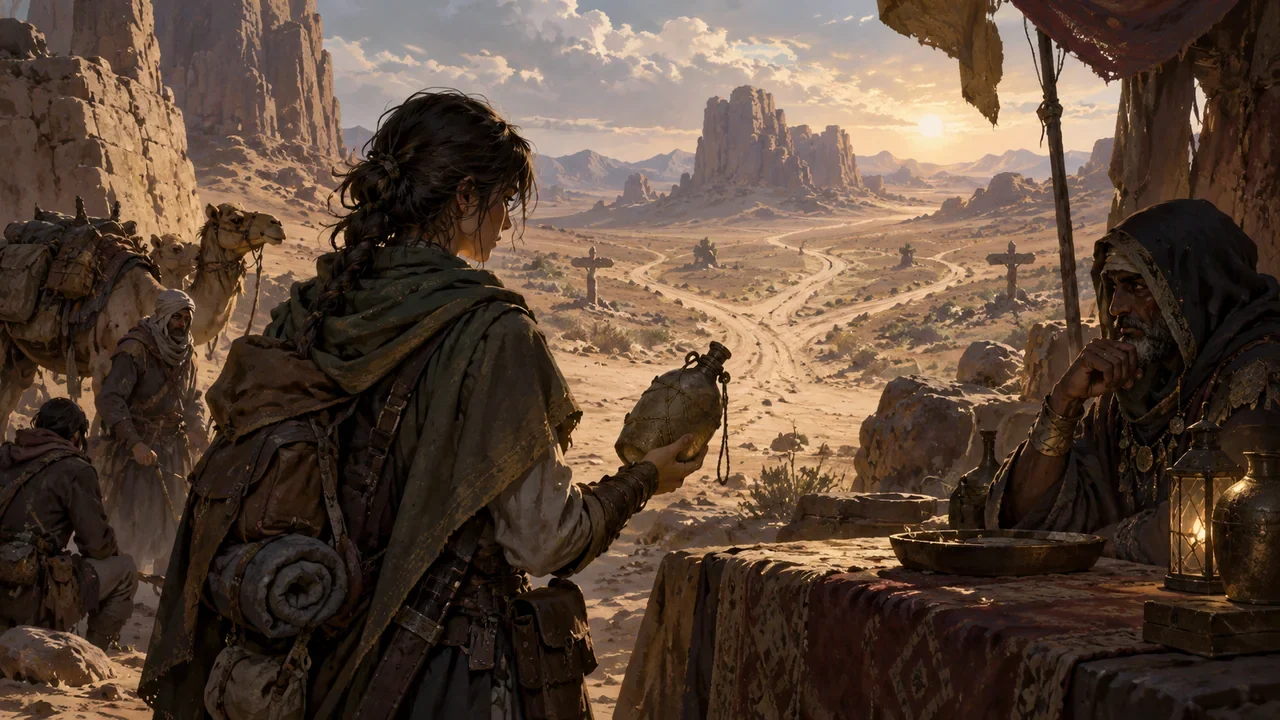
Making costs clear depends on dividing "what I can be certain of now, what I can only estimate, and what I cannot know at all" into three layers, and disclosing only the first two before an action. Using the fictional teaching example "Desert Caravan" to explain: the group has three water skins left, each enough for everyone to travel one day, and there are three routes ahead. The author needs to do four things: give the known magnitude before the action, do not secretly add more during the action, explain the real changes and reasons after the action, and when resources are insufficient, provide alternatives instead of directly declaring death.
First Distinguish the Three Layers of Information
Known cost is a fact that the player character can directly observe or has already experienced at this moment. Example: three water skins, each one day, the current position, yesterday's water consumption rate. These must be written next to the options.
Estimated cost is a judgment that has a basis but will fluctuate. Example: the northern route usually takes two extra days during sandstorm season, but no one has measured this year's wind strength. When writing an estimate, include the basis and uncertainty words, such as "according to past caravan records, about two extra days."
Unknown risk is something the character cannot reasonably predict. Example: whether the southern route oasis still has water. Unknown does not equal concealment: you can write "oasis water level unknown," letting players know this is a gamble, rather than letting players think the southern route is the shortest.
When the three layers are mixed together, players will treat estimates as promises and unknowns as the author deliberately screwing them over. Write them separately, and resource deduction becomes readable.
Comparison of Three Route Texts
For the same scene, the three writing approaches have very different effects. The table below is a fictional teaching setup; the values are only for demonstration, not balance test results.
| Route | Writing A: only write the result | Writing B: write known + estimate | Writing C: write known + estimate + unknown |
|---|---|---|---|
| Northern route | "Take the northern route, consume two days." | "The northern route detours two extra days; it is known that you must drink two extra skins; if the wind is stronger than usual, it may take another half day." | Same as B, plus "whether the sandstorm season comes early, no one can confirm." |
| Middle route | "Take the middle route, consume one skin." | "The middle route can be reached in one day; it is known that one skin is consumed; the supply point along the way dried up last year, so you cannot count on it." | Same as B, plus "whether the supply point has been buried by quicksand is unknown." |
| Southern route | "Take the southern route, may save water." | "The southern route takes two days; it is known that two skins are consumed; according to the old map, the oasis water level has about half a skin left." | Same as B, plus "the old map is five years old; whether the oasis is still there is unknown." |
Writing A makes players choose in an information vacuum, and when water is deducted they easily feel tricked. Writing B makes clear what can be calculated, and players can weigh it. Writing C lays out the bet clearly; if players choose the southern route, they are actively taking on risk, not being arranged by the author.
How to Write the Magnitude Disclosed Before Action
The goal of disclosure before action is not to give a precise answer, but to let players know "roughly how bad the worst case can get." You can organize one sentence in this order:
- Known consumption: exactly how much will be deducted.
- Estimated range: how much more may be deducted, and on what basis.
- Unknown item: which item cannot be predicted, and what direction the consequence is.
Example wording (fictional): "Take the northern route; it is certain that two skins are consumed; based on past wind conditions, another half skin to one skin may be consumed. Whether the sandstorm comes early cannot be judged by the group; if encountered, it will cause additional delay."
This sentence does not promise "only two skins will definitely be deducted," nor does it present the unknown as known. When players make the choice, they have three numerical layers in hand: 2, 2.5–3, and "possibly more."
Before and After Execution Comparison
After the action, explain the real changes and reasons, rather than only popping up "water -2." Comparison example (fictional):
| Stage | Text | Function |
|---|---|---|
| Before action | "The northern route certainly consumes two skins; the wind may consume another half skin to one skin." | Give the magnitude |
| During execution | "Wind rose in the afternoon of the second day; the group walked an extra half day." | Explain the source of the change |
| After action | "Actually consumed three skins: two skins for the journey, one skin for detouring around the dunes. Zero skins left." | Reconcile the account |
The explanation after execution must match the estimate before action. If the actual deduction is three skins, but beforehand you only said "about two skins," then afterward you must point out which specific event the extra skin came from, such as detouring around the dunes. Only if players can trace it will they treat the next estimate as a reference.
When Resources Are Insufficient, Give Alternatives
When water is deducted to zero, do not directly write "you died." First give executable alternatives so players can continue participating. Example (fictional):
- "Unload one camel's cargo in exchange for half a skin of water, but lose part of the goods."
- "Switch to the middle route, spend one extra day, but it is certain that only one skin is consumed."
- "Send two people lightly equipped ahead to fetch water, while the main force waits in place; the risk is splitting the group."
Alternatives must also clearly mark their cost layers: exchanging for half a skin of water is known, how much cargo is lost is estimated, and whether the people sent ahead can return is unknown. Insufficient resources are not the endpoint; they are another kind of cost for continuing to choose.
Completion Check
After writing a passage about resource deduction, check item by item:
- In the text before action, are the known, estimated, and unknown each identifiable?
- Does the estimated item carry a basis, rather than being a number pulled from thin air?
- Can the real changes after action correspond to one of the items stated before action?
- Is the specific reason for the extra deduction pointed out?
- When resources reach zero, is at least one alternative option given, with its cost layer clearly marked?
- Does the full text avoid writing the unknown as known, and avoid writing estimates as promises?
If all six pass, what players see when resources are deducted is an account that can be reconciled, not a sudden ambush. Next, you can pick the most recent resource deduction passage in your own draft, rewrite the sentence before action according to the three layers above, and then add a sentence after action to reconcile the account.