How to Write Lightweight Mysteries for Festival Deduction: First Let Players Know How the Festival Normally Works
First write clearly the festival's "normal day," then let the anomaly appear. Only when players know how the handover, lantern lighting, parade, and lantern collection originally proceed can they judge which step is wrong. Otherwise every unfamiliar custom looks like a clue, and deduction turns into guessing the author's mind.
Introduction
First write clearly the festival's "normal day," then let the anomaly appear. Only when players know how the handover, lantern lighting, parade, and lantern collection originally proceed can they judge which step is wrong. Otherwise every unfamiliar custom looks like a clue, and deduction turns into guessing the author's mind.
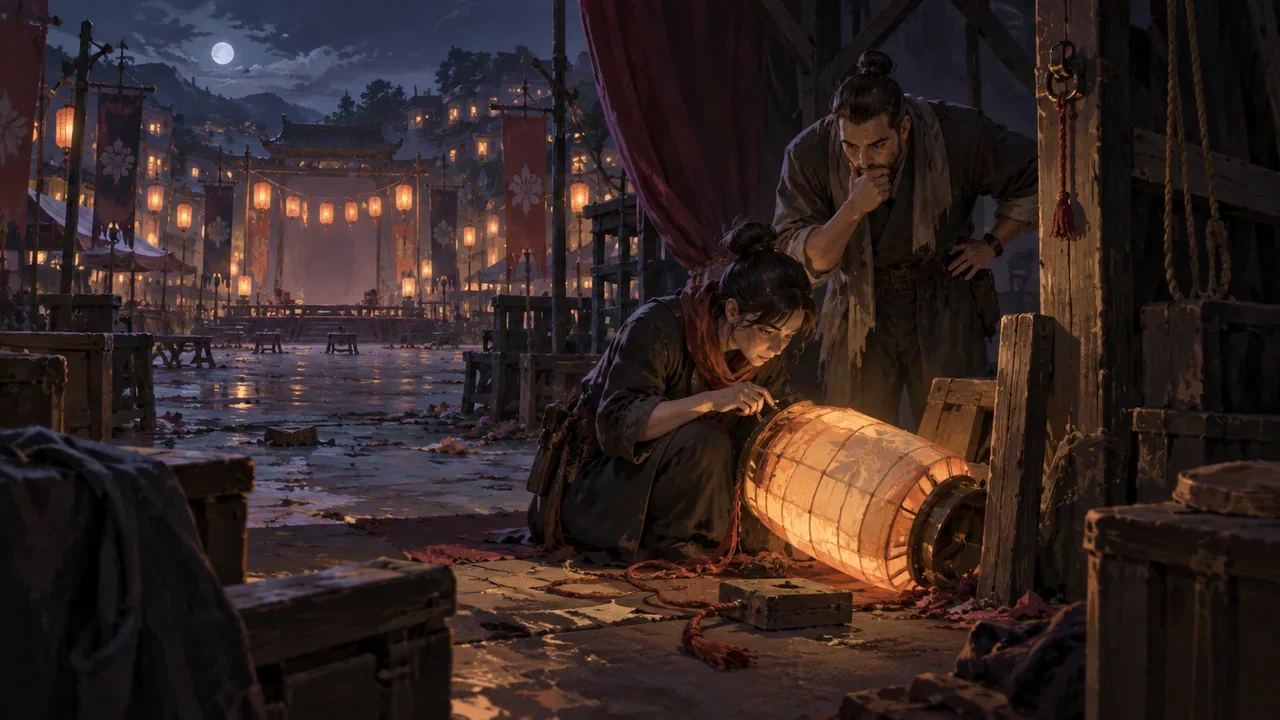
Below, a fictional teaching example, "Tide Lantern Festival," is used for illustration. It is an adult community festival, with no intimate content involving minors, and all characters, numbers, and dialogue are invented for writing demonstration. The goal is not to make players solve the case, but to let players make one verifiable judgment within limited information.
First Write the Baseline Procedure, Then Write the Anomaly
The normal procedure of the "Tide Lantern Festival" can be fixed as four stages:
- At You hour, the lantern maker hands thirty-six tide lanterns to the lantern patrol, registering the number of lanterns and lantern numbers.
- At Xu hour, the lantern patrol lights the lanterns along the two routes of the inner ring and the outer ring; the inner ring lights first, the outer ring lights later.
- At Hai hour, the community representative reads the blessing at the tide platform, and after reading, the lantern patrol collects the lanterns.
- Before Zi hour, the lantern maker checks the number of collected lanterns; if one is missing, it is recorded, with no blame pursued.
These four stages are the baseline. If players do not know that "the inner ring lights first," they will not think there is a problem with the outer ring lighting first; if they do not know that "if one is missing, it is only recorded," they will treat the missing lantern as a murder case.
The baseline procedure should be written as daily conversation that characters can say casually. For example, the lantern maker A Li says: "That row on the inner ring lights first, the wind is weak. The outer ring waits until the tide level rises before lighting, otherwise the lantern covers will be flooded backward." This sentence explains both the order and the reason. The reason does not need to be complex, as long as it lets players know this is customary.
Then add one more daily detail: when collecting lanterns, the lantern patrol puts the lanterns in two piles according to the inner ring and outer ring; the lantern maker only counts the total, not the order. This detail is useful later, because it makes "the order is wrong" and "the number is wrong" two different things. Players can first suspect the order, then go back and check the number, and will not be led to a single conclusion right away.
Three Changes: Two Anomalies, One Irrelevant
Anomaly one: at Xu hour when lighting the lanterns, the outer ring lights first. The lantern patrol A Lan explains: "Tonight the wind comes from the outer ring, so I lit that side first." This explanation is reasonable, but conflicts with the registered order. Players need to judge: did the wind really change, or is A Lan covering something up?
Anomaly two: at Hai hour when the blessing is read, there is an extra lantern on the tide platform without a lantern number. The lantern maker A Li says: "This is not one I issued." The lantern patrol A Lan says: "Maybe someone put it there themselves." This does not directly point to a crime, only to "a lantern outside the procedure."
Irrelevant change: the community representative changed a cloak. Someone mentions, "Last year it was blue, this year it is gray." It does not affect lantern lighting, handover, lantern collection, or change the number of lanterns. It is written in to let players practice elimination. Players can ask, but after asking they will find it is only a change of clothes.
Note: A Lan's saying "the wind comes from the outer ring" is only an explanation proposed by a character; whether it is true still needs further checking, and the narration does not thereby confirm the wind direction. Players cannot treat this sentence as a weather record. A Li's saying "this is not one I issued" is also only a character statement, not omniscient narration. Clues must appear first, then let players infer.
Choice and Verification Round
After Hai hour, players have one choice: first check the lantern number, or first ask about the cloak. Both choices can advance, but only checking the lantern number can verify anomaly two.
The complete dialogue can be written like this:
Player: A Li, are all thirty-six registered? A Li: Registered. Inner ring eighteen, outer ring eighteen. Player: What about the one on the tide platform? A Li: Not in the register. My lantern feet all have carved marks; that one does not. Player: A Lan, did you see it when you lit the outer ring? A Lan: No. When I got to the tide platform, it was already there. Player: Who changed the cloak? A Lan: The representative changed it himself. Last year's blue one got damp from the tide, so this year it was changed to gray.
In this dialogue, once the cloak is asked about, it ends and produces no new clue. The lantern number, however, produces a verifiable point: the carved mark. Players can ask to see the lantern foot, and A Li agrees. The inspection result is: the one on the tide platform has no carved mark, but the inside of the lantern cover has the smell of outer-ring lantern oil. This conclusion only shows that it may come from the outer ring, not who put it there.
The verification round should allow harmless explanations. For example, A Lan can say: "Maybe some child from the outer ring took the wrong one." This is not the answer, but it is a reasonable possibility. If players choose to believe it, the story can continue, only lacking one confirmation. A lightweight mystery does not require a unique solution; it requires players to know what they believed and what they missed.
Here is another reusable dialogue template, convenient for applying to other festivals:
Player: According to the rules, who should do the next step? Character: I should. Usually it is... Player: What is different today? Character: The order is reversed, but the number matches. Player: What can be checked? Character: Check the register, or check the physical mark.
In the template, "the number matches" and "the order is reversed" should be written separately. Players first confirm the number, then deal with the order, and the deduction burden will be much lighter. If a character says as soon as they open their mouth, "Something big has happened," players will skip the baseline and go directly into panic, and the lightweight mystery becomes heavy.
Completion Check
After writing a festival mystery, use this table for self-check:
| Check item | Passing standard |
|---|---|
| Baseline procedure | Players can state at least three normal steps in order |
| Number of anomalies | Two, and both can point back to the baseline |
| Irrelevant change | One, and after asking it produces no new clue |
| Labeling of excuses | Words fabricated by characters are not written as world facts |
| Verification action | Players can perform one specific check, such as looking at a carved mark |
| Harmless explanation | At least one reasonable possibility, without forcing a conviction |
If the "baseline procedure" column in the table cannot produce three steps, first add daily life, do not add clues. If the "irrelevant change" still produces new information after being asked about, then it is not an irrelevant change, and should be deleted or changed into an anomaly.
Finally, do a small action: take the festival scene you are writing, first write a daily dialogue of "how it was spent on this day last year," then write the first difference this year. Only write the difference, do not explain. After writing, decide whether it is a clue.