How AI Text Puzzles Avoid “Answers Changing with the Chat”: First Write an Author Answer Table
To avoid answers changing with the chat, don't rush to revise the prompt first. Break the puzzle into an author answer table: each clue's fixed text, acceptable answers, synonymous expressions, error prompts, and reveal conditions each occupy a row, and generated narration may only cite content from the table, and may not invent new clues or new judgments on the fly. Below, a fictional teaching example walks through the complete process; the three star markers, observatory number, and dialogue in the example are all fabricated and do not correspond to any real work or code.
Introduction
To avoid answers changing with the chat, don't rush to revise the prompt first. Break the puzzle into an author answer table: each clue's fixed text, acceptable answers, synonymous expressions, error prompts, and reveal conditions each occupy a row, and generated narration may only cite content from the table, and may not invent new clues or new judgments on the fly. Below, a fictional teaching example walks through the complete process; the three star markers, observatory number, and dialogue in the example are all fabricated and do not correspond to any real work or code.
1. First Fix the Puzzle's Skeleton
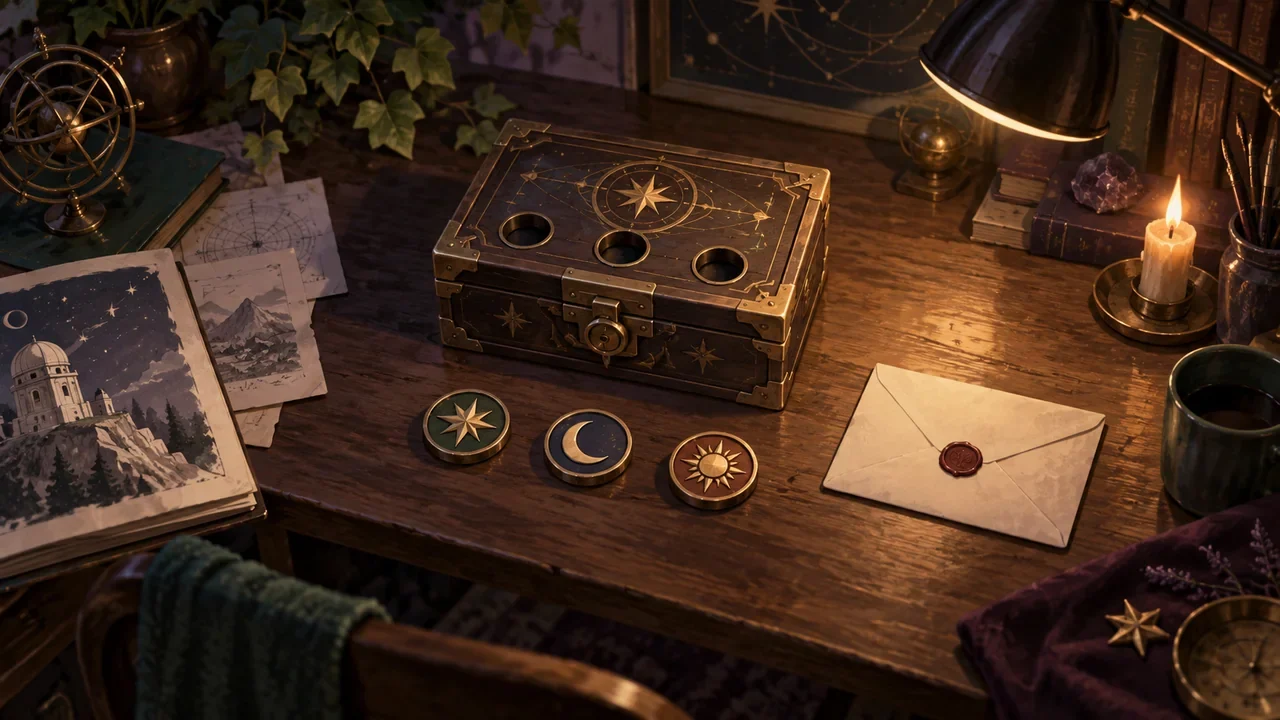
Suppose you are writing a text adventure: the player enters an abandoned observatory and needs to enter a three-digit number to open the inner room. The clues are three star markers, distributed across the first three scenes.
First write out the three immutable facts:
- Star marker A is on the east windowsill, engraved with “seven.”
- Star marker B is in the interlayer of the duty log, engraved with “two.”
- Star marker C is on the telescope base, engraved with “nine.”
The observatory number is “seven-two-nine,” i.e., 729. This number is only an internal convention of the fictional example, not a recommended parameter, and does not represent any real password rule.
Once the skeleton is fixed, when AI generates narration it may only describe the positions and engravings of these three star markers, and may not add “there is also a fourth star marker on the wall” or “there is a note with 5 written on it tucked in the log.” If the model temporarily adds a fourth star marker, the player will get mutually contradictory clues, and the answer will naturally change with the chat.
2. What the Answer Table Looks Like
The answer table is a judgment checklist the author writes for themselves, not an interface shown to the player. It contains at least five columns: clue number, fixed text, acceptable answers, synonymous expressions, error prompts and reveal conditions. Below, the observatory example is filled into a complete table.
| Clue number | Fixed text | Acceptable answers | Synonymous expressions | Error prompts and reveal conditions |
|---|---|---|---|---|
| A | The star marker A on the east windowsill is engraved with “seven” | seven | 7, 柒 | When the three have not all been collected, prompt “the star markers have not all been seen yet” |
| B | The star marker B in the interlayer of the duty log is engraved with “two” | two | 2, 贰 | Same as above |
| C | The star marker C on the telescope base is engraved with “nine” | nine | 9, 玖 | Same as above |
| Combination | The three star markers arranged in the order A, B, C | seven-two-nine | 729, 七二9, 柒贰玖 | If the order is wrong, prompt “the order does not match the arrangement of the star markers” |
| Reveal | The inner room door opens, revealing the star map | — | — | Triggered only when the combination is correct and all three have been discovered |
The “synonymous expressions” column in the table is crucial. Players may input Arabic numerals, traditional uppercase forms, or mixed writing. You may accept 729, 七二九, 柒贰玖, but you do not have to accept “九二七,” because the order itself is part of the puzzle. The accepted range is decided by the author and written into the table; generated narration cannot accept “729” today and reject “七二九” tomorrow.
3. Make Generated Narration Run Around the Table
With the table, the prompt can be written as a constraint-style prompt rather than an open-ended one. For example:
You may only describe the fixed text of clues A, B, and C in the answer table. When the player inputs a combination, first compare it against the acceptable answers and synonymous expressions; any input not in the table must be answered according to the error prompt. Do not add star markers, numbers, or opening conditions.
The model may miss synonymous expressions, and may also treat “柒” as a new clue. The table can provide a basis for manual verification, but cannot guarantee that the model is correct every time. If the work requires strictly consistent judgments, then independent rules must be implemented and verified outside the generated narration, checking whether the input hits an entry in the table, and only allowing the reveal after a hit. This is a production plan that needs to be implemented separately; it does not mean that after writing it into the prompt, the existing generation system possesses a deterministic puzzle engine. When the rules have not yet been implemented, you should manually check round by round according to the table, correct any misjudgments found, and must not treat the model's answer directly as the final judgment.
4. How to Respond When Close to the Answer
The player will not input the correct combination all at once. Responses when close to the answer must also be written into the table first, to avoid the AI improvising freely. You can set three tiers:
- Only one star marker discovered: the narration mentions only that star marker and does not hint at the total number.
- Two discovered: the narration may mention “one more is still missing,” but does not reveal which one is missing.
- All three present but the order is wrong: prompt “the order does not match the arrangement of the star markers,” and do not directly give the correct order.
Corresponding dialogue example (fictional):
Player: “I input 927.” Narration: “The inner room door does not respond. The light seeping through the crack in the door flickers once, then dims again. You remember that the star markers are arranged in the order A, B, C, but you are not sure whether you have remembered the order wrong.” Player: “Then I'll input seven-two-nine.” Narration: “A faint sound of gears comes from inside the door, and the star map lights up in the darkness.”
Here “light seeping through the door crack” and “sound of gears” are narrative decoration, not new clues. The decoration may change, but the judgment must not change. If some generation writes “sound of gears” as “the door lock springs open,” while the combination is actually wrong, the player will mistakenly think the answer was correct. Therefore, responses when close to the answer must also be limited to the feedback tiers allowed in the table.
5. Manual Regression Input Checklist
After writing the table, prepare a set of manual regression inputs and run through them every time you change the prompt or the narration. The checklist for the observatory example can be:
- Input “seven,” expected: only confirm star marker A, do not open.
- Input “729,” expected: when the three have not all been collected, prompt “the star markers have not all been seen yet.”
- Input “七二九” and all three have been discovered, expected: open.
- Input “927,” expected: wrong-order prompt, do not open.
- Input “柒贰玖,” expected: accept according to synonymous expressions.
- Input “four,” expected: do not add clues, respond according to a miss.
After running the checklist, do a completion check: whether every acceptable answer in the table can trigger the corresponding result; whether every out-of-table input will not accidentally open; whether new numbers or new star markers outside the table appear in the narration. Only when all three pass is this version of the puzzle considered stable.
6. Common Deviations and Corrections
Deviation one: writing the answer only in the prompt. The prompt will be diluted by subsequent conversation; the table is the fixed reference. Correction: build the table first, then write the prompt.
Deviation two: leaving synonymous expressions blank. If a player inputs “柒” and is rejected, they will think the puzzle is broken. Correction: list the acceptable forms one by one, and also state clearly the range that is not accepted.
Deviation three: letting the AI judge “almost correct.” Responses when close to the answer must be divided into fixed tiers and must not rely on the model's improvisation. Correction: write the three tiers of feedback into the table; during generation, only select a tier, do not invent a tier.
Deviation four: not updating the table after changing a clue. If the author changes star marker B from “two” to “three,” the combination, synonymous expressions, and regression inputs must all be updated accordingly. Correction: every time you change the fixed text, change the table first, then change the narration.
This table does not solve all problems; it only turns “answers changing with the chat” into “answers changing with the table.” If the table does not change, the answer should not change; if the table changes, all related rows change together. As a next step, you can take a puzzle you are currently writing and first fill in the three columns of clues, acceptable answers, and synonymous expressions, then add error prompts and reveal conditions.