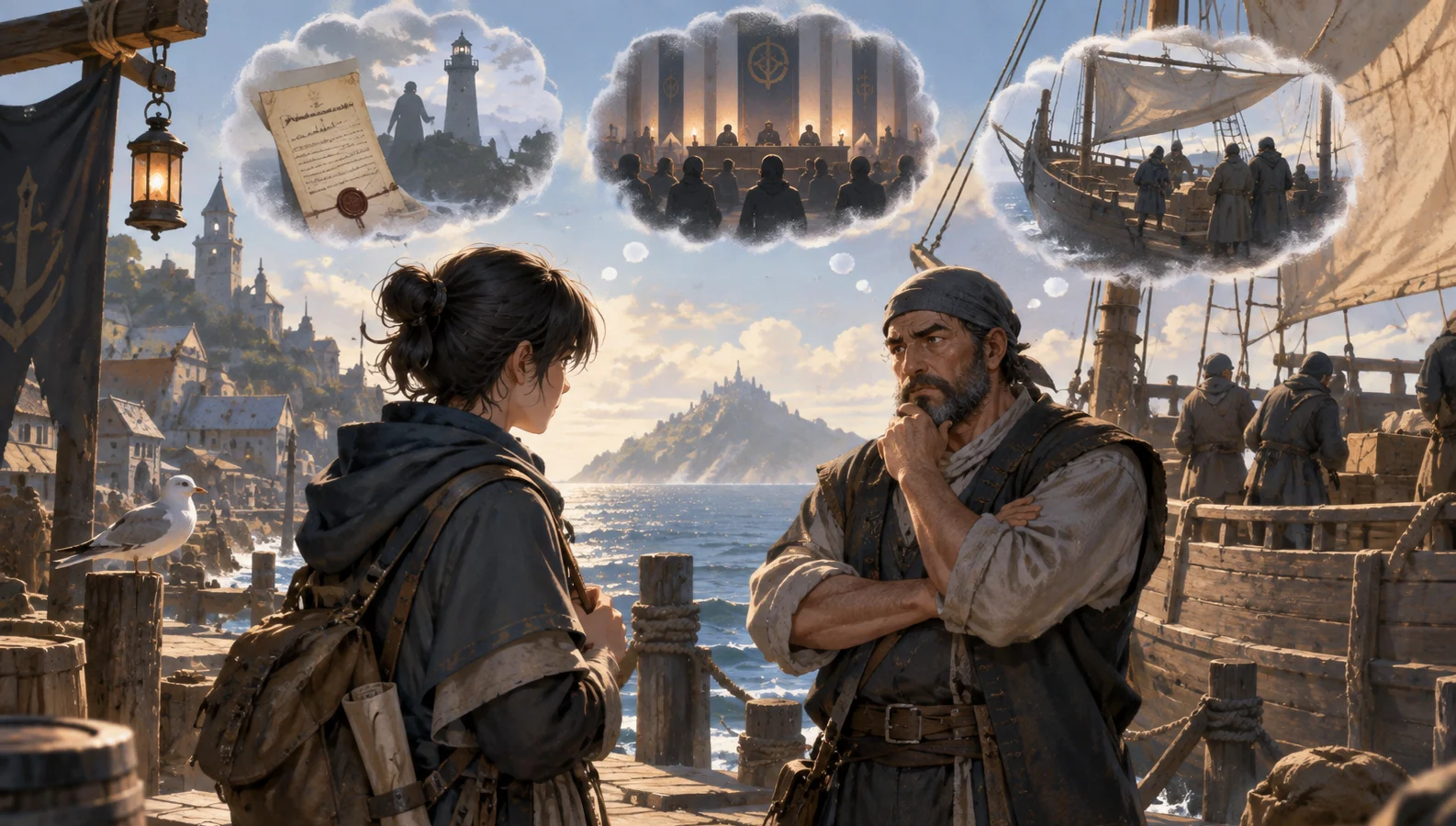
Can Randomness Change More Than Decoration? Decide Which Facts Are Off-Limits
Weather can change investigation routes and their costs, but it cannot casually change who witnessed the incident. Use a randomness boundary table to define fixed facts, variable conditions, and presentation variations, including when each is determined and which later scenes it can affect.
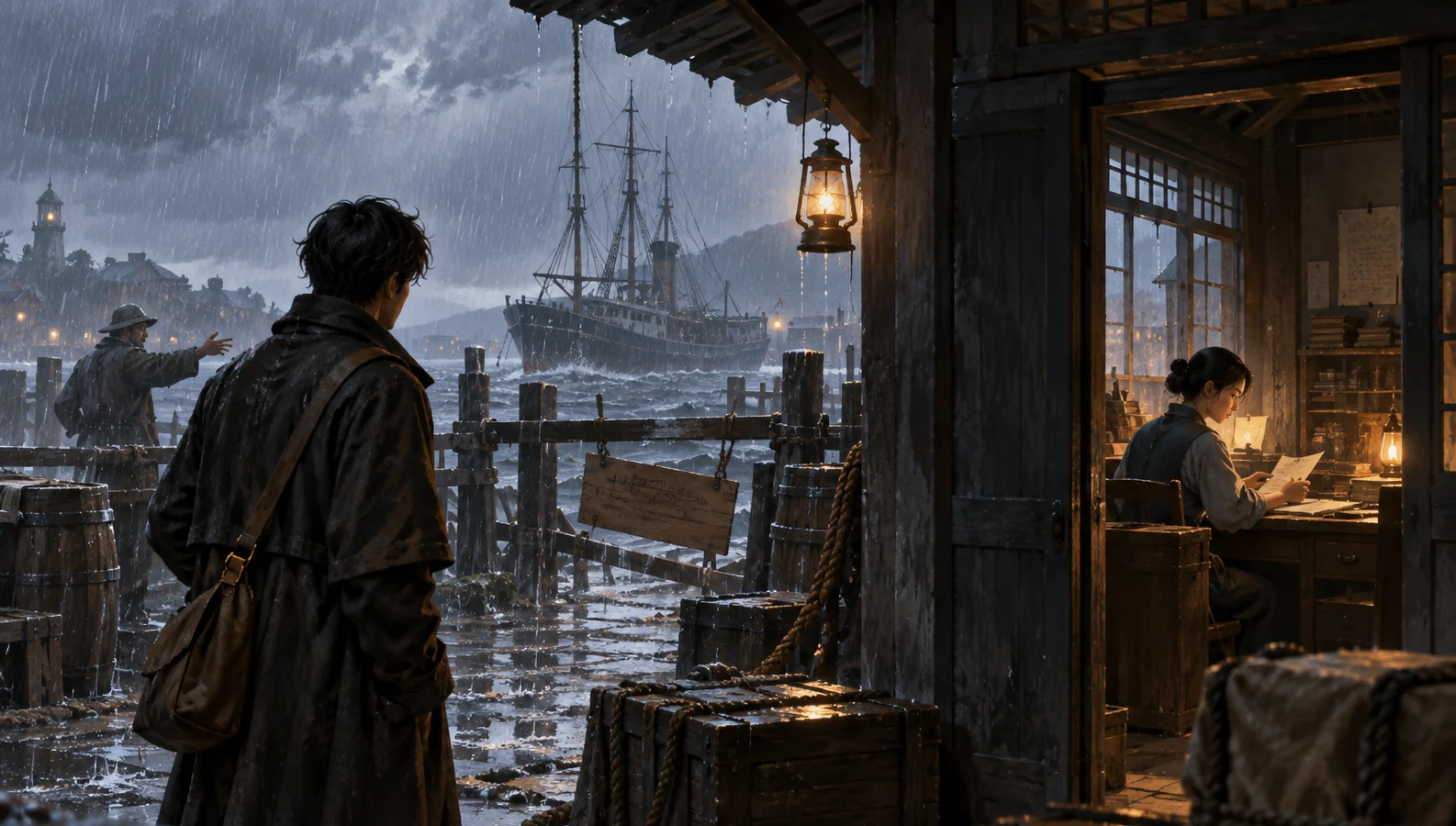
Randomness can change difficulty, but define its scope first
Random variation need not stop at rain sounds, clothing colors, and opening dialogue. It can suspend a ferry service, make a witness close up shop early, or prompt players to weigh two investigation routes differently. The prerequisite is that a random draw may change only conditions the author has explicitly listed. It must not also rewrite the facts players are using to reason through the case.
Whether something can be randomized depends not on whether it is “background,” but on what later scenes rely on it for. Weather that only sets the mood is a presentation variation. Weather that determines whether the ferry runs is a variable condition. If a downpour on the night of the incident explains why footprints disappeared, it already serves as evidence and must remain fixed within this case.
The “Rain Harbor Cargo Crate Case” below is a fictional teaching example. Its characters, rules, and branches were created for demonstration; they are not a real user case, tested results, or product features. In this setup, dock bookkeeper Lin Cen saw someone switch cargo crate labels during last night’s shift change. Today, the player needs to find her and confirm when the switch happened. Today’s weather may be randomly drawn; the witness is always Lin Cen.
Put the boundaries in a table you can fill in directly
A boundary table should answer at least six questions: what changes, which layer it belongs to, which values are allowed, when it is determined, what it may affect, and what it must never affect. Simply writing “important characters are fixed” is insufficient: the author might still give someone else eyewitness status in another conversation.
| Item | Layer | Allowed content | When determined | May affect | Must not affect |
|---|---|---|---|---|---|
| Key witness | Fixed fact | Lin Cen, dock bookkeeper, personally witnessed the label switch | When the case is finalized | How different speakers address her | Identity, eyewitness status, the event she witnessed |
| Weather during last night’s incident | Fixed fact | No rain; sufficient visibility | When the case is finalized | Wording of recollections | Using today’s weather to retroactively change witnessing conditions |
| Today’s weather | Variable condition | Clear, light rain, heavy rain | Before the day’s first scene | Ferry routes, travel time | Last night’s facts, whether testimony is true |
| Lin Cen’s location today | Derived condition | At the docks in clear weather or light rain; in the accounts office in heavy rain | After the weather is determined | Where to look for her | Independently drawing a different location |
| Description of rain sounds | Presentation variation | Drips beneath the eaves, rain striking a tarpaulin | When writing the scene | Atmosphere and phrasing | Quietly adding thunder, flooding, or inaudible testimony |
When copying this table, fill in the prohibited effects before the candidate values. If you cannot write the former, you do not yet know which story commitments a change might affect. Candidate values should also form a finite set, so that “freely changing weather” does not quietly include dense fog, storms, or other states whose consequences have not been planned.
The location in this table is not a second random draw. It follows a rule once the weather is determined. Drawing both independently could produce “the witness goes to the accounts office in heavy rain” and “the witness is still waiting at the docks in heavy rain” at the same time.
Walk through heavy rain: change the route, not the witness
Suppose today’s draw is heavy rain. First record the day’s state: “Heavy rain; ferry service suspended; Lin Cen in the accounts office.” Making heavy rain a condition for suspension is a fictional rule of this example, not an explanation of how real ports operate. Continue using this record when the player enters the second scene; do not draw the weather again.
At the docks, the player sees a suspension notice, and the attendant explains that Lin Cen has moved to the accounts office. The player can take the long embankment route, spending two action slots, or ask a porter to guide them through a warehouse shortcut, spending only one slot but owing a favor: helping sort cargo manifests on one occasion. The routes differ in time and later obligations, and the author needs to make those costs visible before the choice.
Add one more constraint for this example: Lin Cen stays until that day’s investigation is finished. The longer route is slower, but it will not make the player lose their only witness without warning. If the author wants a departure deadline, they must also check whether the slowest route still gets the player there in time, rather than merely adding a countdown.
At the accounts office, Lin Cen still says she saw the label switch during last night’s shift change. Heavy rain cannot turn her account into “I heard it from a colleague” or change the bookkeeper into a captain. In the clear-weather version, players may find her directly at the docks and save travel time, but they still need to ask how she remembers the time of the shift change.
Randomness has therefore changed the player’s action plan without deciding whether the testimony is credible. Players must still cross-check the timing. Bad luck with today’s weather merely makes obtaining the testimony more involved.
Three ways to cross the boundary, and how to fix each
The first is drawing again every time a scene is entered. The player leaves the docks and returns; suddenly the weather is clear and the ferry is running, making the earlier detour cost feel like a gameplay mistake. Fix this by limiting update points, for example to the start of a new day. If the story needs the weather to clear in the afternoon, write that event and its triggering conditions in advance, specifying how it follows from the morning’s state.
The second is smuggling conditions into decorative prose. “The rain swallowed her final sentence” looks like a figure of speech, but it changes access to information. “Water dripped from the hem of her coat” usually has no such consequence. The first sentence must move into the condition layer, explaining how the player can hear it again or ask follow-up questions and whether that costs time. Otherwise, replace it with a description that does not interfere with hearing the content clearly.
The third is replacing a witness to fit the weather. Heavy rain makes a dock scene awkward to write, so the accounts office supervisor testifies in Lin Cen’s place. This changes who knows what and may undermine later character motivations. Move Lin Cen instead, or have the supervisor provide her whereabouts. The supervisor may know where she is; they cannot inexplicably inherit her firsthand experience of last night.
Another situation is easy to misjudge: a character saying something incorrect does not mean the facts have drifted. The supervisor may mistakenly say Lin Cen went aboard a boat, but the author must preserve the attribution of this claim to the supervisor’s mistaken judgment and provide evidence that can be checked. Otherwise, readers cannot distinguish deliberate misdirection from a self-contradictory script.
Validate with two records before expanding randomness
Before finalizing the draft, prepare two records: one listing the case’s fixed facts, and another recording the day’s state for clear weather, light rain, and heavy rain separately. Manually follow each state through to the witness interview, checking witness identity, what was witnessed, route costs, and arrival conditions. These are checks an author can perform, not a claim that this example has already been tested.
Ask three questions in sequence: Does the earlier evidence still hold? Can the necessary investigation still happen at the latest possible arrival time? Do later scenes acknowledge the costs the player paid? If any question cannot be answered, narrow the candidate set or fill in the missing conditions first. Do not patch the gaps with improvised dialogue.
If you do not want to maintain different routes, randomize presentation only. If you want controlled pacing, specify the weather by chapter. If you want players to bear the consequences of a choice, let them decide whether to head out in the rain today or return tomorrow, with the consequences of waiting made explicit. These approaches address repetition, narrative planning, and decision-making respectively; they need not all be delegated to a random draw.
Randomizing witness identity across playthroughs is not categorically impossible either. However, it requires establishing a complete, compatible set of evidence and character motivations at the start and maintaining consistency throughout that playthrough. That goes beyond this example’s daily weather variation. Clearly defining the scope of one random element makes an investigation easier to understand than allowing every fact to change.