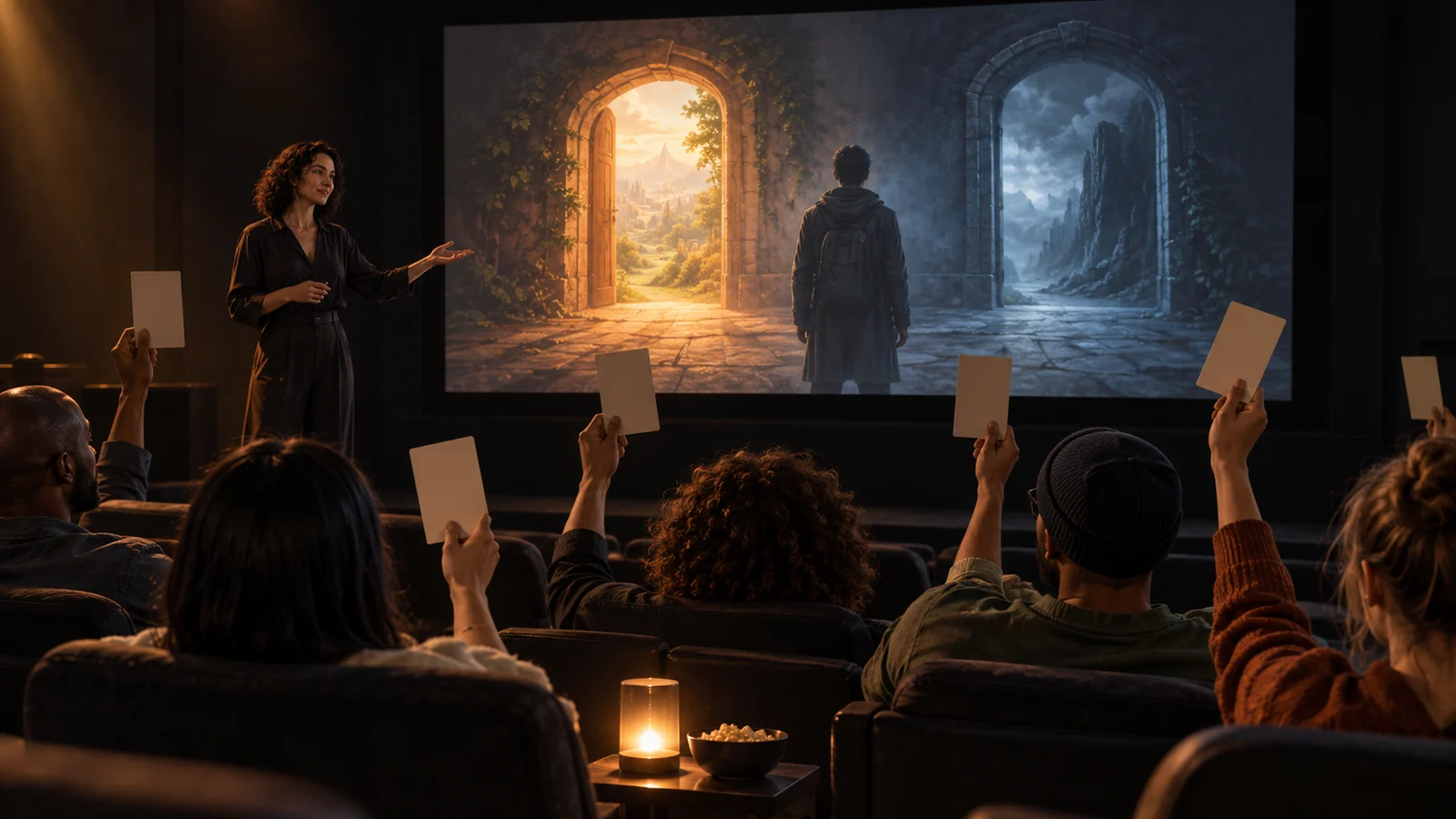
Slow-Motion Choices in an Interactive Film Game: Thinking or Hesitating?
Before staging a branch, establish whether a slow-motion choice consumes time within the story. A slow-motion timing card separates playback duration, story events, and the character’s experience, giving actions and accusations after normal speed resumes a clear basis.

Introduction
When an interactive film game inserts a choice into slow motion, first establish how far the story advances while the audience thinks, and whether the character has already begun to act. More screen time does not automatically mean more hesitation. Any mistake, loss, or dialogue after normal speed resumes must follow the agreed sequence of story events. The time an audience member spends reading options cannot be retroactively charged against the character.
The tilting tray below demonstrates how to fill out a “slow-motion timing card.” This is an original fictional teaching example, not a real user experience, a tested result, or a DramaFork product feature. It does not depend on any particular engine.
1. Define the Three Kinds of Time Separately
Playback time is the duration the audience spends watching the slowed footage, identifying the options, and making a decision. Story time is what the tray, glass marbles, and characters actually go through in the fictional world during that interval. Character experience concerns whether the moment feels stretched out to the character and whether they actually weigh their options within the story.
These three need not align. A director can expand a brief reaching movement so the audience can see the danger, while the character still acts immediately upon noticing the tilt. Alternatively, the character may genuinely be unable to decide: their hands stop in midair as the tray continues to tip. Both approaches work, but the same vague instruction—“slow this part down”—cannot adequately describe both.
Subjective slow motion also does not mean the world has actually slowed down. The former may simply express attention or tension. The latter is a rule of the fictional world and requires an explanation of which objects it affects. Without such a premise, a slowed background alone does not establish that the character has gained additional capacity to act.
Nor does a moment feeling long to the character, on its own, prove that they delayed an attempt to save something. To write that “hesitation cost them the opportunity,” you still need to identify what happened during that hesitation and how the change closed an opportunity that had previously existed.
2. Start with a Timing Card for Immediate Action
Place a cup of water at the left end of the tray and loose glass marbles at the right. The protagonist notices the tray tilting and raises both hands, but has not yet touched either end. The player decides which end to support first. Here, the two approaches prioritize protecting different things; neither is designated in advance as the only correct answer.
| Timing card field | Entry for this example |
|---|---|
| Start of slow motion | The right end has just begun to drop. The outermost marble starts moving toward the edge. Neither hand has touched the tray. |
| Story clock rule | The choice presents a fixed, brief portion of the tilt. More audience thinking time adds no further story events. Every option enters the action at the same stage. |
| Character experience | The dangerous instant is subjectively expanded. The character is not shown repeatedly weighing the alternatives and has no power to slow the world. |
| Character action | The protagonist raised both hands immediately and already has them up. The choice determines which hand supports the tray first; the other then assists. |
| Point of return to normal speed | The palm on the chosen side is about to touch the tray. The return preserves the tilt angle, direction of movement, and lack of contact. |
| Basis for consequences | Differences arise from which end is supported first, not from how long the audience takes to choose. |
“A fixed, brief portion” still needs recognizable action boundaries. In this example, the interval runs from the marble beginning to move to a point before it crosses the edge. The choice presentation must not advance on its own to the marble hitting the floor. The team does not need to start by agreeing on a universal number of seconds, but everyone must identify the same starting and ending states.
If a section of footage repeats while waiting for input, later events must not treat that repetition as the tray tilting multiple times. The card defines a process that happens once within the story. Any extension of the footage must respect that agreement.
3. Check What Causes the Consequences in Each Branch
If the player chooses “Support the left end first,” normal speed resumes just before the left hand supports the tray. The teaching example stipulates that the cup is steadied while one marble slips off the right side. Later passages may acknowledge that the protagonist prioritized the cup, but this does not justify claiming that they reacted too slowly.
If the player chooses “Support the right end first,” normal speed resumes just before the right hand supports the tray. Here, the example stipulates that the marbles stay on the tray while a little water spills from the cup. Later passages may judge that trade-off, but they still cannot explain the spill as the result of the audience taking too long to read the options. These outcomes are authored for this example. Whether the specific movements are convincing still depends on how they are staged.
To check the design, imagine the same option being selected once after a quick decision and once after careful thought. If both follow this card, the branch entry and story consequences should be identical. Otherwise, the design has effectively introduced another time rule. You must either revise the card or remove the additional penalty.
Apply the same check to dialogue. “You went for the marbles first” addresses an action priority; “You just stood there the whole time” asserts that a pause occurred. Without evidence in the action, the latter assigns blame incorrectly. If a supporting character misunderstands the protagonist, the accusation can remain, but the narrative must make that misunderstanding recognizable instead of treating it directly as established fact.
4. To Portray Hesitation, Rewrite What Happens in the Story
Now keep the same tray scene but change the creative goal: the protagonist really does hesitate. Simply extending the slowed footage is not enough. The timing card’s story clock, character action, and point of return must also change.
In the hesitation version, the protagonist raises their hands, then stops, looking from one end to the other. During this explicitly established stretch of story action, the outermost marble crosses the tray’s edge. The choice determines which end they support first after hesitating. Normal speed resumes with the marble already off the tray and neither palm yet in contact.
Both branches must now inherit the fact that this marble has left the tray. Supporting the right end first can save the remaining marbles, but it cannot put the marble that has already left the tray back without explanation. A later reference to “that moment when you stopped” now has support in both the performance and the change in an object’s state.
This still does not require converting the audience’s actual thinking time into the duration of the character’s hesitation. This example uses a fixed story pause that every choice inherits. If the director does want a longer wait to cause greater losses within the story, the relationship between waiting and story progression must be defined separately. A slow-motion style alone is not enough to communicate that rule.
The trade-off between the two versions is now clear. Immediate action gives the audience time to decide what to do while preserving the character’s quick response. Hesitation makes the pause itself part of the characterization, but that pause must carry visible consequences.
5. Work Backward Before Returning to Normal Speed
Start with the consequence and trace it back to the timing card. Why did the marble fall: because of which end was supported first, or because it had already crossed the edge during the hesitation? Then trace back through the action. Did the character actually pause or reach as required for that consequence? Finally, check that the return shot preserves those facts.
Three common failures are a marble that has already fallen during the choice reappearing on the tray at the branch entry; dialogue accusing a character of remaining motionless when their hands were moving throughout; and later accusations changing with audience waiting time even though the card specifies that no additional story events occur. The first breaks state continuity. The other two break the agreed causal logic. Smooth editing alone cannot repair them.
For handoff, read the timing card alongside both branches’ entry points, outcomes, and relevant dialogue. Every loss should be traceable to a defined action or change within the story. If it is not, first remove the causal claim or provide the staging needed to support it.
This card is suited to a slow-motion choice within a single, localized crisis. Time jumps between scenes, powers that slow the world, or events that keep evolving while the audience waits require more complete time rules. The card also does not replace action matching. First establish how far the story has progressed; only then can you determine the stage of the action at which normal speed should resume.