Do Mirror Details Count as Clues in Interactive Film Games? Checking for Early Reveals
Hiding a visitor in the main frame does not necessarily keep their identity secret. Treat the mirror as a separate information channel, then use a reflection disclosure review sheet to check recognizable details, prior evidence, and choice timing. Decide whether to retain the reflection as an intentional clue, develop it into supported misdirection, or remove the early reveal.
Introduction
If information in a mirror is recognizable before a choice and can be connected to something already known, it belongs in the clue review. Keeping a face out of the main frame does not establish that the person's identity is still unknown. The storyboard artist should deliver a reflection disclosure review sheet: a side-by-side record of the main frame and the reflection, showing what judgment the reflected information supports, whether it should be disclosed at that point, and how to revise it.
The dressing-room scene below is an original fictional teaching example. Its characters, mirror placement, and proposed revisions were created for explanation. It is not a real user case, an empirical finding, a hands-on test, or a DramaFork product feature.
Define What Must Remain Unknown Before the Choice
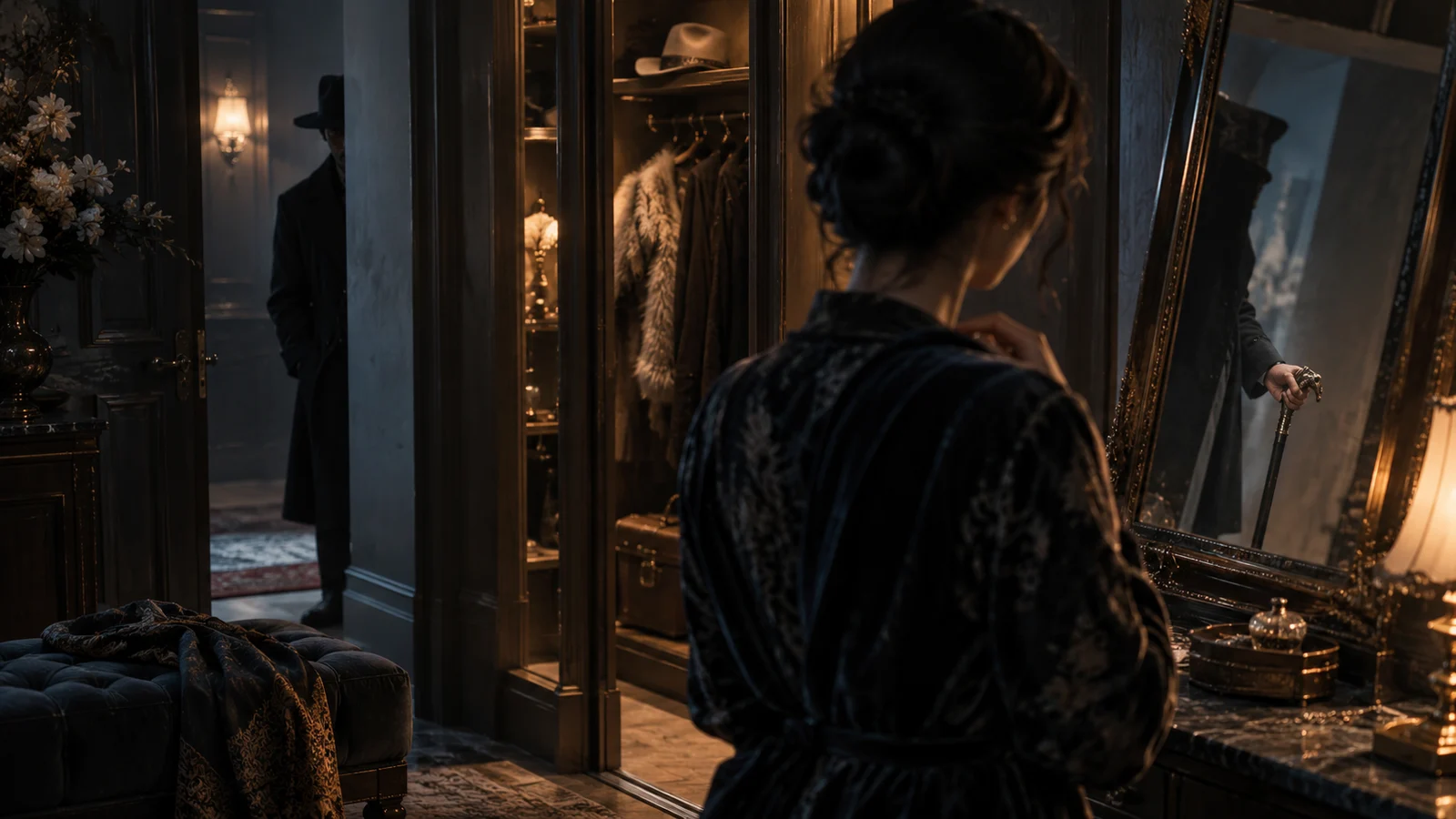
The protagonist is sorting letters in a dressing room. A visitor waits outside the door, their body concealed by a wall. The player's next choice is “Open the door immediately” or “Ask through the door first.” The original intention is for the player to know that someone is outside without having confirmed who it is.
An earlier shared opening sequence has established that Gu Heng uses a cane with a silver bird handle bearing a notch, and that the protagonist recognizes this mark. In this scene, however, an angled wardrobe mirror reflects a hand holding a cane. Both the silver bird and its notch are clearly recognizable. The protagonist has not yet turned around, and the subsequent dialogue still reads, “I have absolutely no idea who's outside.”
At least two points need review: the player may already have recognized the cane, while the dialogue continues to assume that the player has no evidence of identity. Do not immediately reduce this to a “mirror continuity error.” Write the intended boundary on the sheet: “Before the choice, the player may know that someone has arrived, but should not see a distinctive possession pointing to Gu Heng.” This makes it possible to judge whether the reflection crosses that boundary.
Also distinguish ownership of an object from the identity of its holder. Recognizing Gu Heng's cane directly supports “Gu Heng's cane is by the door.” It does not automatically prove that Gu Heng is holding it. If the story allows the cane to be borrowed or passed to someone else, the holder's identity remains uncertain. Even so, this strong association has changed the basis for the choice; it cannot be treated as if nothing has been revealed.
Put the Main Frame and Reflection on the Same Review Sheet
First establish the spatial relationship with a written shot-layout sketch, then check it against the storyboard. The two columns below describe two areas of the same frame, not two consecutive shots:
| Main-frame area | Mirror area |
|---|---|
| Foreground: the protagonist sorts letters with their back to the doorway | In the mirror: a hand extending beside the door |
| Midground: the side of the wardrobe and the angled mirror | In the hand: the silver bird cane handle, with its notch facing the mirror |
| Background: a wall conceals the visitor's body | Outside the reflection: the visitor's face and torso |
| Choice: open the door / ask through the door | The cane handle is already in frame before the choice appears |
This sketch represents only the proposed composition. It does not establish that the reflection would work on set. At the storyboard stage, also draw the relative positions of the mirror, cane, concealing wall, and viewpoint to confirm that the object could actually appear in the reflection. Do not invent an impossible reflection simply to hide a face.
Next, add a record beneath the sketch on the same sheet. Describe the specific recognizable features; do not write only “cane.” Disclosure status is an editorial decision: an intentional clue, supported misdirection, a leak to remove, or something still awaiting confirmation.
| Version and reflected object | Recognizable details and prior evidence | Disclosure status | Revision |
|---|---|---|---|
| Original: hand and cane handle | Notch in the silver bird; ownership established in the shared opening | Leak: exceeds this scene's intended disclosure | Remove the distinctive mark or change the judgment the choice asks for |
| Retained-clue version: the same handle | Can be associated with Gu Heng, but he has not been seen | Intentional clue | Allow subsequent questions to the visitor to draw on it |
| Revised-angle version: hand and cane shaft | Only an ordinary shaft is visible; the notch cannot be matched | General environmental information | Adjust the mirror angle and review the full movement sequence |
When reusing the sheet in practice, add the shot number, version, point of first visibility, choice node, and review status. Keep the original and revised versions on separate rows so the record does not collapse into an untraceable “resolved.”
Check Visibility, Recognizability, and Association in Order
On the first pass, answer only “What appears in the mirror?” without reading the reveal. On the second, check whether its features are distinguishable. Seeing a dark vertical line and recognizing a notched silver bird are different degrees of disclosure. Only on the third pass should you check whether the association has been established earlier on the current route.
In this example, the shared opening has already established who owns the cane, so the original version provides enough prior context for an association. If another entry point bypasses that opening, give it a separate row: players on that route can recognize an unusual cane handle but cannot yet use it to name the visitor. What the reviewer knows about the story must not be counted as evidence available to the player.
Finally, align the first recognizable appearance with the choice. A detail that is unclear at the start of a shot may become clear as the camera moves closer. A brief lift of the hand may also turn the notch toward the mirror. The review should cover the entire sequence before the choice, including movement into and out of frame, rather than approving a single attractive still.
If the footage has not yet been shot, record “Intended to be recognizable in the storyboard; check against the finished footage.” A clearly drawn storyboard does not prove that the detail will be recognizable in the finished scene, nor does it justify claiming that players will certainly notice it.
Three Revisions Create Three Different Judgment Tasks
To preserve the original uncertainty about identity, use the revised-angle version. Keep the hand and an ordinary section of the cane visible in the mirror, but ensure that the distinctive handle stays outside the reflected area throughout. The choice remains about whether to engage immediately with an unidentified visitor. The cost is losing an observable detail, and potentially having to restage the hand movement and mirror composition.
To reward observation, use the retained-clue version and change the question to “Why is this cane here?” The player can still choose to open the door or ask a question. After they ask, however, the dialogue can mention the silver bird handle, let the visitor explain where it came from, and then proceed to checking identity. What is retained here is an association with an object; the option should not simply become “Open the door for Gu Heng.” If the protagonist is to mention the reflected detail aloud, first establish how they obtain that information. The player's seeing something does not automatically mean the character has seen it.
To use the cane as misdirection, write a separate chain of evidence. For example, if an earlier scene has established that Gu Heng handed the cane to a messenger, the reflection permits two interpretations: Gu Heng has arrived, or the messenger still has the cane. Opening the door and seeing the holder can later distinguish between them. The cost is maintaining the prior information needed for both interpretations. If the reveal suddenly announces, “Actually, he lent it to someone,” a “misdirection” label on the review sheet cannot supply the missing evidence.
Close the Issue with a Review at the Choice
After revision, stop at the choice and complete three sentences: “What is directly visible in the mirror is…” “Together with earlier information on this route, this suggests…” “What still cannot be confirmed is…” For the retained-clue version, the answers should be: the notched silver bird handle is visible; it can be associated with Gu Heng's cane; the object alone cannot confirm who is holding it. If the subsequent sequence still requires the player to guess the visitor's identity with no supporting evidence, the issue remains unresolved.
Common failures include darkening a still but overlooking a raised-hand movement, removing the handle only to reveal an equally identifying cuff, and changing the shot while retaining the old dialogue. After every revision, review all identity-related information before the same choice to confirm that the leak has not simply moved elsewhere.
This sheet is useful for reviewing indirect disclosures caused by mirrors at the storyboard stage, and can also be used for similar compositions involving reflections in glass. It cannot replace a recognizability check of the finished footage, and it cannot prove that every player will notice the background. At handoff, leave checks pending until filming, routes not yet covered, and later references to the detail on the sheet so the next review can follow the same chain of evidence.