Directing Background Actors in an Interactive Film Game: Don’t Let an Early Reaction Give the Secret Away
When a background character can turn to look depends on when the information actually reaches them. A beat-by-beat background reaction chart connects position, audibility, cues, and permitted actions—and changes with each interactive route.
Introduction
Plan each background character’s reactions around the specific cues they receive. A director cannot simply say, “Everyone looks surprised when the change of route is announced.” Specify who hears what, which line allows them to turn, and who should keep working. During rehearsal, a background reaction chart maps these conditions beat by beat, so you can check whether a pause, a backward glance, or an exit implies knowledge the character does not yet have.
The station concourse below is a fictional teaching example. Its characters, dialogue, and routes were created to explain the method. It is not a real user case, an empirical finding, a hands-on test, or a DramaFork product feature.
Establish the information boundaries before deciding who can move
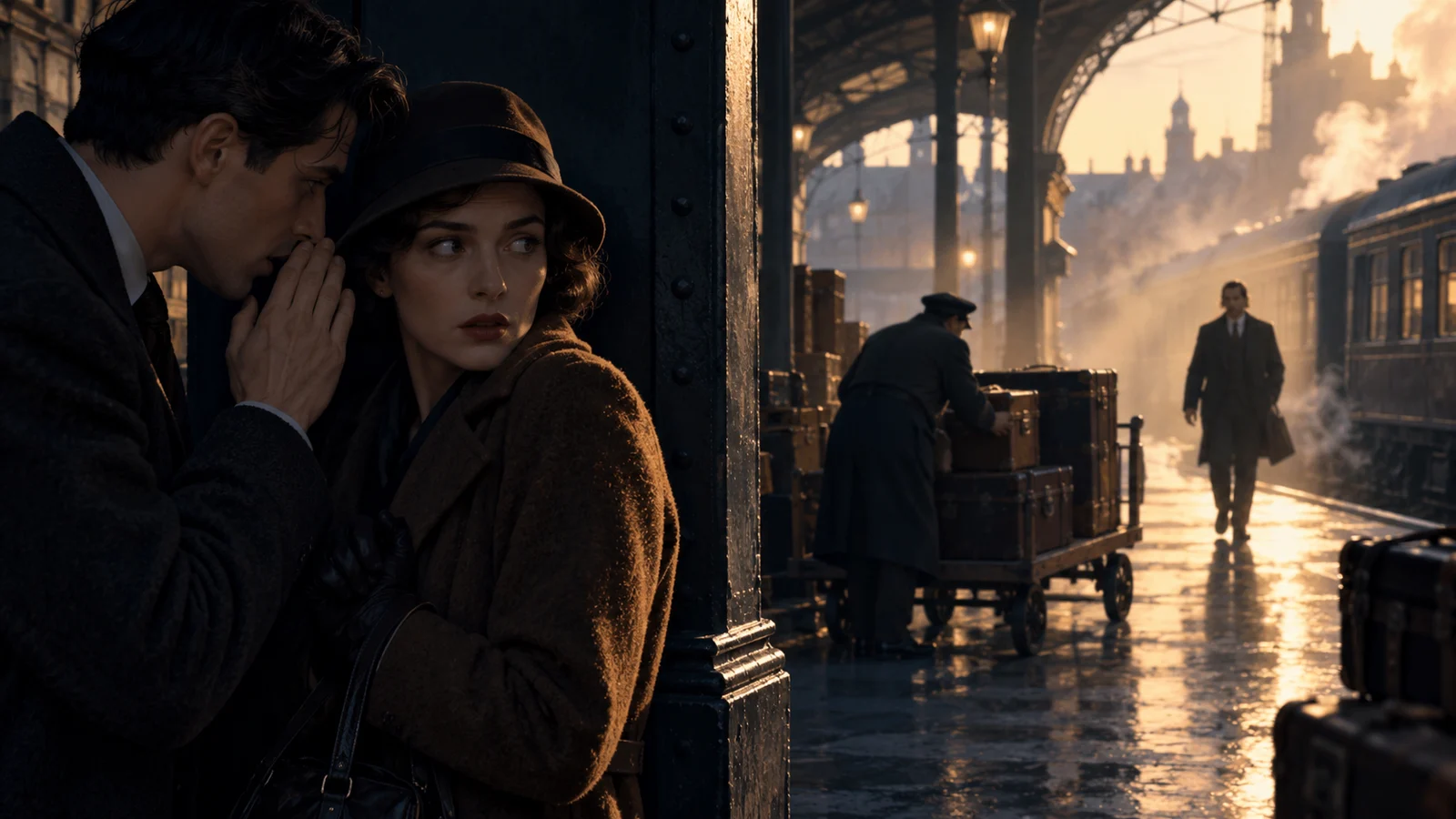
In the foreground of the concourse, the group leader quietly tells the nearby passengers, “The plan has changed. We’re going through the east gate instead.” Zhou, a companion, stands beside the passengers. Chen, a porter, is sorting suitcases by a distant luggage pile. For this example, Chen cannot make out the conversation; he can only see people moving. The information reaches him only when Zhou walks over and relays it.
This is a condition of the scene, not a general rule about distance and volume. In an actual rehearsal, use the blocking, delivery, and ambient sound to establish exactly which words each character can make out. An actor hearing a line on set does not mean their character hears it in the story. If the picture and sound clearly present the announcement as a broadcast throughout the concourse, yet Chen is required to remain completely unaware, the staging needs to change.
Separate the information into two layers: “Something has changed” and “We’re going through the east gate instead.” On hearing the first, passengers may stop checking their tickets and look up for confirmation. Only after receiving the second do they have a reason to orient their luggage toward the east gate. Do not use a blanket “They know now” to permit every subsequent action.
Write the reaction’s starting point as a cue an actor can pick up
“React after the leader finishes speaking” is still too broad. The leader might finish one sentence, pause, and then add the destination. The chart should quote specific words or identify a visible action. That gives actors a clear starting point and lets the director pinpoint where a reaction came too soon.
This example breaks Chen’s reaction into three steps. As Zhou approaches, Chen may notice someone coming but continues moving suitcases. When Zhou calls “Chen,” he may look up in response while continuing the task with his hands. Only after hearing “We’re going through the east gate instead. Stop moving these for now” does he steady the suitcase and stop moving the luggage. He can put the suitcase back where it was only after hearing, “Leave this batch here for now.”
These cues establish the earliest permissible starting point. They do not require everyone to move simultaneously on the final word. A passenger may look at the leader before putting away a ticket; Chen may first steady the suitcase he is holding. Any delay should come from the task in progress, not from arbitrarily stretching a pause to make the performance look natural.
If Zhou merely waves without communicating the change of route, Chen may notice him, but he cannot immediately turn the luggage toward the east gate. Noticing a person and understanding a situation need separate entries in the chart.
Build the scene with a beat-by-beat background reaction chart
The following sample can be adapted directly. A “beat” means a change in an information or action condition, not a fixed number of seconds. Each row starts with a trigger condition, then defines the range of permitted actions. Without a cue, the character continues the original task.
| Beat and character | Position | What they can hear clearly | Cue | Permitted actions and limits |
|---|---|---|---|---|
| One: nearby passengers | Beside the leader | The quiet conversation | After “The plan has changed” | Stop checking tickets and look at the leader; do not walk toward the east gate |
| Two: nearby passengers | Same position | The destination | After “We’re going through the east gate instead” | Put tickets away and reorient luggage; wait to be led |
| Two: Chen | Distant luggage pile | Cannot make out the foreground dialogue | No relevant cue yet | Keep sorting suitcases; do not stop because of the announcement |
| Three: Chen | Beside the luggage pile | Zhou’s call, once Zhou approaches | Zhou calls “Chen” | Look up in response; do not suggest knowledge of the route change |
| Four: Chen | Beside Zhou | The relayed message | After “We’re going through the east gate instead. Stop moving these for now” | Steady the suitcase, stop moving the luggage, and look at Zhou |
| Five: Chen | Same place | The additional instruction | After “Leave this batch here for now” | Put the suitcase back; do not independently move it toward the east gate |
When briefing actors, explain what they should be doing while they wait. Chen needs to check the orientation of the suitcases and straighten their handles. He must not freeze early just to “wait for the cue.” A background character suddenly stopping an everyday task can read as awareness of a change, even without a surprised expression.
If the relayed line is too long for an actor to pick up the starting point, adjust the dialogue to make the instruction to stop moving the luggage explicit. The trade-off is more direct exposition. If you want to retain a subtler delivery, add a question or an act of confirmation; do not treat an ambiguous cue as a complete message.
When the route changes, rewrite the actions that follow the information
Suppose that, on another route, the player has the leader walk directly to the luggage pile and inform Chen, while Zhou stays in the foreground. You cannot simply reuse the original chart and make Chen wait for Zhou to approach before stopping. Change the source in beat four to the leader, replace the cue with the actual instruction to stop moving the luggage in this version, and remove the action in which Chen waits for Zhou and then looks up.
Now suppose a route tells Chen only, “Stop for a moment,” without telling him about the switch to the east gate. He may stop moving the luggage, but he cannot look toward the east gate or indicate the new direction to passengers arriving later. Both routes ending with “stops moving the luggage” does not mean the character has the same information.
Alongside the reaction chart for each route, therefore, add a final state statement: “Chen knows about the route change and the destination” or “Chen knows only that he should pause.” Before the routes merge into a shared ensemble scene, check which state the shared shots require. If Chen is to give directions unprompted later, supply the missing information first or stage his actions separately for each route.
Prioritize rows where the source, content, or arrival order of information changes. Then check the people affected by those actions. If passengers turn because Chen turns, for example, a change to Chen’s cue also requires their reactions to be restaged.
Use counterexamples in rehearsal to catch premature reactions
Run through the chart once, checking only whether each action has an identifiable source. A typical counterexample: the leader has just said “The plan has changed” when Chen, far away, immediately stops handling a suitcase and turns around. Even if the actor explains that he was “just glancing over,” an action placed so close to the key line may still lead viewers to infer that he heard the news. To correct it, have him continue his original task and look up only after he is called.
Run it again, deliberately delaying Zhou’s departure. Chen’s stop should also move later with the relayed message. If he still stops at the original moment, the actor has memorized the timing rather than picked up the cue. Repeat with different pauses in the dialogue to keep checking whether he is relying on a fixed duration.
Finally, review each route’s ensemble scene as a continuous sequence, including the cuts before and after the message is relayed. Notes only need to specify “which route, which action, what cue is missing, and how to revise it.” Do not write only “the reaction feels unnatural.” This method suits ensemble scenes that need a clear order in which characters become informed. If a character already knows the news, or the story deliberately hints that he has been eavesdropping, document that information source separately. A turn prompted purely by footsteps can stay, but it must not develop into behavior that suggests understanding of the route change.