Reordering Investigation Montages in Interactive Film Games: Don’t Invent Causality Through Shot Order
Separate what each investigation shot requires the character to know from what its action establishes, then decide which shots can change places. A completed montage order constraint table distinguishes dependencies across the sequence from prohibited direct cuts, keeping characters from making judgments before their evidence appears.
Introduction
To decide whether an investigation montage can be reordered, first ask what the character needs to know before each shot, then what new understanding the shot gives them. Investigation shots that do not rely on each other’s results can change places; a shot that draws a conclusion must wait until all its supporting evidence has appeared. At handoff, do more than write “variable order”: provide an order constraint table and list every permitted complete sequence.
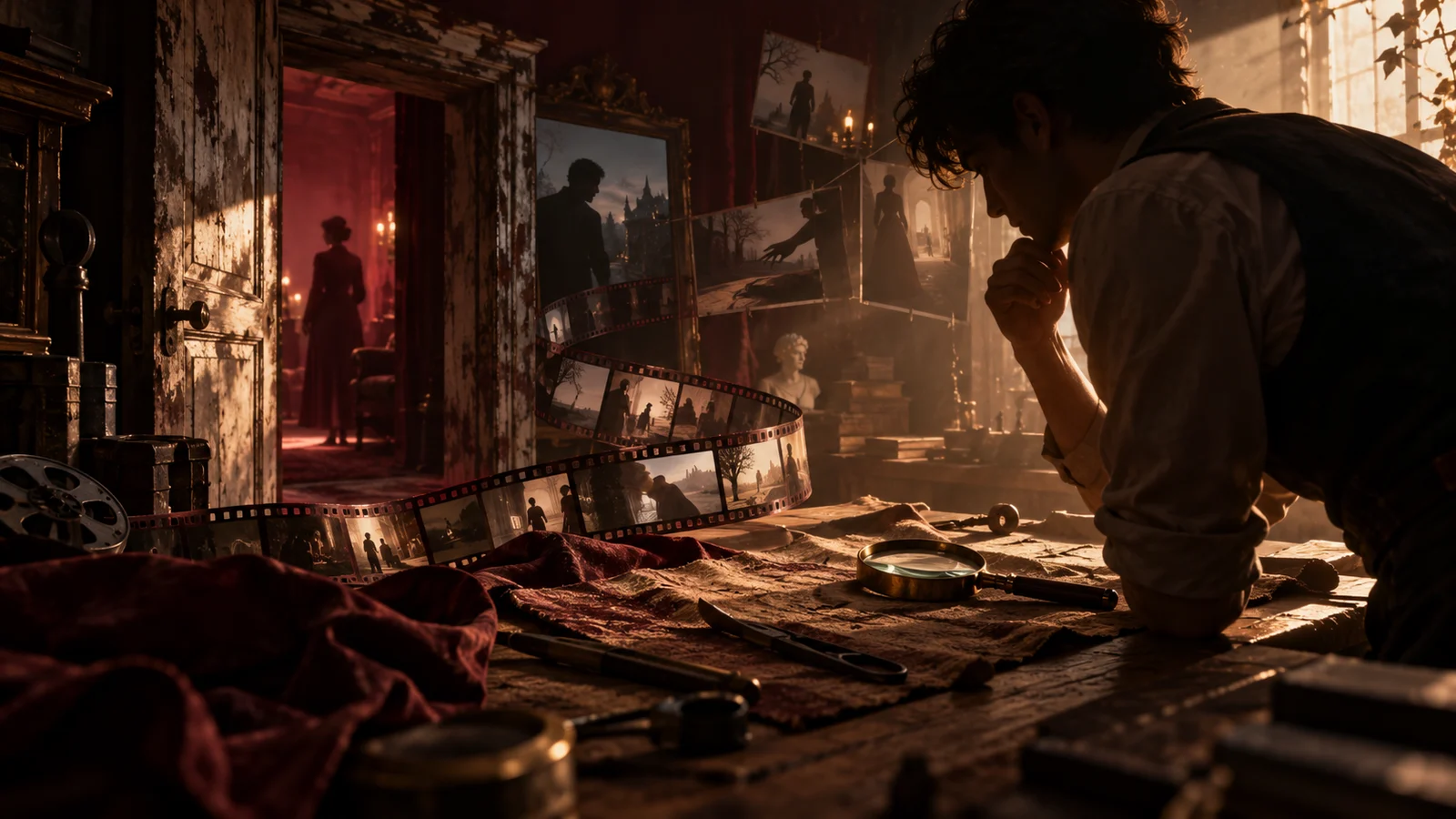
The example below follows an investigation in an old workshop: inspecting wear marks, comparing old tools, and marking a suspected entry point. This is an original fictional teaching example, not a real user case, measured result, hands-on test, or DramaFork product feature. The judgments in these shots belong to the fictional setup; they are not a method for identifying physical traces in the real world.
1. Separate Observation from Judgment Within Each Shot
The character is looking for a place where someone might have entered the workshop. Before this sequence begins, they know only that the doorframe and the old tools are worth examining. They have not identified an entry point. There are no memories or flashbacks here: the images follow the character’s investigation as it happens.
Shot A: The character bends down to inspect the doorframe, running a finger along two wear marks before pausing. The image establishes the marks’ location and shape. No tool appears, and there is no dialogue claiming that someone pried at the door. Record only this result: “Doorframe wear observed.”
Shot B: The character spreads out a tool cloth and compares two old tools side by side, noticing that one has a narrow, flat end. The comparison is between the tools themselves, not between a tool and the wear shown in Shot A. Record the result as “Differences between tool ends observed.” Do not quietly upgrade it to “Tool matches marks.”
Shot C: The character circles the door on a sketch of the workshop and says quietly, “Let’s flag this as a possible entry point for now.” The writing rule for this example is that the character combines the wear location with the tool observation to prioritize this spot for further investigation. Both observations must be complete, but the method of entry remains unconfirmed.
This distinction determines whether A and B can change places. If B instead shows a tool being held close to the doorframe for comparison, it may already include the process of discovering what A reveals. The shots would need to be broken down again; the original permission to reorder them would no longer apply.
2. Put the Constraints in a Table You Can Check Cell by Cell
“Information prerequisites” lists what must already be established before a shot begins. “Action outcome” records what the shot actually adds by its end. Any permission to swap shots must include its conditions. Prohibited direct cuts must specify a direction, not merely name two shots.
| Shot | Information prerequisites | Action outcome | Permitted swaps | Prohibited direct cuts |
|---|---|---|---|---|
| A: Inspect wear | No entry point has been marked; the doorframe is available for inspection | The character has seen the wear’s location and shape | May swap with B, provided there is no dialogue referring to the tools or eyeline connection to them | C→A prohibited: this sequence does not place the first observation directly after the judgment |
| B: Compare old tools | No entry point has been marked; the tools have been laid out | The character has seen differences between the tool ends | May swap with A, provided the comparison stays between the tools | C→B prohibited: this sequence does not place the first tool observation directly after the judgment |
| C: Mark a suspected entry point | The observations in both A and B are complete | A point of interest is added to the sketch, and the character decides to investigate further | May not swap with A or B | No additional restriction; apply those in the first two rows |
Add a sequence-wide rule below the table: A must precede C, B must precede C, and A and B have no fixed order relative to each other. “Both complete” means that both prerequisites must be satisfied, not that either one will do.
Prohibiting direct cuts cannot replace the sequence-wide rule. Even if an unoccupied workshop shot is inserted between C and A, the character still makes the judgment too early. A cutaway changes the transition; it cannot supply evidence the character has not yet acquired.
When copying this table, retain all five columns: shot ID, information prerequisites, action outcome, permitted swaps, and prohibited direct cuts. List dependencies across shots separately below it. If no local restriction on a direct cut is needed, write “None.” Do not invent constraints just to fill the table.
3. Walk Through Each Valid and Invalid Sequence
This example has only three investigation actions. The permitted complete sequences are “A→B→C” and “B→A→C.” The first highlights the unusual doorframe wear before showing tools worth considering. The second establishes the differences between the tools before directing attention to the doorframe. Their emphasis differs, but the evidence available before C is the same.
For the first sequence, check only “Wear observed” after A. After B, also check “Tool differences observed.” At C, both boxes are checked, so the character can mark the point of interest. In the second sequence, the boxes are checked in reverse order, but C’s prerequisites are still satisfied.
“A→C→B” is invalid: when C plays, the tool observation has not happened yet. Even if the audience has guessed what the tool was used for, their guess cannot be recorded as the character’s investigative finding. “B→C→A” likewise lacks the doorframe observation.
The other two permutations begin with C, so both prerequisites are missing. Of the six permutations of these three shots, only the two listed above satisfy this example’s rules. This is a logical deduction from an original shot script, not data about the viewing experience.
If a route allows B to be skipped, it cannot lead straight into the original C. You can restore B or write a different judgment shot that relies only on the wear and expresses a weaker suspicion. The latter changes the strength of the reasoning and needs its own prerequisites; changing the shot ID alone is not enough.
4. Independent Content Still Needs Its Transitions Checked
Once the table checks out, watch and listen to each candidate sequence as a whole. Focus on whether a transition quietly adds a meaning absent from the script—for example, turning “wear is discovered” into “this tool caused the wear.”
Suppose B has an alternate final shot: the character raises a tool and presses it down out of frame. If this cuts directly to A’s close-up of the doorframe, the movement and sound may make the next shot read as the tool touching the frame. Give this version its own ID, “B-alt,” and record “B-alt→A prohibited,” because the cut implies an interaction that has not been shown.
This differs from C’s missing prerequisites. The knowledge established by A and B can remain independent, while one particular transition is unsuitable. You could restore the ending with the tools resting in place or recut the end of the movement. Permission to swap the base version of B does not authorize every take.
Listen to dialogue that crosses the cut, too. If C’s “Let’s flag this as a possible entry point for now” begins before the second observation even starts, the audio may deliver the judgment too early. Move the judgment until after both observations are complete, then check the entire sequence again.
5. Hand Off the Prerequisites Along with the Freedom to Reorder
The final handoff includes the completed constraint table, the two permitted sequences, and notes on prohibited direct cuts involving alternate footage. Whenever a shot version changes, ask again: Have the prerequisites changed? Has the outcome changed? What new implication does the transition introduce? Do more than confirm that all three clips are on the timeline.
This method applies to sequences with a variable investigation order in which the character’s knowledge accumulates step by step. Explicit flashbacks, foreshadowing, or unreliable narration require separate clarification of the time depicted in the images and the time when the character acquires the information. This example’s order table cannot be applied directly to those cases.
Nor does the method guarantee that audiences will understand the intended causality. The constraint table can rule out orders that lack supporting evidence on the page, and watching the sequence through can help reveal questionable transitions. Actual comprehension still needs to be checked separately. Keeping these two sequences limits editing freedom; in return, every judgment has a traceable basis.