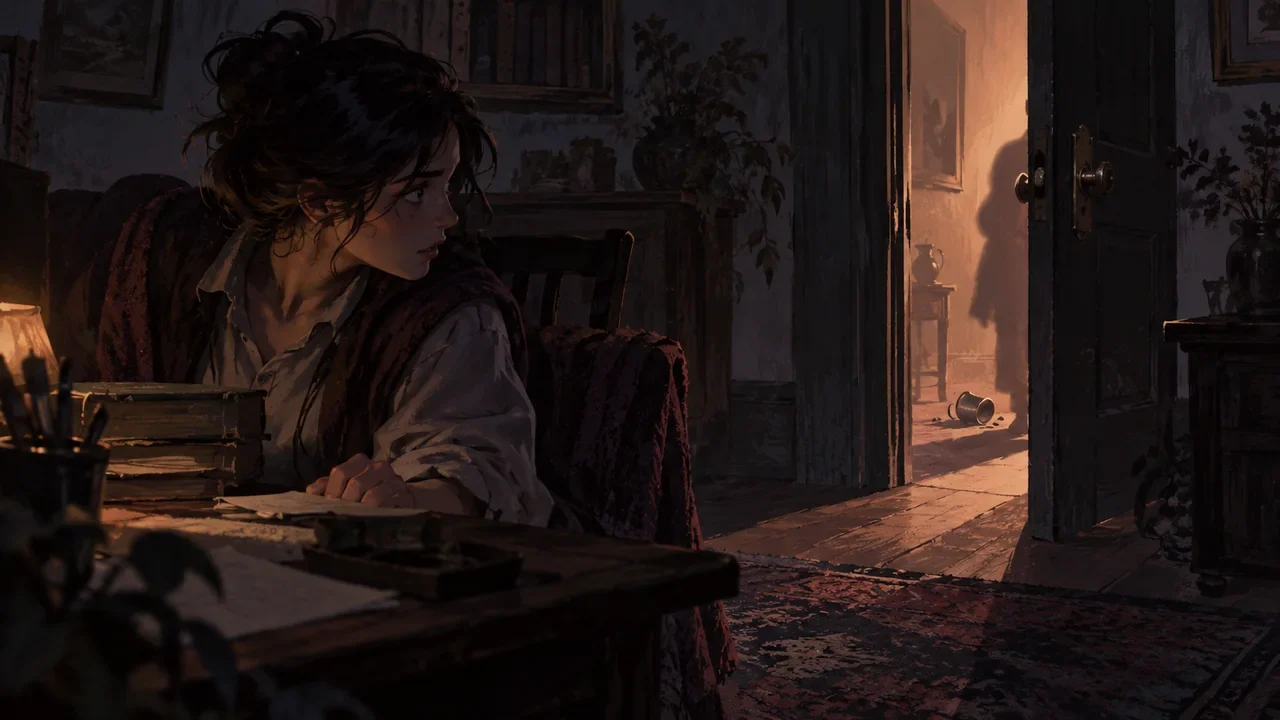
How to Film Whispers in an Interactive Film Game: Staging Who Can Hear What So It Can Be Checked
A close-up alone cannot make a whisper private. Use a whisper staging card to coordinate the intended listener, the server’s route, the screen, ambient sound, and the timing of a pause, giving both the secrecy and overhearing branches a basis in the scene.

Introduction
When staging a whisper scene in an interactive film game, first decide who can hear each line, then plan the blocking and shots. A close-up of someone’s lips can suggest intimacy, but it cannot establish that a nearby third person hears nothing. Record the intended listener, the bystander’s route, concealment conditions, and signs of possible overhearing on a whisper staging card. Later differences in what characters know will then have a basis you can check.
The banquet scene below is an original fictional teaching example. It is not an actual user case, a tested result, or a DramaFork product feature. Its positions and actions serve only to explore narrative plausibility; they provide no guarantee about real-world acoustic distances.
1. Break the Secret into Lines You Can Check
At a banquet, Lin Lan and Zhou Heng discuss retrieving a letter beside a folding screen. Lin Lan intends to say, “Go to the west corridor after the banquet. The letter is under the blue vase.” A server carrying glasses passes on the other side of the screen. The question is not simply whether “the server knows the secret,” but whether he makes out the location, the hiding place, and the time of the planned action.
In this example, the first sentence ends before the server approaches. The second falls around the moment when he might stop. In the secrecy version, he keeps walking toward the dining table and picks up no intelligible part of the secret. In the overhearing version, he stops at the screen’s edge and makes out “under the blue vase,” but knows nothing of the west corridor or the arrangement to go after the banquet.
This breakdown constrains the later writing. In the overhearing version, the server may ask about the blue vase; he cannot go straight to the west corridor and retrieve the letter from its exact hiding place. If the plot requires him to learn the whole plan, move his stop earlier and retime both sentences. Changing only his later dialogue is not enough.
2. Map the Route; Do Not Treat the Screen as Soundproofing
Start with a plan-view sketch. The banquet tables are to the north, with the screen across the center. Lin Lan and Zhou Heng stand at an inside corner on its south side, while the server walks east along the passage on its north side. There is a turn at the screen’s east end where the server’s route brings him closer to the speakers. The two face each other, with Lin Lan standing at an angle with her back toward the passage.
The sketch establishes three separate things: whose view the screen blocks, where the server passes, and during which action the secret is spoken. The screen can explain why Lin Lan fails to notice the server. It cannot, by itself, explain why sound would not reach him. Turning away from the passage is also just one staging choice; it cannot establish secrecy on its own.
Write ambient sounds as events with beginnings and endings. Conversation continues at the banquet tables; someone moves a dining chair as the server approaches; then the sound settles back to normal. Do not simply write “the room is noisy.” If the crucial line falls in a quiet moment, a vague description of background noise will not support the design.
Attention also needs visible action. In the secrecy version, the server looks toward the dining table, responds to a guest’s gesture, and keeps walking. In the overhearing version, he stops first, then turns his head toward the screen. Looking down at the glasses does not mean he loses his hearing. The secrecy version must therefore also coordinate the crucial line with his continued movement away.
3. Complete a Whisper Staging Card
Place the card beside the storyboard so the director, writer, and editor can check the same set of conditions. Here is the completed card for this example. For another scene, keep the fields and rewrite their contents.
| Field | Entry for This Example |
|---|---|
| Secret | Go to the west corridor after the banquet; the letter is under the blue vase |
| Intended listener | Zhou Heng, facing Lin Lan, hears the entire exchange |
| Bystander’s position | The server passes along the screen’s north side toward its east end |
| Visual obstruction | The screen blocks the speakers’ and server’s views of one another; the turn at the east end exposes the position where he comes closer |
| Ambient activity | Banquet conversation continues, with a chair moving as he approaches; this does not guarantee sound isolation |
| Conditions for secrecy | The first sentence ends before the server approaches; the last is spoken only after he has passed the turn and is continuing away |
| Overhearing event | Wine sloshes to the rim of a glass; the server stops at the east end to steady it, then turns his head to listen |
| Information overheard | His stop overlaps the last sentence; he makes out only “under the blue vase” |
| Evidence for the audience | The same shot establishes where he stops; the last sentence overlaps the duration of his stop |
| Limits on later knowledge | He may mention the blue vase, but cannot know about the west corridor or the timing without further grounds |
The card’s “conditions for secrecy” are not a formula that makes the words impossible to hear on set. They require the work to provide staging sufficient to support that branch. If the finished scene still leaves the server lingering right beside the speakers, or has the last line spoken particularly loudly, revise the blocking or soften later claims that the secret remained private.
4. Make the Stop a Concrete Event in the Branch
Both versions begin with the same medium shot, showing the two people inside the screen, the turn at its east end, and the direction of the server’s movement. After the first sentence, the player chooses for Lin Lan: “Wait for him to pass” or “Keep talking.” The choices specify when she speaks; they do not announce “Secret kept” or “Secret leaked” on the player’s behalf.
If the player waits, Lin Lan breaks off. The shot retains the server’s passage around the turn and his response as he heads toward the dining table. Only once he continues away does Lin Lan lean closer to Zhou Heng and deliver the last sentence. Waiting costs a brief interruption to the conversation. Zhou Heng may urge her on with a puzzled look, but he cannot finish the secret for her ahead of time.
If the player continues, Lin Lan immediately delivers the last sentence. At that moment, the wine sloshes, and the server stops at the turn to steady the glass. He then turns his head, remaining there while she says “under the blue vase.” Steadying the glass explains why he stops; turning his head shows his attention shifting. These actions support the overhearing version only when they occur during the crucial line.
The stop alone establishes only an opportunity to hear. If a later scene needs to confirm that he made out the words, the server might probe, “That blue vase you mentioned—which one did you mean?” This fictional line confirms only the fragment already recorded on the card; it does not fill in the rest of the plan for him.
In editing, do not show the entire whisper and then insert a close-up of the stop whose timing is impossible to determine. Retain at least one shot that establishes the overlap in space and time. When the audience needs to understand the whisper, the sound can be presented from a listening perspective close to the speakers. That does not mean every character present hears it with the same clarity.
5. Test the Card Against Two Follow-Up Scenes
Follow the secrecy version with a scene in which the server collects glasses as usual. Follow the overhearing version with his question about the blue vase. For each piece of information a character now voices, ask: can it be traced to a specific sentence, a stop, and a position? If the only answer is “because the plot needs it,” return to the card and revise it.
Then check three common gaps: the server has left, but the next shot places him nearby again without explanation; ambient sound suddenly disappears before the crucial line, yet the claim of secrecy stays unchanged; or the overhearing version gives him only the vase, but later he knows where to retrieve the letter. The first two need clearer spatial or timing information. The third requires removing knowledge he has no basis for, or adding a new event through which he acquires it.
To preserve suspense, you can show only the stop and record the outcome on the card as “Whether he made out the words remains to be revealed.” Do not simultaneously use him as a confirmed holder of the secret to drive a crucial action. This delays the reveal and requires later evidence to confirm what he heard.
This card is suited to storyboard and blocking discussions for secret conversations within a single scene. It does not address permission to pass information on, nor does it replace the planning of background reactions after someone learns something. Actual filming still requires judgment based on conditions on set. If there is insufficient support for “he definitely cannot hear,” make the secrecy the characters’ own assumption, or move the crucial line until after the third person has clearly left.