
• Home
  • Blog
  • Gallery
  • Pricing
  • Home
  • Blog
  • Gallery
  • Pricing
Start creating

Creator blog

Better stories start here

Discover practical AI tools, interactive storytelling methods, and production lessons—from the first idea to a story people can play.

DRAMAFORKStories · Craft · Possibility
Topics
AllProduction PracticeProduct workflowInteractive narrativeCreation tutorialsChoosing toolsGetting started
201 articles

Editorial / 02

Latest articles

Practical methods for narrative structure, visual production, and everything in between.

A postal novice checks envelope information first while an experienced clerk prompts the next step nearby.Featured
Production practice2026.10.01

How to Teach Players Controls in Interactive Stories: Let the First Attempt Also Complete a Story Task

The easiest way to teach players controls is to write the tutorial action directly as the story task itself. The player's first attempt made to advance the story is the operation you want to teach; feedback comes simultaneously from the interface and the story, and there is no need to open an extra "tutorial level."


DramaFork Editorial Team13 min read
Continue reading

Blog categories

  • All201
  • Production Practice59
  • Product workflow34
  • Interactive narrative49
  • Creation tutorials19
  • Choosing tools33
  • Getting started7

Make your story playable for the first time

Start with one story decision

Create a project

The next move is yours

Make your story playable for the first time

Do not wait for every video to be finished before testing the story. Build the characters, rules, and branches first, then let real choices guide what you make next.

Start with one story decision

Try a playable example

Let agents handle production complexity while you keep creative control.

Start with one story idea, then shape scripts, characters, shots, and branches into a playable first version.

Product

  • Pricing
  • Capabilities
  • Workflow
  • Examples
  • FAQ

Explore

  • Playable gallery
  • Creator blog
  • Creator partnership

Legal

  • Privacy
  • Terms
© 2026 DramaFork/AI interactive story studio
Press Enter to send, or drag away and release.
Three action cards arranged in a unified order showing action, object, and ferry cost.
Production practice2026.09.30

When Options Are Long and Players Forget the Previous One After Reading: First Unify the Comparison Order

Arrange the three options in the same order: first write the action, then the object, then the known cost, and finally the uncertain result. Place the same type of information in the same position for each option, so readers have a fixed basis for comparison. Move background exposition outside the options, and keep risks within the corresponding action. Below, a fictional teaching example, "Three Options at the Ferry," goes through three rewrites, and a manual check method for reader retelling is provided.

DramaFork Editorial Team16 min read
Continue reading
A glossary desk places a passage token and invitation envelope into separate shaped compartments, with definition boundaries shown by physical fit instead of text.
Production practice2026.09.30

How to Write an Interactive Story Glossary: Which Words Can Change, and Which Meanings Cannot?

What a glossary needs to solve is not "how should this word be translated," but "where does this word appear, to what degree may it be changed, and will changing it break the plot logic." The method can be divided into four steps: first assign each word a semantic slot, then write a definition, context, and counterexample for it, then mark the variable parts and the frozen parts, and finally list the undecided translated names separately for the reviewer to adjudicate one by one.

DramaFork Editorial Team14 min read
Continue reading
A change log linking revision reasons, a new bridge action, and affected assets.
Product workflow2026.09.30

How to Write a Change Log for Interactive Stories: Separate Reasons, Changes, and Affected Routes

A change log should have three columns: reason, change, and affected routes. The reason explains "why it changed," the change states "what changed," and the affected routes list "which assets and branches need review." A fictional teaching example runs throughout: an interactive film game originally had a "broken bridge" node in Chapter 2, where players had to find a rope to cross the river; the author later changed the broken bridge to a "delayed ferry," because the original design made a gentle route feel abrupt. All names, numbers, and dialogue below are fictional.

DramaFork Editorial Team12 min read
Continue reading
A pointing hand beside two speakers is clearly redirected toward one of them.
Production practice2026.09.29

Who Does “He” Refer to in Branching Subtitles: How Can You Remove Ambiguity Without Lengthening Dialogue?

Here is the conclusion first: replace the pronoun with a form of address, let an action carry the reference, or rearrange the sentence so that the same line of dialogue has only one interpretation when read at all three entry points, and the word count can often stay the same or even become shorter. Below, a fictional teaching example, “two adult couriers in the same scene,” is used to walk through the complete process. All characters, dialogue, and numerical values are invented for explanation, not actual test data.

DramaFork Editorial Team16 min read
Continue reading
Two creators turn vague feedback into a revision ticket pointing to a specific scene action.
Product workflow2026.09.29

Two Creators Take Turns Reviewing: How Do You Turn "This Is Wrong" Into an Actionable Revision Ticket?

Turning "this is wrong" into a revision ticket has only one core action: make every piece of feedback land on the seven fields of version, node, symptom, expectation, reason, responsibility, and review. When two people take turns reviewing, each first fills out a ticket independently, then merges conflicting items, and only then touches the draft. Below, a fictional teaching example is used to walk through the whole process; the people, dialogue, and values are not actual test data.

DramaFork Editorial Team14 min read
Continue reading
A local service on one computer faces another computer across the street, with a public connection bridge indicating the reachable address.
Product workflow2026.09.29

localhost Appears in a Remote Asset Package: Why It May Not Open on Another Computer

If a remote package's asset addresses point to localhost, then after switching computers they will request the recipient's own machine. The service on the creator's computer does not move along with the ZIP, so "it plays on my machine" is not enough to prove that others can play it too. The order of handling is: confirm the actual request address, verify the application domain, re-export, then validate on another device.

DramaFork Editorial Team13 min read
Continue reading
A delivery case prepared with acceptance materials according to device, network conditions, and target route.
Product workflow2026.09.28

Write the Delivery Goal Before Exporting: A One-Page Brief for the Recipient's Device, Network, and Verification Route

Before exporting, write a one-page delivery brief that clearly states the recipient device, network conditions, how to run it, the target route, and acceptance criteria, then decide whether to use a local asset package or a remote link package. The order cannot be reversed: first define how the recipient opens it and how they judge success, then choose the delivery format. Below, a fictional teaching example walks through the entire process, with the project named "Tide Post Office" and the recipients being two reviewers from the partner "Shoreline Studio."

DramaFork Editorial Team15 min read
Continue reading
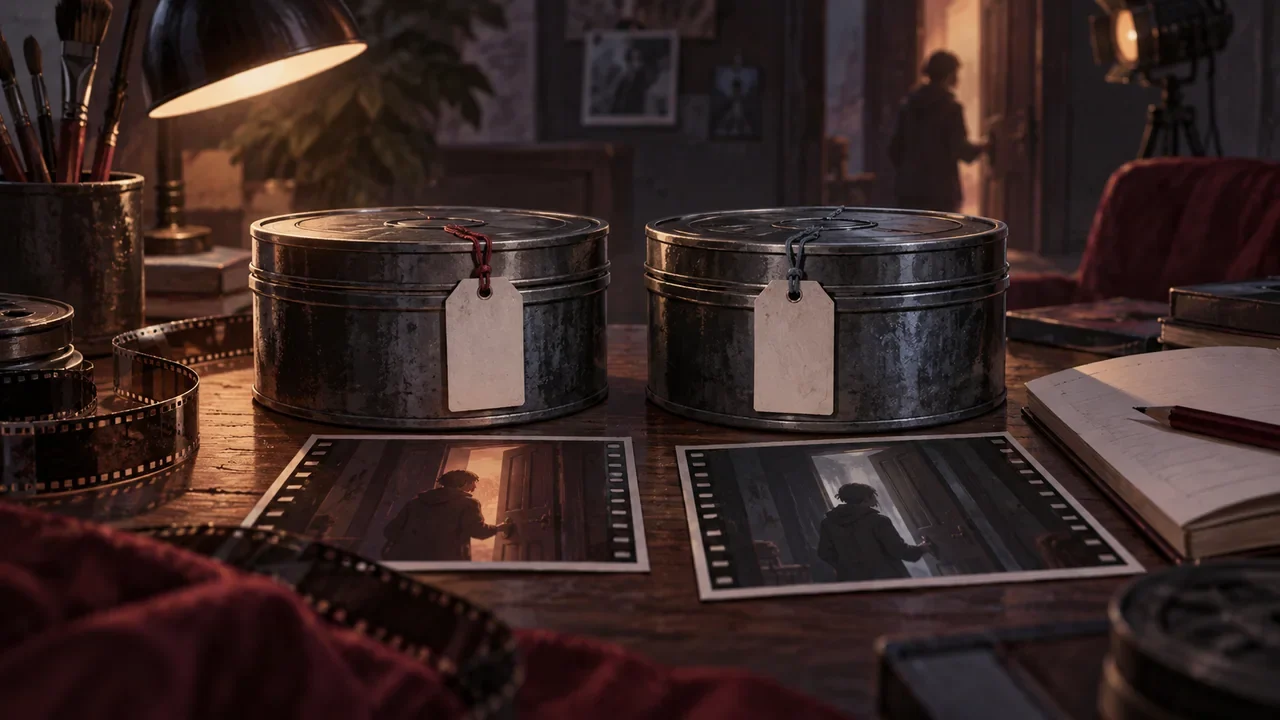
Two similar door-opening asset reels distinguished by object-state tags and scene thumbnails.
Product workflow2026.09.28

How to Avoid Attaching the Wrong Asset When Shot Names Are Similar: Make a Manual Mapping Table for Interactive Works

Conclusion first: write the four columns "node, shot, asset version, entry state" into the same table, with each row corresponding to only one playable asset file, and keep both the scene action and the consequence difference in the name. The table can be maintained manually in an ordinary document; DramaFork currently has no automatic asset audit function, and whether an asset is attached incorrectly must be checked by a person against the table. The following uses fictional teaching examples; the numbers and quoted words are not actual test data.

DramaFork Editorial Team12 min read
Continue reading
An old film reel remains intact beside a newly edited action sketch, with a reviewer judging whether it can still be reused.
Product workflow2026.09.28

DramaFork Shows "Needs Update" but the Old Assets Are Still There—How Should Creators Judge Whether They Can Still Be Used?

"Needs update" only means that this change touched a dependency of some completed step. It does not mean the old assets have already been replaced, nor does it mean they are necessarily wrong. What you need to do is manually verify: is what was changed the fact that the old assets are expressing? If the fact expressed by the old assets still holds, they can continue to be used; if the fact they express has already been changed, they need to be redone or at least changed to be consistent.

DramaFork Editorial Team14 min read
Continue reading
A production process passes three review lamps before planning, script, and high-cost assets.
Product workflow2026.09.27

When to Pause Auto-Advance: Set Three Human Review Questions for a DramaFork Project

Auto-advance is good for quickly laying out the parts you have already thought through; pause only where "the cost of rework will spill over into many downstream steps." For a two-person small team, it is recommended to set only three checkpoints: before the plan is finalized, before the script is converted to storyboards, and before high-cost video batch generation. Each checkpoint answers only one question; once answered, either release or return it, without requiring confirmation at every step.

DramaFork Editorial Team15 min read
Continue reading
  1. 1
  2. 2
  3. 3
  4. ...19