Must Reunion Stories End in Reconciliation? Designing a Successful, Dignified Farewell
Using an original band reunion scenario, set separate conditions for completing a performance, clarifying the past, and continuing to work together. Let players negotiate credits, permission to use materials, and withdrawal arrangements, making a dignified farewell a fully realized successful ending too.
A reunion need not mean restoring the past
“Former bandmates reunite years later” comes with built-in expectations: Why did they part ways, and can they still take the stage together? But if every option ultimately pushes the two toward reconciliation, players are effectively just mediating their dispute on the author's behalf. A more compelling approach is to first give them the right to leave the relationship unrestored, then ask what this collaboration can accomplish.
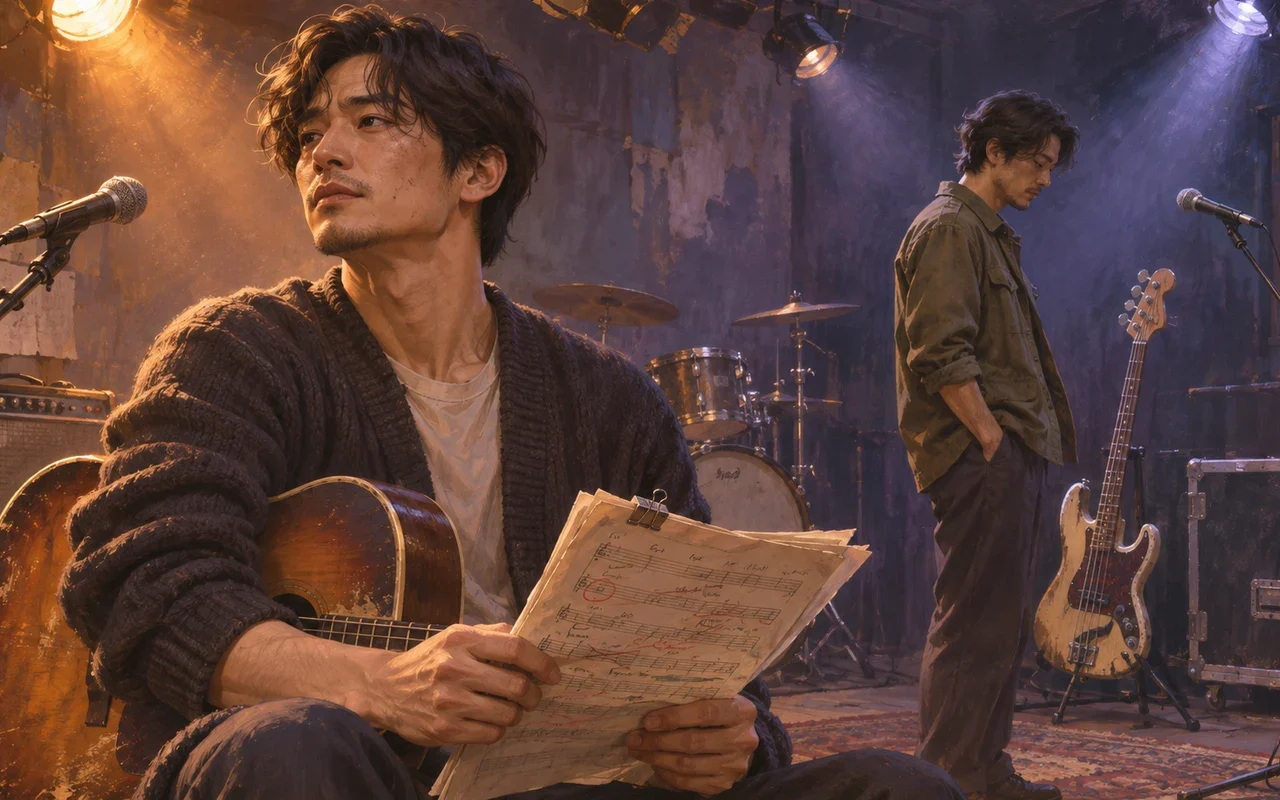
In the original scenario The Eve of Reunion, the band Switchback broke up eight years ago. Their old venue is about to close, and the organizer invites Lu Xian and Cheng Ye to perform a farewell song. The player acts as a temporary producer. Lu Xian has kept a revised draft of an old song; Cheng Ye holds an application to remove his name from the credits that he never sent at the time. They remember the process of assigning credits on the same record differently, but neither wants anyone else making decisions for him again.
This story does not draw on real artists' experiences, nor does it treat one person's silence or the other's agitation as evidence of who is telling the truth. Its central question is this: If they cannot restore what they once had, can they still complete a collaboration to which both consent?
Separate the three goals
| Goal | Observable result | Conclusion that does not automatically follow |
|---|---|---|
| Complete the performance | Both confirm the set list, credits, rehearsals, and withdrawal arrangements | Their personal relationship has not necessarily been repaired |
| Clarify the past | Original drafts, the application, and timeline records are checked against one another | All private materials do not necessarily have to be made public |
| Continue working together | Both explicitly agree to another collaboration | The band has not necessarily reunited |
If all these goals are folded into a single “relationship score,” a high-scoring ending can easily overstep the characters' boundaries. A smooth rehearsal may mean they have regained their ability to work together; someone's willingness to apologize may mean he acknowledges a particular mistake. Neither can commit the other person to “starting over.”
Let players convey information—and face the consequences of how they convey it
After their first private conversation, Lu Xian allows the player to tell Cheng Ye that he wants to review the credits again, but does not authorize the player to make his entire manuscript public. At this point, the story can offer three distinct actions: relay only what he has permitted, request broader permission, or use the manuscript as evidence without authorization.
The first approach takes longer but leaves room for collaboration. The second may be refused, but gives the player a chance to explain why the materials are needed. The third may bring the past into public view sooner while undermining the player's credibility as a producer. The consequences should specify who withdraws which permission and which rehearsal is canceled as a result, rather than merely displaying “Cheng Ye's affection decreases.”
The story need not grind to a halt when someone refuses to share materials, either. The player can arrange for each musician to confirm the public credits separately, or change a full reunion into separate performances. The compromise needs to change the format of the show so that the negotiation carries a cost, rather than treating refusal as an obstacle waiting for another click.
Design a successful route to a dignified farewell
This route can require the player to do three things: keep unauthorized materials private, verify one fact that can be made public, and have each musician confirm his boundaries for the performance. In the end, Lu Xian and Cheng Ye finish the farewell song but explicitly state that they will not reunite the band.
The ending does not need a hug to suggest that they have actually reconciled. Lu Xian could hand Cheng Ye the old song's credits page; Cheng Ye confirms the revisions, and the two then leave through different exits. What the player has accomplished is a collaboration grounded in consent, rather than making the characters act out a reunion ending familiar to the audience.
Another successful route could restore their working relationship, but its conditions should be more specific: both must not only clarify the past, but also propose and accept new arrangements for credits and communication. Future collaboration requires a new agreement; an old song cannot stand in for one. If those conditions are unmet, completing the performance can still count as success, simply without personal reconciliation thrown in as a bonus.
Failure should come from overstepping boundaries, not refusing to reunite
If the player fabricates the organizer's demands, edits a private apology into a promotional video, or announces a reunion without consent, canceling the performance becomes a consequence with a traceable cause. Conversely, when both clearly say they do not want to share a stage, negotiating separate farewells can also be a way for the player to complete the task.
When reviewing the writing, replay the three routes separately: “share the stage without reuniting the band,” “perform separately,” and “continue working together.” Check whether the characters have voiced their own choices, whether the subsequent story respects those statements, and whether the promotional copy promises a relationship outcome the story itself does not deliver.
The power of reunion stories lies in more than meeting again. It also comes from acknowledging that a shared past can be carefully examined while each person's future remains theirs to decide. The band and characters in this article are an original illustrative scenario. They do not represent relationships between real artists, and this article makes no claim to have conducted experiments on player preferences.