• Home
  • Blog
  • Gallery
  • Pricing
  • Home
  • Blog
  • Gallery
  • Pricing
Start creating

Creator blog

Better stories start hereBetter stories start here

Discover practical AI tools, interactive storytelling methods, and production lessons—from the first idea to a story people can play.

DRAMAFORKStories · Craft · Possibility
Topics
AllCreation tutorialsInteractive narrativeGetting startedGalgame Route DesignVisual Novel ProductionInteractive Fiction DesignNarrative Design for Interactive Film GamesInteractive Film AccessibilityInteractive Film WorkflowInteractive Game BasicsInteractive Film Presentation and DeliveryInteractive Film LocalizationInteractive Film ProductionNarrative MechanicsCreative CollaborationGetting startedFictional Case StudyStory LocalizationMobile and AccessibilityActing and StagingExploring Time and SpaceRelationships and GroupsResources and ConstraintsInformation and CommitmentsProduction PracticeProduct workflowChoosing tools
25 articles

Editorial / 02

Latest articlesLatest articles

Practical methods for narrative structure, visual production, and everything in between.

Cinematic editorial illustration: people converse quietly in the station foreground while a porter continues sorting luggage in the distance.Topic selection
Interactive Film Game Narrative Design2026.10.13

Directing Background Actors in an Interactive Film Game: Don’t Let an Early Reaction Give the Secret Away

When a background character can turn to look depends on when the information actually reaches them. A beat-by-beat background reaction chart connects position, audibility, cues, and permitted actions—and changes with each interactive route.


DramaFork Editorial Team17 min read
Continue reading

The next move is yours

From a story to a playable world.From a story to a playable world.

Do not wait for every video to be finished before testing the story. Build the characters, rules, and branches first, then let real choices guide what you make next.

Start with one story decision

Try a playable example

From a story to a playable world.

Create interactive narrative games with DramaFork: connect scripts, characters, shots, and choices into a playable first version.

Explore & play

  • Explore gallery
  • Interactive film
  • Text game
  • Character IP
  • Rankings
  • Works index

Create & collaborate

  • My creations
  • Film studio
  • Text-game studio
  • Character studio
  • Creator partnership

Reading room

  • Creator blog
  • Story topics
  • Article archive

Story guides

  • Interactive storytelling
  • Making interactive films
  • Designing text games
  • Character and worldbuilding

Plans & credits

  • Pricing
  • Credits

Policies & support

  • Privacy
  • Terms
  • Cookies
© 2026 DramaFork/DramaFork · Interactive narrative games
Press Enter to send, or drag away and release.
Cinematic editorial illustration: two adult repair technicians lean forward and speak across a workbench at the same time.
Interactive Film Game Narrative Design2026.10.13

When Two Characters Speak at Once: Letting Players Choose Who to Hear First in an Interactive Film Game

Make “who to hear first” a choice about speaking order, not whose opinion to accept. Use a turn-taking score to track the onset of overlap, the current speaker, information still to be delivered, and cues for handing the floor back. Then check where every observation goes in both possible orders.

DramaFork Editorial Team18 min read
Continue reading
A cinematic editorial illustration: an adult caretaker is about to continue speaking as a foreground figure raises a hand to interrupt.
Interactive Film Game Narrative Design2026.10.13

When Players Interrupt a Line in an Interactive Film Game, What Happens to the Rest?

Hearing “You can go in” does not mean the player has heard the escort condition that follows. Place interruption windows at semantic completion points, then use an interrupted-line recovery table to decide what to supply, drop, or turn into a question. Later dialogue must not treat unspoken information as shared knowledge.

DramaFork Editorial Team17 min read
Continue reading
Cinematic editorial illustration: an adult actor in close-up grips a drawer handle while an off-camera reader beside the camera raises a hand in shadow; a narrow beam of light connects the on-camera and off-camera spaces.
Interactive Film Game Narrative Design2026.10.13

Shooting Reverse Shots Separately in Interactive Film Games: Off-Camera Lines That Preserve Actors’ Reasons to Respond

When shooting each side of a conversation separately, agree on which line and action mark the other character’s change of position, then leave the actor room to respond. A fictional counter scene shows how to fill out a reusable off-camera cue card, separating essential pauses and delivery from performance details that can vary naturally.

DramaFork Editorial Team18 min read
Continue reading
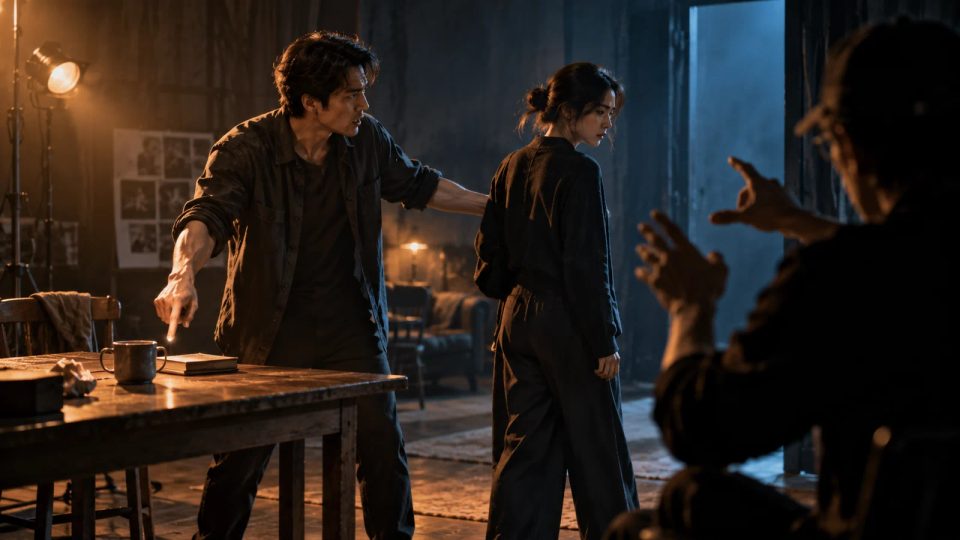
Cinematic editorial illustration: in a rehearsal room, an adult actor blocks the path of a scene partner who is about to leave, pointing with one hand at an object on a table.
Narrative Design for Interactive Film Games2026.10.13

How an Interactive Film Game Director Can Turn “Angrier” into a Playable Direction

Turn “more disappointed” or “angrier” into a request a scene partner can respond to now: specify whom the actor is addressing, the behavior they want, the tactic, and when to end the attempt. Use a fictional rehearsal scene to fill out a reusable direction-rewriting table and identify where a note goes beyond the script.

DramaFork Editorial Team18 min read
Continue reading
Cinematic editorial illustration: in a sparse audition room, an adult actor reaches toward the doorway.
Narrative Design for Interactive Film Games2026.10.13

Interactive Film Game Auditions: Assessing Branch Adaptation by Changing Prior Events

Keep the dialogue, the task of borrowing a key, and the scene partner’s response fixed. Change only one event that happened before the scene. This reusable audition card helps you observe how actors turn different prior events into immediate action—and distinguish grounded adjustments from simply intensifying emotion.

DramaFork Editorial Team18 min read
Continue reading
  1. 1
  2. 2

Blog categories

  • All500
  • Creation tutorials40
  • Interactive narrative60
  • Getting started11
  • Galgame Route Design25
  • Visual Novel Production25
  • Interactive Fiction Design25
  • Narrative Design for Interactive Film Games25
  • Interactive Film Accessibility10
  • Interactive Film Workflow10
  • Interactive Game Basics10
  • Interactive Film Presentation and Delivery10
  • Interactive Film Localization10
  • Interactive Film Production10
  • Narrative Mechanics11
  • Creative Collaboration11
  • Getting started1
  • Fictional Case Study10
  • Story Localization10
  • Mobile and Accessibility10
  • Acting and Staging10
  • Exploring Time and Space10
  • Relationships and Groups10
  • Resources and Constraints10
  • Information and Commitments10
  • Production Practice59
  • Product workflow34
  • Choosing tools33

From a story to a playable world.

Start with one story decision

Create a project