
• Home
  • Blog
  • Gallery
  • Pricing
  • Home
  • Blog
  • Gallery
  • Pricing
Start creating

Creator blog

Better stories start here

Discover practical AI tools, interactive storytelling methods, and production lessons—from the first idea to a story people can play.

DRAMAFORKStories · Craft · Possibility
Topics
AllProduction PracticeProduct workflowInteractive narrativeCreation tutorialsChoosing toolsGetting started
49 articles

Editorial / 04

Latest articles

Practical methods for narrative structure, visual production, and everything in between.

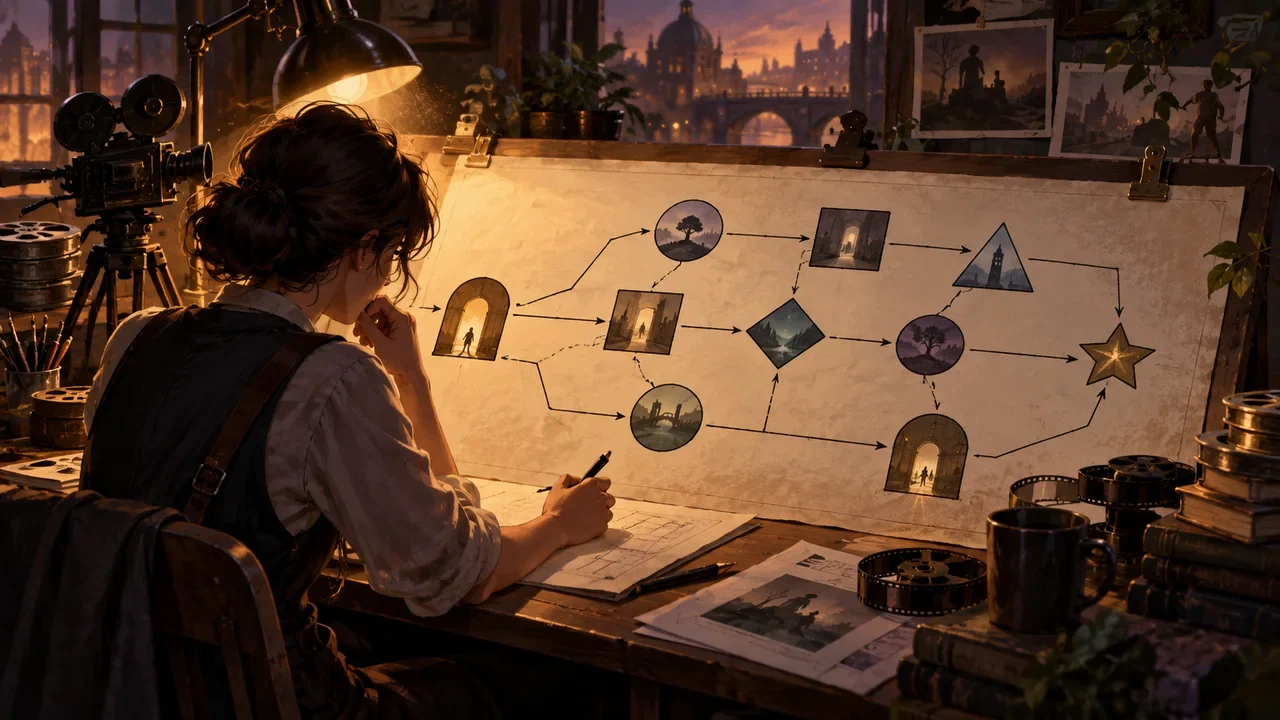
Cover of the blog article “Keeping Branching Diagrams Under Control: Node IDs, Entries, Exits, and Conditions”Topic selection
Interactive narrative2026.08.24

Keeping Branching Diagrams Under Control: Node IDs, Entries, Exits, and Conditions

A branching diagram ready for production is a routing map shared by the team, rather than a story poster. Every node must have a stable ID, clear entry conditions, verifiable state changes, and explicit exits. The diagram answers “where do we go?”; the script answers “what do we perform?” Cramming entire pages of dialogue into a flowchart only makes both impossible to maintain.


DramaFork Editorial Team11 min read
Continue reading

Blog categories

  • All201
  • Production Practice59
  • Product workflow34
  • Interactive narrative49
  • Creation tutorials19
  • Choosing tools33
  • Getting started7

Make your story playable for the first time

Start with one story decision

Create a project

The next move is yours

Make your story playable for the first time

Do not wait for every video to be finished before testing the story. Build the characters, rules, and branches first, then let real choices guide what you make next.

Start with one story decision

Try a playable example

Let agents handle production complexity while you keep creative control.

Start with one story idea, then shape scripts, characters, shots, and branches into a playable first version.

Product

  • Pricing
  • Capabilities
  • Workflow
  • Examples
  • FAQ

Explore

  • Playable gallery
  • Creator blog
  • Creator partnership

Legal

  • Privacy
  • Terms
© 2026 DramaFork/AI interactive story studio
Press Enter to send, or drag away and release.
Blog article cover for “More Variables Do Not Mean More Professional Design: How to Separate Relationship, Evidence, Resource, and World States”
Interactive narrative2026.08.23

More Variables Do Not Mean More Professional Design: How to Separate Relationship, Evidence, Resource, and World States

The value of a variable lies not in how many there are, but in whether it can explain player behavior, change subsequent content, and be reliably maintained by the team. An interactive film game with manageable production usually needs only four layers of state: relationships, evidence, resources, and world facts. Every variable should have a single meaning, clearly defined write points, visible feedback, and an eventual payoff; variables that cannot meet these requirements should be merged or deleted.

DramaFork Editorial Team13 min read
Continue reading
Cover of the blog article “What Problems Do Untimed Choices, Timed Choices, QTEs, and Clue Combinations Each Solve?”
Interactive narrative2026.08.23

What Problems Do Untimed Choices, Timed Choices, QTEs, and Clue Combinations Each Solve?

Interaction formats are tools that help players complete different cognitive tasks, not seasoning. Untimed choices support deliberation, timed choices reveal instinct, QTEs create physical pressure, and clue combinations test understanding. Decide what players should think or feel at that moment before choosing an interaction format, so the entire work does not become a showcase of buttons.

DramaFork Editorial Team13 min read
Continue reading
Blog cover for “Writing Choice Text: Are Players Predicting Outcomes or Expressing Attitudes?”
Interactive narrative2026.08.23

Writing Choice Text: Are Players Predicting Outcomes or Expressing Attitudes?

The core purpose of choice text is not to shorten dialogue, but to help players understand what they are deciding. The most common confusion comes from mixing two kinds of promises: one asks players to predict the outcome of an action, such as “Pry the door open / Find the key”; the other asks them to express a character’s attitude, such as “Trust her / Question her.” Both can work, but every option in a set must use the same basis for comparison.

DramaFork Editorial Team12 min read
Continue reading
Cover of the blog article “What Makes a Choice Meaningful: Outcomes, Costs, Information, and Character Expression”
Interactive narrative2026.08.22

What Makes a Choice Meaningful: Outcomes, Costs, Information, and Character Expression

A meaningful choice does not have to open up an entirely new storyline every time, but it should do at least one of four things: change an outcome, demand a cost, use information the player has, or express a character’s position. An option that does none of these is just a page-turning button; teams can keep it to control pacing, but should not promote it as changing destiny.

DramaFork Editorial Team12 min read
Continue reading
Cover of the blog article “What Scripts Are Easier to Produce with AI Video: Write for Generation and Filming Constraints First”
Interactive narrative2026.08.22

What Scripts Are Easier to Produce with AI Video: Write for Generation and Filming Constraints First

Neither AI video nor low-budget live-action filming can turn any script into a consistently reliable finished work at low cost. A more reliable approach is to control, during writing, the number of characters on screen together, continuity across extended actions, scene changes, prop interactions, and shot length, and convert content that is difficult to produce reliably into sound, interfaces, text nodes, or reusable reaction shots.

DramaFork Editorial Team13 min read
Continue reading
Blog article cover for “Interactive Mysteries Fear ‘Unfairness’ Most: How to Plant Clues Without Giving Away the Answer”
Interactive narrative2026.08.22

Interactive Mysteries Fear “Unfairness” Most: How to Plant Clues Without Giving Away the Answer

A fair mystery does not require players to guess the whole truth in advance. It means that once the answer is revealed, they can look back and confirm that the key facts appeared and that they had a chance to reach a judgment closer to the truth. Hidden clues can be hard to find, but they must not depend on characters who never appeared, rules changed at the last minute, or explanations known only to the author.

DramaFork Editorial Team13 min read
Continue reading
Cover of the blog article “A Character Relationship Map Is Not Enough: What Each Person Knows, Conceals, and Misunderstands”
Interactive narrative2026.08.21

A Character Relationship Map Is Not Enough: What Each Person Knows, Conceals, and Misunderstands

A relationship map only shows who is connected to whom; it cannot explain what makes the suspense work. An interactive story also needs an information gap matrix: which facts each character knows, where they learned them, what they deliberately conceal, what they mistakenly believe, and under what conditions they are willing to speak. Often, players’ choices change the flow of information rather than the events themselves.

DramaFork Editorial Team13 min read
Continue reading
Blog cover for “Why the Protagonist Follows the Player: Building Character Motivation for Choices”
Interactive narrative2026.08.21

Why the Protagonist Follows the Player: Building Character Motivation for Choices

Choices in interactive film games cannot simply represent what the player wants to do; they must also be actions the character might take in their current circumstances. Character motivation does not restrict interaction; it establishes believable boundaries for choices. The same person can hesitate, lie, take risks, or change their position, but every change needs a reason rooted in desire, fear, information, or relationships.

DramaFork Editorial Team13 min read
Continue reading
Cover of the blog article “Adapting a Three-Act Story into an Interactive Structure: A Fixed Framework and Variable Nodes”
Interactive narrative2026.08.21

Adapting a Three-Act Story into an Interactive Structure: A Fixed Framework and Variable Nodes

The three-act structure can work for interactive film games, but you cannot simply finish a linear script and insert choices between acts. A more practical approach is to retain a fixed causal framework while letting players change the order in which they obtain information, character relationships, methods of resolving the conflict, and the final cost. The framework keeps the story moving, while variable nodes ensure that player actions are remembered.

DramaFork Editorial Team13 min read
Continue reading
Cover of the blog article “An Interactive Film Game’s Theme Is More Than a Slogan: It Must Become a Recurring Dilemma”
Interactive narrative2026.08.20

An Interactive Film Game’s Theme Is More Than a Slogan: It Must Become a Recurring Dilemma

An interactive film game’s theme is not a lesson the author states at the end, but a dilemma the player repeatedly faces. If the theme is “trust,” the work should repeatedly ask players to decide whom to believe with incomplete evidence, making trust a source of both strength and risk; if the theme is “memory constitutes identity,” players should personally choose to preserve, delete, or exchange memories.

DramaFork Editorial Team12 min read
Continue reading
  1. 1
  2. 2
  3. 3
  4. 4
  5. 5