How to Design Dual Identities in a Fictional Infiltration Story: One Answer Facing Two Listeners
The key to a dual identity is not that "he has two faces," but that the same answer must serve two listeners at once, and the two listeners understand that answer differently. When designing, first write down the surface task and the hidden goal, then list at least two listeners for each scene (one who believes the surface identity, one who might see through it), then write an answer that "makes sense on both sides," and finally mark which layer of information this answer advances and which layer of information bears risk.
Introduction
The key to a dual identity is not that "he has two faces," but that the same answer must serve two listeners at once, and the two listeners understand that answer differently. When designing, first write down the surface task and the hidden goal, then list at least two listeners for each scene (one who believes the surface identity, one who might see through it), then write an answer that "makes sense on both sides," and finally mark which layer of information this answer advances and which layer of information bears risk.
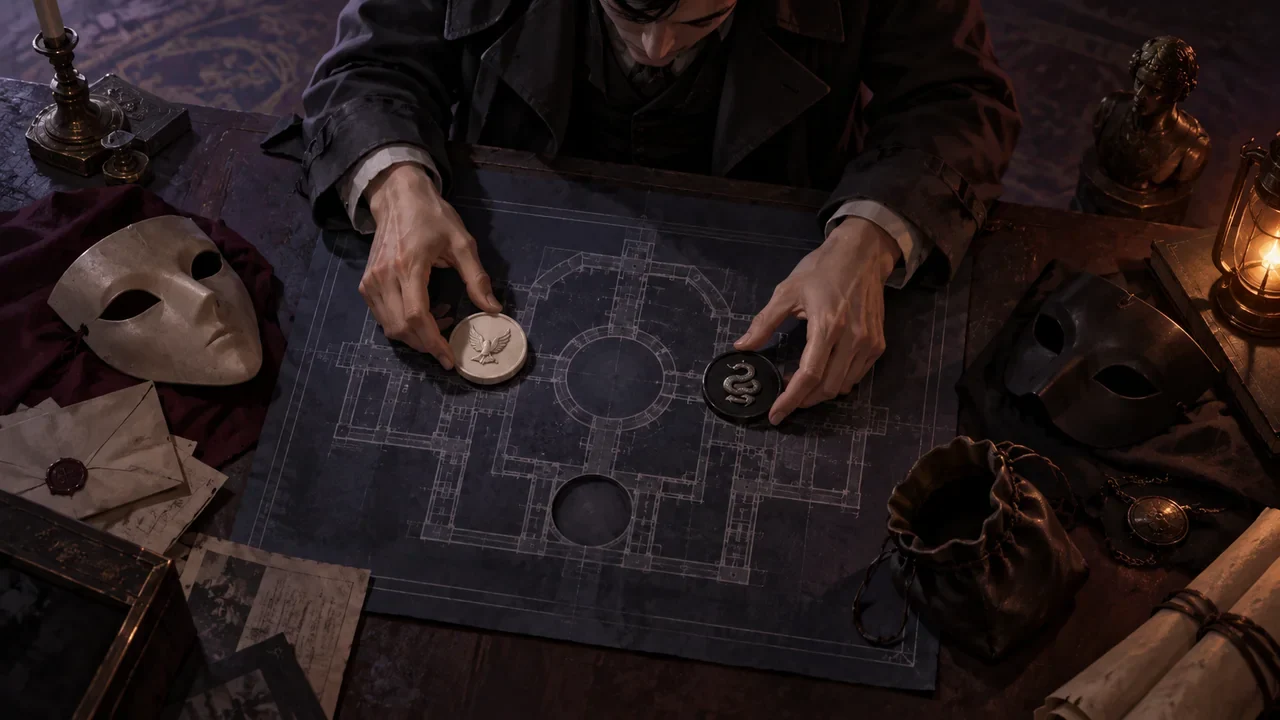
Below, the fictional fantasy kingdom The Silver Mask Ball is used as a running case. This is a teaching fictional example; the characters, banquet, and consequence table are all made up and do not point to any real scenario.
First Fix the Two Layers of Tasks, Then Write Dialogue
Give the protagonist two task lists, and the format must be specific enough to say "who expects what result on what occasion."
| Layer | Goal | Who is listening | Consequence of failure |
|---|---|---|---|
| Surface task | Infiltrate the Silver Mask Ball under the identity of musician's apprentice "Lorne," and record the performance order of three forbidden songs for the host family | Ball steward, referrer | Be expelled from the banquet, lose the chance to record |
| Hidden goal | Confirm whether the king's uncle handed the secret letter to the masked dancer, and let the true contact know the secret letter has been swapped | King's uncle, contact | The contact takes the wrong letter, the operation is exposed |
The two lists must be able to be advanced or slowed by the same sentence at the same time. If a certain answer serves only one layer, then it is just ordinary dialogue and does not constitute the pressure of a dual identity.
Three Kinds of Banquet Dialogue: The Same Answer, Two Listeners
Scene One: The Steward Asks, "Which Musician Did You Study Under?"
The surface listener is the steward, who cares whether Lorne's background is credible; the hidden listener is the contact standing three steps away, who needs to confirm whether Lorne is one of his own.
Lorne answers: "I studied under Samuel of the North Corridor. He coughed badly last winter, and this year he only lets me copy scores for him."
- What the steward hears is: an apprentice attending on behalf of a sick teacher, whose background can be checked, not much of a threat.
- What the contact hears is: "North Corridor" and "winter" are the code positions agreed upon between him and Lorne, indicating that contact can proceed tonight according to the original plan.
- This sentence advances the surface task (the steward lets him pass) and at the same time advances the hidden goal (the contact receives the signal).
When writing this kind of answer, the code words should be hidden in reasonable details, such as place names, seasons, and occupational habits. Readers can discover the two layers when looking back, but will not feel it is abrupt in the moment.
Scene Two: The King's Uncle Asks, "What Were You Just Doing in the Side Hall?"
The surface listener is the king's uncle, who is testing whether Lorne left the performance seat; the hidden listener is the steward, who has just begun to suspect Lorne a little.
Lorne answers: "The candle in the side hall was about to go out, so I went to replace it. By the time I came back, the second song was already more than halfway through."
- What the king's uncle hears is: Lorne admits he left, but the reason is trivial and does not look like he was following the secret letter.
- What the steward hears is: Lorne voluntarily explained leaving his seat, his attitude is cooperative, and the suspicion can be set aside for the time being.
- The hidden goal does not advance, but it is not exposed either. Lorne uses the actually occurred action of "replacing the candle" to cover the real behavior of "going to the side hall to confirm the location of the secret letter."
Note here: an excuse fabricated by a character is not a new world fact. Lorne saying "I went to replace the candle" does not mean the side hall really lost a candle; it only means he chose to explain it that way. The author should clearly mark in the notes which parts are facts and which are character statements, to avoid later treating the excuse as a setting.
Scene Three: The Masked Dancer Asks, "Do You Believe the King's Uncle?"
The surface listener is the masked dancer, who may be one of the king's uncle's people; the hidden listener is the contact, who needs to know whether Lorne is still on the side of the original plan.
Lorne answers: "I only believe the marks on the score. If anyone has changed them, I can tell at a glance."
- What the masked dancer hears is: an apprentice who only cares about music scores and does not care about politics.
- What the contact hears is: "marks" refers to the secret marks on the secret letter, and "changed" shows that Lorne has already discovered the letter was swapped.
- This sentence greatly advances the hidden goal, but the risk is also the highest: if the masked dancer happens to also know the meaning of "marks," Lorne is exposed on the spot.
Identity Exposure Consequence Table
Write each kind of "which layer of information is seen through by whom" into a checkable table, to make it convenient to check whether the tension holds.
| Layer seen through | Who sees through it | Immediate consequence | Subsequent usable pressure |
|---|---|---|---|
| Surface identity | Steward | Asked to present a token from his school | Lorne must find Samuel himself to testify |
| Hidden goal | King's uncle | Confined in the side hall | The contact cannot receive the signal, the flow of the secret letter changes |
| Both layers at once | Masked dancer | Brought to the center of the dance floor to "present a song" | Lorne must transmit the final message during the performance |
| Neither layer broken | No one | The banquet ends, the task is half completed | The king's uncle begins to suspect there is an insider, the next scene is tighter |
The purpose of this table is: every time the author writes a double-meaning answer, he can ask "if this sentence is misheard, which row will it fall into?" If it cannot fall into any row, it means this sentence does not truly create the pressure of a dual identity.
Let the Player Judge Which Layer of Information Is Exposed
The player does not need to see the labels "surface task/hidden goal," but needs enough clues to make a choice. Three options can be given, each corresponding to a different exposure risk:
- Answer along with the surface identity; the hidden goal does not move, but it is safe.
- Respond to the hidden listener with a code; the hidden goal advances, but if a smart person among the surface listeners understands it, it is dangerous.
- Say a piece of nonsense that advances neither layer, stall for time, and make one listener lose patience.
The basis for judgment must be planted in advance: whether the steward has noticed the North Corridor, whether the king's uncle knows the code words, whether the masked dancer is observing the contact. Only after the player grasps these clues will he feel that "which layer is exposed" is chosen by himself, rather than triggered randomly.
When AI-generated dialogue is involved, it can be treated as a draft tool, but two points must be checked manually: whether the code words have been written as new world facts; whether the reactions of the two listeners have been written as "certain to notice." AI output is not guaranteed to be correct every time, and the author still needs to check personally whether the clues appear first and the inferences come later.
Completion Check
After writing a dual-identity scene, check item by item:
- Can both the surface task and the hidden goal be stated clearly in one sentence?
- Does each scene have at least two listeners, and do they understand the same sentence differently?
- Are the code words in the double-meaning answer hidden in reasonable details, rather than stiff labels?
- Is the excuse fabricated by the character marked as a statement, rather than a world fact?
- Does the exposure consequence table cover "only one layer broken" and "both layers broken at once"?
- Before the player makes a choice, has he already obtained the clues needed for judgment?
If all six points can be answered, then the dual identity is not just a setting, but every answer creates tension between two listeners. The next step can be to pick a banquet scene, first write the listener perspectives of the steward, the king's uncle, and the masked dancer, then go back and revise Lorne's answer until it holds under all three perspectives.