When a Sixth Key Enters Your Draft: How to Merge Item Functions and Preserve Narrative Differences
Separate what an item does, what it means to the characters, and the details players must recognize before deciding what to merge, relocate, or keep. A six-key reduction matrix shows how to simplify inventory management while preserving promises, evidence, and choices.
Merge repeated operations first, then decide where their meaning belongs
When a sixth key enters your draft, do not start cutting items based on how often they appear. Split each key into three columns: what it lets the player do, whose relationship it represents, and which details players must recognize. Identical operations can be grouped; meaning tied to characters can move into a handover, dialogue, or a scene; differences that affect reasoning and choices must remain.
The test is whether players can still make the original important decisions after the merge and understand what causes the consequences. Two keys that both open doors are not necessarily interchangeable. If handing over one of them means betraying someone, that handover deserves to remain a separate action.
The old-theater story below is a fictional teaching example, not a real user case, a tested result, or a description of product features. All item presentations and interactions are writing proposals, not indications that DramaFork automatically organizes items.
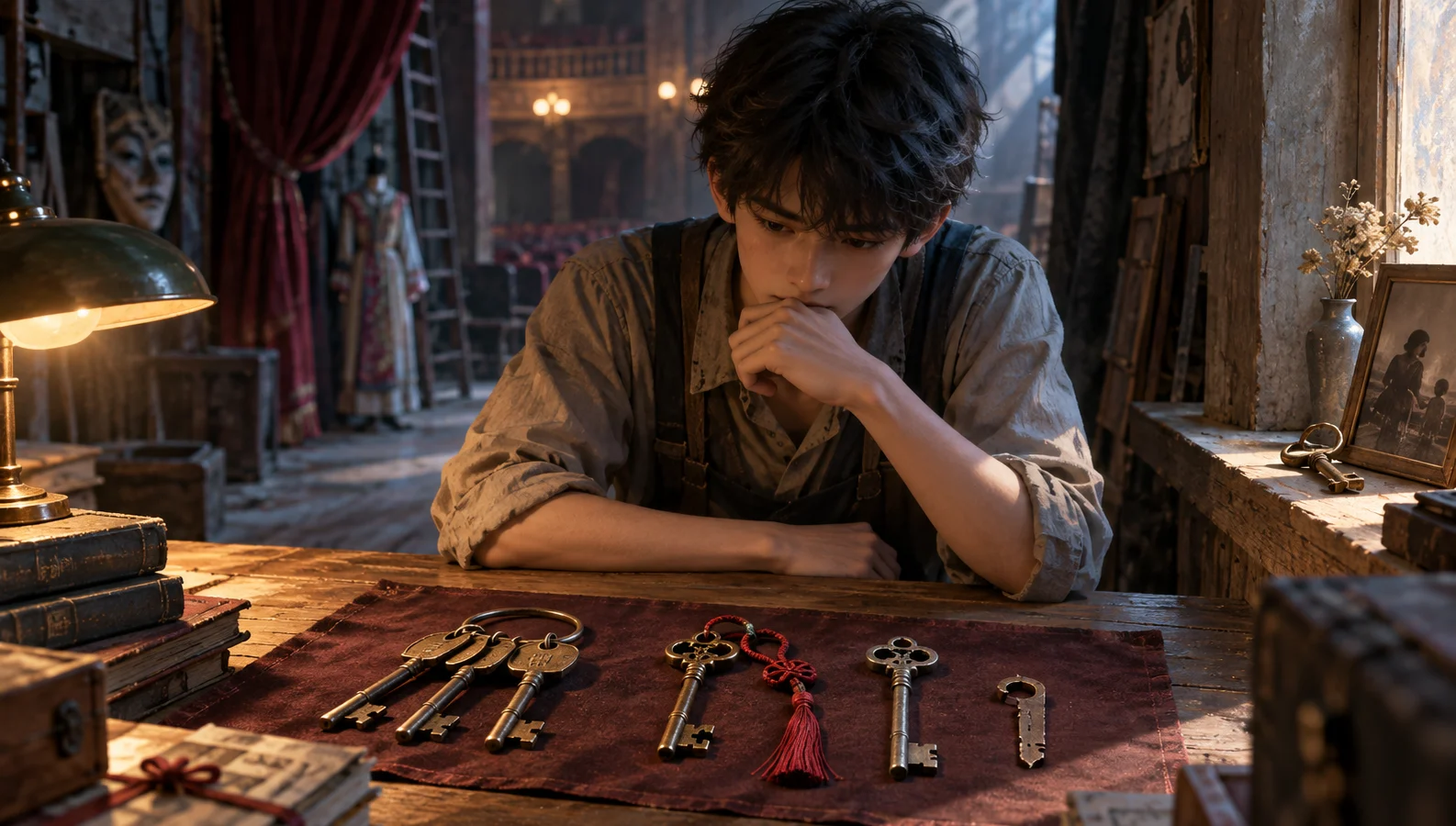
Suppose the player takes the role of Lin Che, an apprentice returning to a theater to sort through belongings left by the deceased. Over one night, he receives a storeroom key, a lighting-room key, an attic key, a red-cord key, an old house key, and half of a broken key. The current draft requires players to pick up each one, read its description, select it, and try it on a door. All six sit in the inventory awaiting a use.
The problem is not simply the quantity. The writer has turned opening doors, promises, remembrance, and identifying clues into the same kind of item waiting to be used.
Give every item a destination with a reduction matrix
When filling this in, describe “function” as an action and its result, not merely “advances the plot.” “Meaning to the characters” must identify a specific relationship. “Required identifying details” should retain only features needed for the next judgment. The final column records what happens to the item and where its role continues, so you do not discover a missing clue only after cutting it.
| Item | Operational function | Meaning to the characters | Required identifying details | What to do with it and where its role continues |
|---|---|---|---|---|
| Storeroom key | Open the storeroom to retrieve stage curtains | No distinct relationship | Storeroom tag | Add to the caretaker’s key ring |
| Lighting-room key | Open the lighting room to inspect the electrical box | No distinct relationship | Lighting-room tag | Add to the caretaker’s key ring |
| Attic key | Open the attic to find the ledger | No distinct relationship | Attic tag | Add to the caretaker’s key ring |
| Red-cord key | Open the mentor’s letter cabinet | A promise not to hand it to anyone else | Red cord; current holder | Keep as a separate item |
| Old house key | No existing door it can open | His mother used to make sure he could let himself in | The notch his mother recognized | Turn into a keepsake within a scene |
| Half of a broken key | Match it against the fragment inside the cabinet lock | Ownership remains uncertain | Shape of the break | Keep separately as evidence |
You can reuse this table directly: one row per item, recording the facts in the current draft before the proposed revision. If you cannot fill a column yet, mark it “to be confirmed.” Do not invent a backstory on the spot just to justify a cut.
“None” is an acceptable entry. Ordinary tools do not all need traumatic histories, and an object with sentimental meaning does not need a dedicated door to open.
Turn six items awaiting use into three inventory entries
Start with the first three keys. Establish that the caretaker originally hands them over together, entry to all three rooms is already permitted, and none will later be lent, lost, or returned separately. They can therefore become one item called the caretaker’s key ring, with the storeroom, lighting-room, and attic tags listed in its description.
The revised handover could read: “The caretaker clips three keys onto one ring. ‘Get the curtains from the storeroom, check the electrical box in the lighting room, and don’t mess up the ledger in the attic.’” At the lighting room, the action text says, “Open the lighting room with the caretaker’s key ring,” and the narration explains that Lin Che selects the key with the lighting-room tag.
What is merged here is the inventory entry used to select and manage the keys. Three physical keys still exist in the story world. None of the three destinations disappears, and no universal key appears out of nowhere. Whatever is discovered in each room still appears in that room’s scene.
Next, address the old house key. In the current draft, it is not used to identify anyone, exchange items, or determine the ending. Its only value is the memory of his mother making sure he could always let himself in. It can stay on a hook on the old home’s doorframe. Before leaving, Lin Che touches the notch and remembers his mother saying, “Let yourself in when you come back.” The old door has been replaced, and this key no longer enters the inventory.
This move preserves the object that triggers the memory but removes the possibility of carrying it or deciding what to do with it. If the story needs players to choose whether to take it or leave it, this cut will not work as written. That decision must be restored to the scene.
Keep the red-cord key and the half of a broken key separately. After revision, there are three entries to manage: the key ring, the red-cord key, and the half of a broken key. This is a change to the structure of this example’s draft, not validated data showing an improved player experience.
Two choices that merging must not erase
The first concerns a promise. The mentor allows Lin Che only to inspect the letter cabinet and forbids him to give the red-cord key to the actor coming to collect a letter. When the actor offers to retrieve it, the player can refuse to hand over the key and open the cabinet personally to fetch the letter, or hand over the key and accept the consequences of breaking the promise for the relationship.
If this key is mixed into the caretaker’s key ring, which can be lent freely, “lend the keys to the actor” becomes ambiguous. Does that grant access to shared rooms or to a private letter cabinet? Keeping the item separate makes it clear which object is handed over and what consequences follow. The red cord helps readers recognize, at that moment, which key the promise concerns.
The second concerns evidence. The half of a broken key fits the fragment inside the cabinet lock. This supports only the conclusion that “these two pieces originally belonged to the same key.” It cannot directly establish who broke it or when, and finding it in someone’s pocket does not establish that person as the saboteur.
The break’s shape must therefore remain consistent between pickup and comparison, and the key fragment’s source must be described through facts Lin Che actually observed. Replacing it with “a damaged key” in the key ring’s description removes an object players can inspect. Replacing the comparison result with narration announcing the culprit exceeds what the evidence supports.
The revised walkthrough runs in this order: first use the key ring to retrieve the items, then face the request to hand over the red-cord key, and finally inspect the break. Streamlined operations, relationship choices, and objects of deduction each have a clear place.
When merging does not work, reduce the burden another way
If the lighting-room key is obtained only after a power outage, it should not be included in a complete key ring at the opening, because that would grant access too early. You can still use a single key-ring entry, updating its tags as keys are handed over and tracking which keys are currently present in each scene of the draft.
If the puzzle itself requires distinguishing six similar keys, recognizing their differences is the task. Grouping them outright would remove the gameplay. In that case, keep all six, reduce repeated descriptions, and use markings on the locks to provide a basis for determining which key fits.
If the six keys belong to different people and lending and returning them are relationship events, they can be displayed in groups by character while their holders are still tracked separately. Grouping the display only makes items easier to find; it cannot replace separate ownership states.
After revising, use the matrix to check three things scene by scene: which key the player currently knows can be used, who loses what after a handover, and where the removed meaning reappears. Then try a counterexample path, such as lending the key ring before visiting the lighting room, to ensure the narration does not open a door with a key no longer in the character’s possession.
An item with no distinct operation and no relationship or identifying detail worth preserving can simply be deleted. If it carries an important decision, let it stay. The aim is to make every act of recognition useful, not to bring the inventory down to a pleasing number.