Can a Key Clue Be Delivered to Players in a Different Way?
Hearing dialogue, seeing a shot, and reading a record may seem to convey the same thing. A moved greenhouse flowerpot shows how to preserve sources, information, and choices.
Introduction
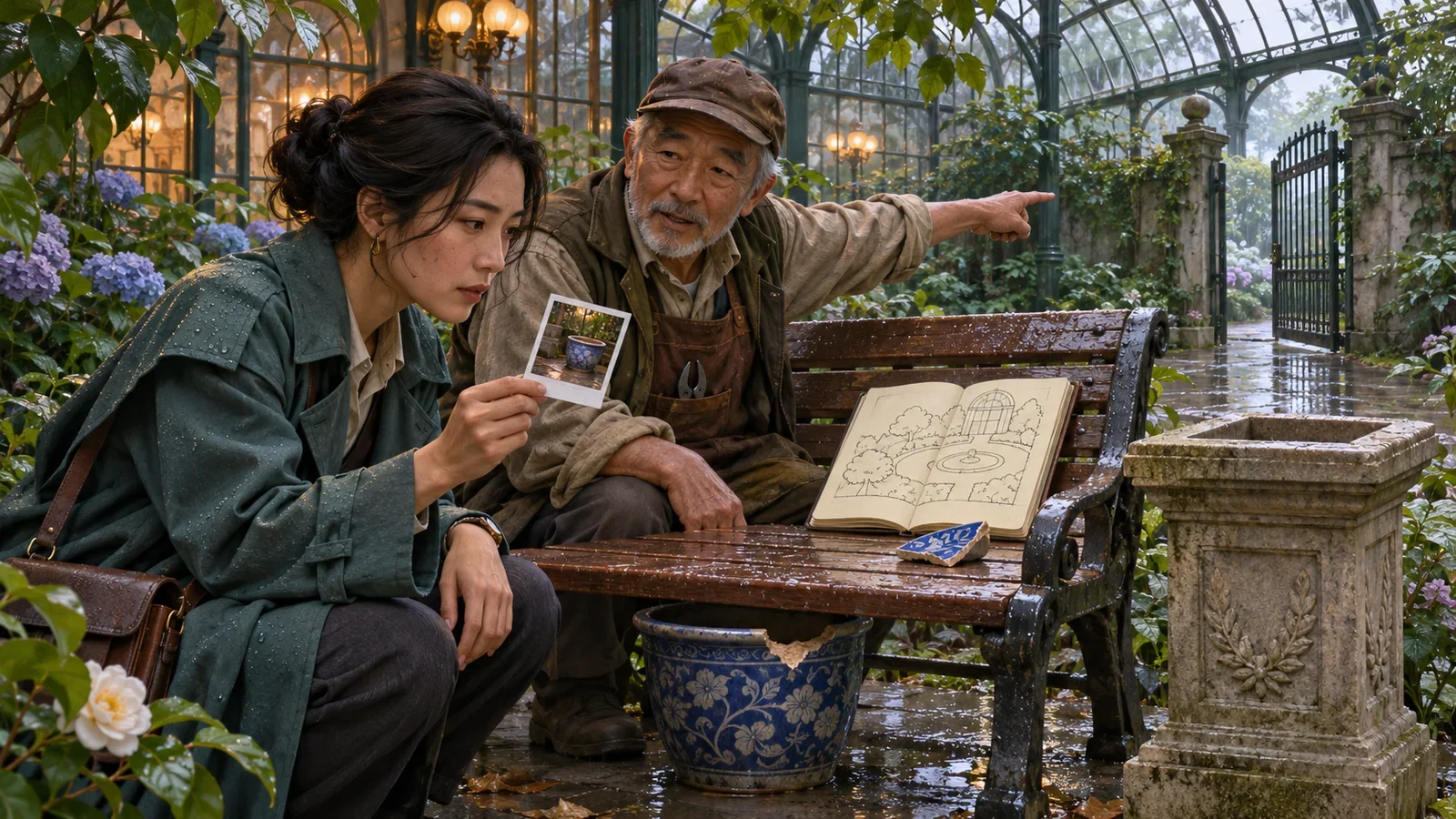
The camera pans past the blue flowerpot beneath the bench. In the next scene, the player must answer: has someone moved the flowerpot that was originally on the stone stand?
Players who saw the image clearly have a chance to judge. Those who only read “The greenhouse is quiet” do not. That is the problem: different presentations of the same scene have delivered different amounts of information.
The greenhouse scene below is an original fictional teaching example. We will present the same clue in several ways, then check whether the next choice still makes sense.
First, Define What This Clue Allows the Player to Judge
The greenhouse’s stone stand is empty. A blue flowerpot with a chipped corner has been moved beneath the bench, and the broken piece of ceramic sits on the seat. The side door is half open, and the gardener is nearby.
What this scene needs to tell the player is that the original flowerpot has changed position and can now be examined beneath the bench. It cannot yet prove who moved it or at what time, much less directly prove that someone outside the side door is stealing things.
Write down that scope before deciding whether to present the clue through images, dialogue, or a record. Otherwise, when adding a line of text, the writer can easily slip into “The gardener just moved the pot beneath the bench,” also giving away the person and timing that still need to be investigated.
If you are planning the accessible experience for an entire project, you can start with How to Plan Accessibility for an Interactive Film. This article addresses just one small part of that work: after changing the medium, does the player still have the same basis for the next judgment?
Put the Facts, Sources, and Available Actions Together
| Presentation | What This Version Actually Conveys | Information Source and Limits | What It Allows Next |
|---|---|---|---|
| Image | The empty stone stand, the blue flowerpot beneath the bench, and its chipped corner | Objects visible in the current shot; does not show the pot being moved | Examine the flowerpot beneath the bench and compare the chipped corner |
| Text description of the image | “The stone stand is empty. Beneath the bench is a blue flowerpot with a chipped corner, matching the appearance of the flowerpot previously on the stand.” | A description of the same shot; does not additionally identify who moved it | Get the same direction for inspection that the shot provides |
| The gardener’s dialogue | “The blue flowerpot you’re looking for is beneath the bench. It wasn’t there a moment ago.” | The gardener’s statement; its accuracy can still be checked | Examine the flowerpot based on his account and ask what he saw |
| Dialogue subtitles | Preserve the gardener’s sentence in full, without adding who moved the pot or a precise time | A text presentation of the same speech; it remains a statement | Examine the pot or ask further questions, just as someone who heard the sentence can |
One distinction is easy to miss here: when subtitles replace sound, the information still comes from the same person; when the gardener’s account replaces observation, the source changes. The former should preserve the same information as closely as possible. The latter carries the limitations of testimony and cannot automatically offer exactly the same certainty as observation at the scene.
There is therefore no need to force every form to use identical wording. What should remain consistent is the basis on which players can judge and how much certainty the work allows them to reach.
Fill the Gap Without Giving Away the Solution
“You discover a suspicious object” gives too little: the player does not know where to look. “To conceal what happened last night, the gardener hid the blue flowerpot” gives too much, squeezing the clue, motive, and conclusion into one sentence.
Start with a concrete, restrained version: “Only a pale ring of water remains on the stone stand. Beneath the bench, half of the blue flowerpot with the chipped corner is visible.” This gives the location and a feature that can be compared, while leaving open who moved it and why.
If color should not be the only identifying feature, let the chipped corner, the pattern around the rim, and the location corroborate one another. But these features must have a basis in the relevant versions. A decisive scratch that rules everyone out cannot suddenly appear only in a supplementary description.
Likewise, if the key information comes from sound, specify where the sound comes from and what was heard, rather than substituting “You hear the truth.” Traceable Sound-Source Clues offers more detailed guidance on writing this.
Do Not Charge Again for the Same Clue in Another Form
Once a player has seen the flowerpot beneath the bench, reading a text description of that image should not cost another investigation opportunity. Reading dialogue subtitles should not consume extra stamina either.
If the player then chooses to verify the information with the gardener, that is a new action. It might reveal what he witnessed, expose inaccuracies in his memory, or raise new questions. It can count as a turn, but players should understand that they are paying for a new opportunity to investigate, rather than collecting information the previous scene should already have provided.
Seeing the same fact three times does not mean obtaining three independent pieces of evidence. If a flowerpot photograph, its caption, and an automatically generated extract all come from the same photograph, they can establish only what that photograph shows. Counting them as three pieces of evidence would unfairly disadvantage players using another form of presentation.
Turn Off One Form of Presentation and Return to the Choice
Finish with a straightforward check: without looking at the image, can you learn the blue flowerpot’s location and the features available for inspection by reading only the necessary text? Then turn off the sound: do the subtitles retain what the gardener actually said? With only the image, is the chipped corner clear enough to support the next comparison?
The goal need not be “Every form immediately reveals everything.” If a passage was designed as an optional observation that can be missed, preserve that design faithfully. But the minimum information needed to reach a required choice should not disappear because the player changes how they read it.
To explore how sound, secondhand accounts, and verification affect choices, see the introduction to The Third Voice in the Silent Cabin. Then return to your own scene and write down which pieces of information the next choice requires. Deliver those, and leave the remaining reasoning to the player.