Where Sound Comes From in the Same Room: Designing Traceable Sound-Source Clues
Knocking that shifts from a wall to a door in a repair room does not necessarily mean its source has moved. Use a sound-source comparison sheet to connect perceived location, competing explanations, verification actions, and text alternatives so players can judge the evidence.
Separate “where I heard it” from “what is knocking”
When knocking seems to change location in a repair room, first give players stable spatial references, then an action that distinguishes “sound carried through a pipe” from “someone knocking outside the door.” The answer must not be hidden solely in the left and right audio channels: players should be able to identify which observation supports which explanation and withhold judgment when evidence is insufficient.
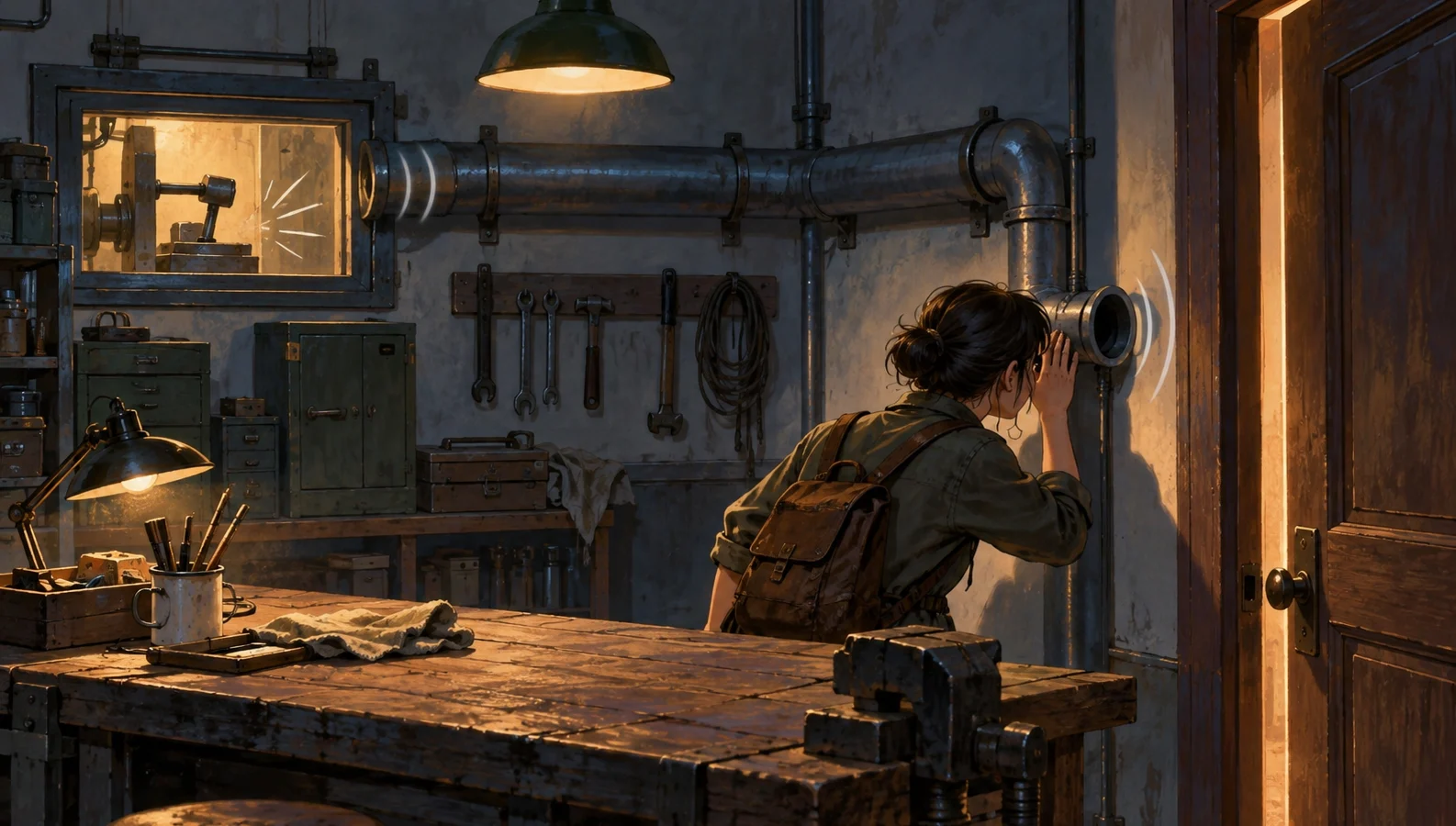
The “old station repair room” below is a fictional teaching example, not a real user case, a tested result, or a product feature. The room has a demonstration sound-transmission pipe along its north wall, a door to the east, and a workbench in the center. The author’s intended explanation is that a striker inside the pipe produces the sound, which enters the room through an opening beside the door. These are rules for a story prop, not conclusions drawn from acoustic measurements of a real room.
At the workbench, players first hear three short knocks from the direction of the north wall. As they approach the east door, the same rhythm seems to come from beside the door. Present only a “change in perceived location,” without declaring that “the knocker moved.” Narrow this section’s task to “where these three short knocks enter the room,” rather than asking players to infer whether anyone is outside the door.
Use a sound-source comparison sheet to constrain every change in location
Fix three names at the top of the script: north-wall pipe section, east-door panel, and pipe opening beside the door. Keep using these names after the camera changes direction; do not casually replace them with “on the left” or “behind you.” Record the character’s position as well. Character movement and sound-source movement must be recorded separately, or even the author may mistake a camera change for a fact about the story world.
You can reuse the following sheet directly. Fill in the observations available to players first, then add the explanation behind the scenes, so the answer does not slip into the clues.
| Node and position | Observation available to players | Remaining explanations | Verification action and expected difference | Text alternative |
|---|---|---|---|---|
| A: Beside the workbench | Three short knocks come from the direction of the north wall | The pipe is producing sound; sound is entering from outside the door | Withhold judgment and note the rhythm | From the direction of the north wall, three short knocks |
| B: Just inside the east door | The same rhythm is heard beside the door; the door panel and pipe opening are adjacent | Sound is emerging from the pipe opening; the door panel is being knocked on | Stay in place and compare the sound with the pipe opening open and closed | Near the east door, three short knocks; exact location unclear |
| C: Still just inside the east door | The knocking beside the door weakens when the pipe opening is closed and returns when reopened | The pipe opening helps transmit sound; other sources remain to be ruled out | Check whether the striker inside the pipe moves in sync | Weaker after the pipe opening closes; restored after it reopens |
| D: At the north-wall observation window | Each time the striker hits the pipe wall, a short knock is heard | The device inside the pipe is the source of this set of sounds | Compare one complete rhythmic sequence | Through the observation window, three strikes against the pipe wall correspond one by one to the short knocks |
The most important column is “Remaining explanations.” If it always contains only the correct answer, investigation becomes mere confirmation of a hint. If two explanations remain equally valid after the action, the script still needs another test that distinguishes between them.
Verification actions must make the two explanations predict different outcomes
In this example, players first examine the prop’s instruction plate and learn that the sliding cover blocks only the pipe opening beside the door; the door panel does not move with it. Explain this rule before the choice, rather than adding it during the reveal. The plate establishes the device’s limits without directly identifying the source of the current sounds.
Then offer an explicit action: “Stay where you are, close the pipe opening, listen to one complete sequence, then reopen it.” The pipe hypothesis predicts that the sound beside the door will change with the sliding cover. The hypothesis that someone is knocking on the door panel cannot, on its own, explain that correspondence. Use the same position and knocking rhythm for both comparisons. Avoid having players turn, move closer, and change camera angles at the same time, leaving them unsure which change caused the difference.
Under the author’s intended setup, the sound beside the door weakens when the opening closes and returns when it reopens. At this point, the character may say only, “The pipe opening affects the sound I hear here.” They cannot immediately conclude, “There’s no one outside.” Next, the north-wall observation window reveals that the striker’s contacts with the pipe wall correspond one by one to the three short knocks. Only then is a fuller judgment possible: this set of knocks is produced by the device inside the pipe and emerges through the opening beside the door.
If players choose “Look outside the door” first, the corridor can be empty at that moment, but an empty corridor is not sufficient evidence to rule out someone knocking: that person may have left. This branch should return “No one is visible outside for now; the sound source remains undetermined,” while keeping the pipe-opening comparison available. Following a mistaken lead need only cost one investigation step. There is no need to punish a reasonable guess by suddenly locking off the route.
Text alternatives must preserve both evidence and uncertainty
Text alternatives must convey location, sequence, and change, rather than merely “knock, knock, knock.” First write, “Three short knocks come from the direction of the north wall.” On the second occasion, write, “When you stand just inside the east door, the three short knocks seem concentrated beside the door.” The second sentence ties perception to the character’s position, avoiding any implication that an object has moved.
Do not label it “pipe knocking” prematurely, either. That would give players relying on text the answer before verification, while those using audio would still have to decide. Only after verification may the wording change to “Confirmed: this set of sounds comes from the striker inside the pipe.” Keep the earlier “exact location unclear” on the record page so the change in conclusion remains traceable.
The text alternative for weakening sound should also state the conditions: “From the same position, the knocking beside the door becomes weaker after the pipe opening closes.” Simply writing “the sound gets quieter” can suggest that the event is ending on its own. For the observation window, write that “the strikes against the pipe wall correspond one by one to the knocks,” without requiring readers to watch tiny movements and identify the rhythm simultaneously.
The three short knocks serve here as a marker for recognizing the same set of events, not as a code. If the story contains other knocking, use a different, describable rhythm or explicitly mark the overlap between the two sets of events. Otherwise, players may connect unrelated sounds into a false path of movement.
Use failure cases to check whether conclusions overreach
The most common failure is a verification action that cannot distinguish between explanations. For example, “Listen carefully again” adds no evidence if it merely replays the original clip. Replace it with a comparison of the pipe opening while the character stays in place. If production constraints do not allow changes in sound, use the observation window instead, letting players compare the device’s movement with the knocking rhythm while retaining synchronized text descriptions.
Another failure is giving an absolute conclusion too early. Changes in perceived sound when the pipe opening opens and closes support only the transmission path. Synchronized movement seen through the observation window provides further support for identifying the sound-producing object. Even together, these observations do not prove that the entire repair room has no second sound source. If the plot includes someone knocking outside at the same time, present that as another distinguishable set of events rather than retaining this example’s single-source answer.
Before submitting the script, perform a silent reading check: with the audio removed and only the text alternatives available, can readers still propose two explanations, choose a verification action, and reach a conclusion with the same scope? Then review each text entry for any extra information about identity or motive. This is an author’s review method, not a claim that user testing has been completed.
Finally, keep a reusable template: “At 〔position〕, I heard 〔location and rhythm〕; it may come from 〔A〕 or 〔B〕; after performing 〔action〕, if 〔difference〕 occurs, it supports 〔limited conclusion〕; what remains unconfirmed is 〔remaining question〕.” Fill in these blanks again when changing rooms or props to check whether the next sound investigation can truly be traced through the evidence.