How Can You Preserve Player Choice Consequences When a Complex Moving Scene Cannot Be Filmed?
Replace complex action with preparation, omitted execution, and a final result check. Use a three-part action replacement table to preserve player choices, prop continuity, and differences that shape subsequent actions.
Introduction
When a complex scene involving moving objects cannot be shown, divide it into three parts: confirm the choice during preparation, omit the execution, and check the result afterward. Preserve the player’s decision about what to move, what to leave behind, and how the objects ultimately change. The continuous sequence of lifting, turning, and carrying things through doorways can be omitted. The images before and after the action must provide enough evidence that what happened was what the player chose.
First, Identify the Decision at Stake in This Move
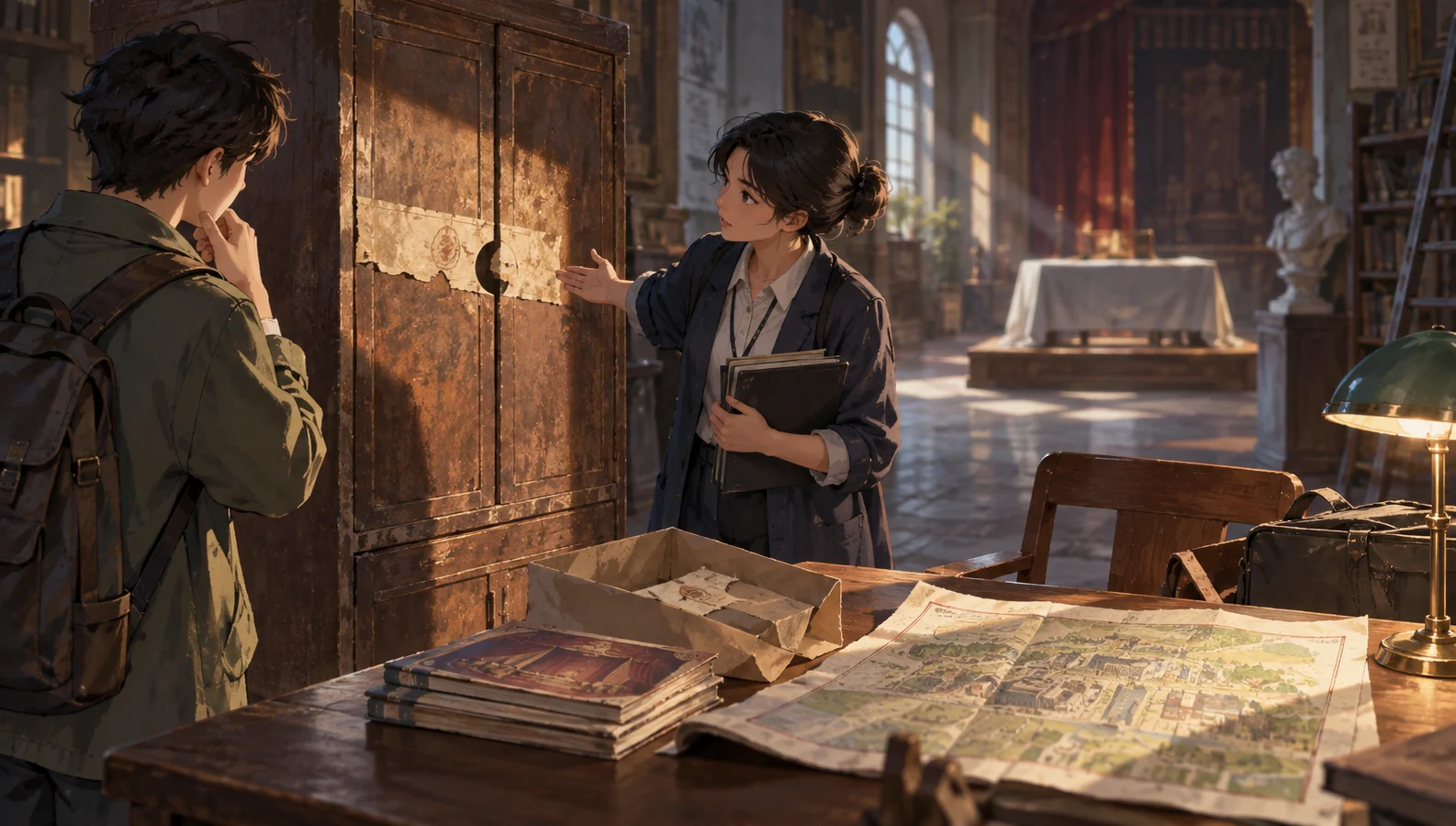
The following is a fictional teaching example: an old theater is about to close, and the player and its caretaker, A-Lan, must move a cabinet of performance archives to the reading room. The characters, setting, dialogue, and outcomes are original examples, not a real user case, tested results, or product features. Nor do they imply that DramaFork will handle these steps automatically.
An old seal spans the gap between the cabinet doors. The player can choose “Move the entire cabinet and preserve the seal” or “Break the seal and take only the programs.” Moving the entire cabinet will occupy the central display table. Taking only the programs leaves space to spread out a map, but the seal will no longer be intact.
The scene preserves a tradeoff between maintaining the original condition and gaining immediate access to the contents. How the two people lift the cabinet or get it through a narrow doorway is not the main point to assess. First, write down the consequences that must survive: “The whole-cabinet route preserves evidence that it has not been opened; the programs-only route provides programs that can be read immediately.” Then specify the cost: “The former occupies the display table; the latter changes the archives’ original condition.” This determines which images must appear later.
Use a Three-Part Action Replacement Table to Guide the Rewrite
Copy this table into the storyboard and fill it with things that can be seen or heard, rather than abstract instructions such as “convey effort.”
| Section | Required content | Whole-cabinet route in this example |
|---|---|---|
| Preparation | Evidence that the choice has been confirmed | The player points to the entire cabinet; A-Lan repeats, “Keep the seal intact” |
| Omitted execution | How the scene transitions in time or location | Cut away while the cabinet is still in the old storage room; a caption reads “After the move” |
| Result check | The same object and its changes | The cabinet with the crescent-shaped notch appears in the reading room, its seal intact |
| Follow-through | Which action the new state changes | The display table is occupied; A-Lan takes the map out of their bag and spreads it on the side table |
The first three rows form the scene; the last constrains what happens next. Preparation confirms intent, the post-move scene demonstrates the result, and the omission between them only connects time and space. It does not decide on the author’s behalf that the action succeeded.
You can also add a rule beside the table: “Do not quietly introduce new facts.” Damage, loss, or changes in relationships that were not part of the choice’s conditions must not suddenly appear simply because the process was not shown. If you need an unexpected event, separately write a traceable cause and feedback that conveys what happened. Once preparation has confirmed that the seal will remain unbroken, the post-move scene need not repeat that promise. Use the space to show the actual consequence of the occupied display table.
Write Both Routes as Ready-to-Use Scenes
In the shared opening, first show the seal spanning the gap between the cabinet doors, then the reading room’s empty central display table and side table. Pointing to the venue markers on the map, A-Lan says, “First, use the map to identify the venue we want to check. Then find that venue’s performance records in the programs and check the dates.” The map identifies locations; the dates come from the programs and cannot be established from the map alone.
A-Lan folds the map and puts it in their bag, then says, “If we move the whole cabinet, it gets the display table. If we take only the programs, we have to break the seal.” The map has not yet been spread on the display table. Both routes begin from the same initial state.
Preparation for the whole-cabinet route: the player sticks a card marked “Reading Room” to the cabinet’s side and answers, “Move the whole cabinet. Leave the seal intact.” A-Lan withdraws the hand reaching toward the seal. The camera holds on the crescent-shaped notch in the cabinet’s side, then cuts to an empty corridor. A time caption reads “After the move.”
The post-move scene takes us into the reading room: the cabinet with the same notch occupies the display table, and the intact seal still spans the gap between its doors. A-Lan takes the map out of their bag, spreads it on the side table, and says, “The display table’s taken. Let’s identify the venues here first.” The next choices are “Examine the venues on the map” and “Decide whether to break the seal.” If the player continues to preserve the seal, they cannot yet read the programs inside the cabinet to check the dates.
Preparation for the programs-only route: the player says, “Take only the programs.” Then show the static result of unsealing the cabinet: the seal has been detached from the cabinet doors and placed in a paper bag labeled “Old Cabinet.” There is no need to film the full process of opening the cabinet and packing its contents into boxes.
After the omission, the programs and the paper bag containing the seal sit at one corner of the reading room’s display table. The rest of the tabletop is empty. A-Lan takes the same map out of their bag, spreads it in the available space, and points to the venue markers. “Which venue’s performance dates should we check first?” Once the player identifies a venue, they can open the programs immediately, but the cabinet can no longer be described as “never opened.”
Both routes connect to the shared objective of identifying a venue and then checking the corresponding performance dates. Their respective conditions still apply after they converge: on the whole-cabinet route, the player can examine the map first but must make a separate decision to break the seal before reading the programs; on the programs-only route, the programs can be opened immediately. The map remains on either the side table or the display table, depending on the route. Removing the carrying action does not remove these conditions.
Choose a Replacement Based on What the Audience Needs to Know
An explicitly marked time jump suits this example because the suspense does not concern whether the move succeeds. To keep the atmosphere uninterrupted, you could keep the camera outside the doorway and use offscreen dialogue to connect the two spaces before cutting to the result. Sound, however, can only convey the action taking place. It cannot by itself prove that the seal is intact or that all the objects are present.
If the post-move scene is also difficult to show in full, use three close-ups: the notch in the cabinet’s side, the intact seal, and the obscured edge of the display table. Together, they establish identity, condition, and location. The details need clear spatial connections, or the audience may think they are seeing cabinets in different places.
You could also change “move the entire cabinet” to “take one program.” This changes the original tradeoff, so the choices and consequences must be rewritten together. You cannot retain a “Move the entire cabinet” button while delivering only a single program.
If the core gameplay involves choosing the carrying order, the route along the way, or the person who receives the objects, jumping straight to completion removes decisions that have not yet been made. Preserve the necessary choices before the omission, or turn the points of divergence along the way into static scenes at stops during the move, showing each decision and its resulting change.
Compare Before and After to Find Rewrites That Do Not Work
A common failure is to give both routes the same post-move image and change only a line to “Done just as you asked.” The dialogue acknowledges the player’s choice, but the audience cannot find any difference in the cabinet, seal, or display table. Add the crucial differences before considering more dialogue.
Another failure is broken prop continuity: the seal spans the door gap during preparation, but afterward only a piece of paper remains on the table. If the intention is to show that the seal has been preserved intact, this instead supports the conclusion that the cabinet has been unsealed. Check positions and connections, not just whether each prop appears.
Check the map too: it goes into the bag first and comes out only after the move, when it is spread on the side table or the free part of the display table according to the route. If you change this to “remove the map from the display table,” you must also rewrite the table’s initial state and explain how space is cleared before the cabinet occupies it. Check what each source of information is used for as well: the map identifies the venue, while the programs provide the corresponding performance dates. The route that preserves the seal must not complete the date check using the map alone.
Before handing over the script, place each route’s preparation and post-move images side by side and temporarily hide the explanatory dialogue. Answer these questions one by one: Is this the same object? Has its location changed? Is the condition that had to be preserved still intact? Where is the cost visible? Does the next action fit the current state?
Hiding the dialogue is only a method for reviewing the script, not a validated guarantee of effectiveness. If a crucial fact depends on a single line to hold true, have that line point to something specific and visible. If the before-and-after images contradict each other, fix the images first. The three-part replacement can omit execution details, but an announcement of completion cannot stand in for the consequences of the player’s decision.