A Fictional Book Restoration Story: Consequences for Keeping Annotations or Restoring a Blank Page
Keeping, removing, or separately preserving annotations in an old book should change how later readers understand it. Use a value–treatment–documentation–payoff table to give each choice a gain, a loss, and a closing action.
Decide Who Gains What Before Writing Whether to Restore the Page
To give both intervention and nonintervention consequences readers can recognize, make the choice change three things: what the next reader sees first, who must explain their judgment, and which questions can still be investigated later. Keeping annotations does not necessarily mean respecting history, and restoring a blank page does not necessarily mean erasing memory. A choice becomes meaningful when it protects a specific goal while giving up another convenience.
This article uses an original fictional teaching example, The Last Page Left Blank. Its characters, book, and treatment outcomes are narrative inventions, not a real user case, tested results, or product features. “Restoring a blank page” refers only to the final state of an originally blank page within the story. It does not describe real techniques for restoring old books.
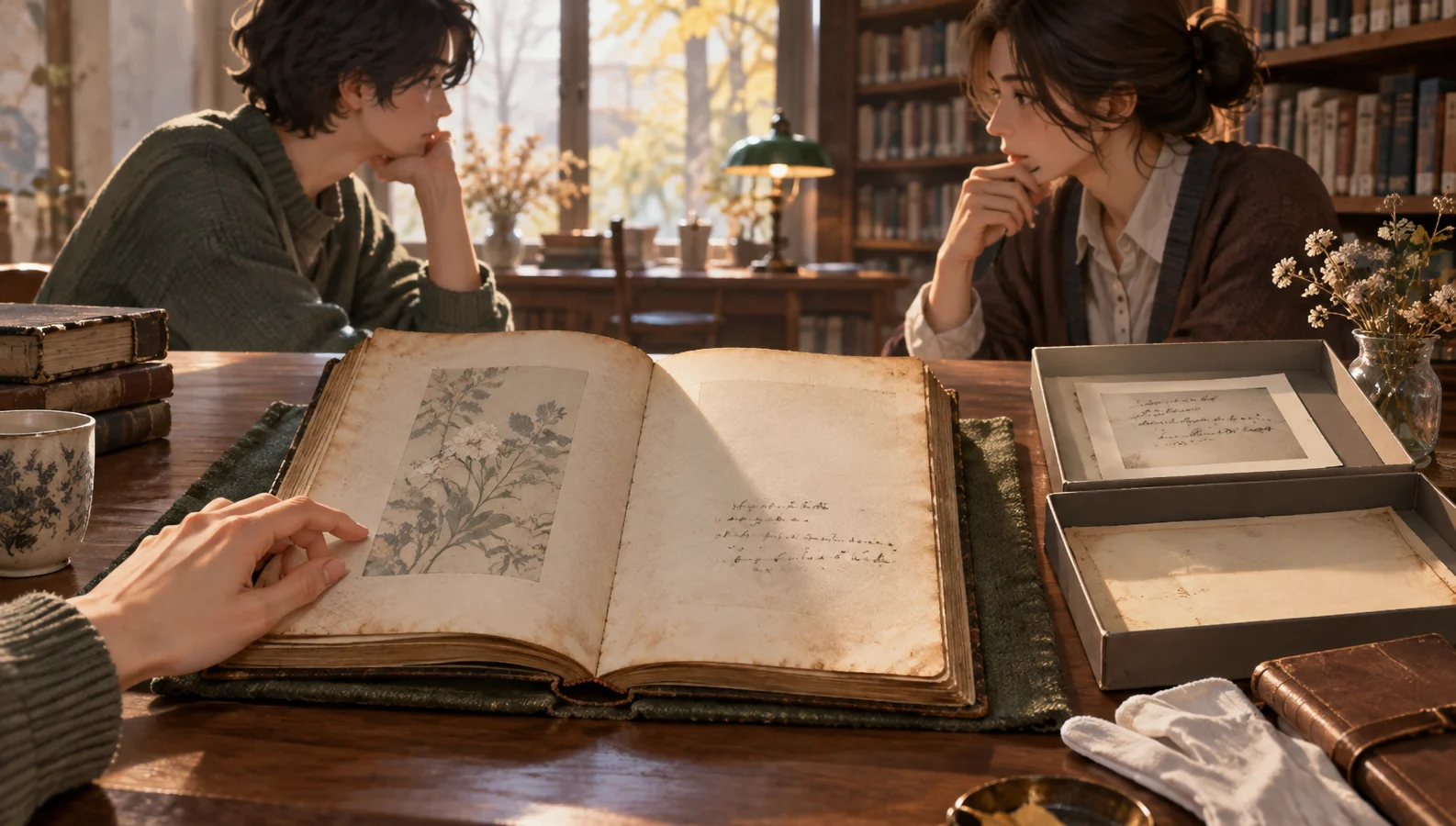
The player handles the handover at a small-town reading room and must decide whether to keep readers’ annotations on the last page of an old poetry collection. The book will remain available to readers after the handover. The decision concerns both the appearance of an old object and how the next reader approaches the poem.
Give every branch one gain, one loss that no backup can fully recover, and a closing action that changes as a result. Do not choose the “correct answer” first and then arrange punishments for the other options.
Put the Conflict on One Page and Separate Facts from Guesses
The poetry collection’s final page originally had no printed text. It now has two handwritten annotations: “My wait for him was finally rewarded.” Below it is another line: “Perhaps she wasn’t waiting at all.” The handwriting differs, and neither line is signed. By the opening of the story, the player has already seen this page. The handover catalog records only that the Zhou family donated the book; it does not identify the annotators.
Zhou Yao, a descendant of that family, wants to keep the handwriting: “At least don’t end their argument for them.” Lin He, who leads the shared reading sessions, wants to restore the blank page: “Whenever we turn to this page, everyone starts arguing about these two sentences. Nobody talks about the poem anymore.” These are the two characters’ wishes and observations, not the author’s verdict on whose values rank higher.
The confirmable facts are the wording, placement, difference in handwriting, absence of signatures on both lines, and contents of the catalog. The annotators’ identities and when they wrote the lines are unknown. “Zhou Yao’s grandmother wrote the first sentence” is only Zhou Yao’s guess. “The second sentence argues against the first” is also an interpretation. The ending must not suddenly confirm that the grandmother wrote one of the lines and reward players who preserved it with a hidden identity reveal.
Both characters can have reasonable needs. Zhou Yao wants the disagreement left by unnamed readers to remain visible; Lin He wants new readers to form their own interpretations first. The conflict concerns the allocation of attention, not who understands books better. Both characters should also know before the handover that keeping a separate record is an option, so the player does not have exclusive access to that information.
Use One Table to Give the Three Treatments Different Trade-Offs
The following value–treatment–documentation–payoff table can be adapted by replacing its contents. Each row must stand on its own. The third cannot claim all the benefits of the first two.
| Treatment | Value given priority | Gain and loss | Documentation and ending payoff |
|---|---|---|---|
| Keep the annotations on the original page | Continuity of reading traces | Later readers can see the disagreement on the same page; their first reading is still drawn toward earlier judgments | Record the current state and unidentified authorship; a new reader first asks who wrote the words |
| Restore the originally blank page | New readers’ starting point for interpretation | The last page no longer steers the discussion in advance; readers no longer encounter the old handwriting while reading the book | Keep a record of the wording and placement; Zhou Yao can recount the past only through that record |
| Keep the annotations separately and leave the last page blank | Letting readers choose whether to encounter earlier interpretations | The earlier remarks remain available; readers must actively seek them out, and the words are no longer on the original page | Create an accessible separate record; in the ending, some consult it while others stop with the poem |
The distinction between the second and third treatments must be concrete. In the second, the record goes into the handover archive to explain what happened. In the third, a separate annotation record is provided for readers to consult by choice. Before the decision, the author must explain what each record is for and how it can be accessed. Changing only the option names is not enough.
Separate preservation has a cost too. Once extracted, the words can look like two isolated opinions, and readers may not realize that they once shared a page. Even if their positions are recorded, the experience of turning to the last page and directly encountering two different hands is gone. This preserves access to the annotations, but cannot fully preserve the way readers encounter them.
Fill In a Documentation Form and Connect the Ending to the Player’s Decision
Documentation prevents the author from casually changing the account later. It does not prove that one choice is morally superior. Whatever path is chosen, first retain a common handover record, then let the treatment determine how that record appears in later scenes.
Copy this form and replace the information in brackets:
- Object and scope: [Which book, which page, and what changes].
- Observed content: [Exact wording, relative placement, visible differences, and whether signatures are present].
- Unknowns: [Annotators’ identities, time and order of writing, and motives].
- Decision and reasoning: [What is chosen, whose needs take priority, and which specific need the choice serves].
- Later access: [Who can find which records, and where].
- Irrecoverable loss: [The reading experience that the record still cannot replace].
Filled in for the third treatment: the object is the two annotations on the poetry collection’s last page. Observed content includes their original wording, upper and lower placement, different handwriting, and the fact that neither line is signed. The annotators’ identities, time and order of writing, and motives remain unknown. The player chooses separate preservation so that new readers can read the poem first, then decide for themselves whether to encounter earlier opinions. The separate record goes in the shared-reading folder, with its location indicated in the catalog. What cannot be recovered is the immediacy of encountering two different hands when turning to the poetry collection’s final page.
The ending could follow through like this: a new reader, A-Jian, closes the poetry collection and says they think the person in the poem has already left. Lin He points to the folder: “Someone once found a sense of waiting in it. You can take a look if you want.” A-Jian turns to the record, pauses, and reads “Perhaps she wasn’t waiting at all” aloud to Zhou Yao. This time, Zhou Yao does not mention the grandmother, saying only, “We still don’t know who wrote it.”
This payoff establishes three things: A-Jian forms an interpretation first and then actively chooses to read the annotations; the old voices have not vanished; and Zhou Yao cannot present a guess as a fact about authorship. The ending need not announce that the player did the right thing.
Use the same shared reading session to bring the other two paths to a conclusion. If the original page is preserved, A-Jian first asks about the handwriting, and Lin He must bring the discussion back to the poem. If the blank page is restored, A-Jian talks directly about the poem, while Zhou Yao opens the handover archive and discovers that all they can do is describe what the page once looked like. When loss appears in an action, readers can perceive it.
Check for False Choices and Mark the Story’s Boundaries
The most common failure is to have all three paths lead to the same sentence: “At last, everyone understood one another.” Compare the characters’ opening actions in each ending. If the differences disappear when you remove the option names, return to the table and specify who encounters which information first, rather than adding more reflections.
Another failure is to make separate preservation a universal answer. If it introduces no search burden, change of context, or difference in the order in which readers encounter the material, it makes the other choices redundant. Conversely, do not make the folder disappear out of nowhere just to balance the options. Costs should arise from the treatment itself and be knowable before the decision.
If the player insists on postponing the decision, the author can let the reading room proceed with the handover in the book’s current state for now, explicitly stating that the decision remains unfinished. The annotations still affect shared reading during the delay. Postponement should not be equivalent to leaving the story, nor must it be punished. If the entire story permits only three treatments, establish in advance the fictional condition that this handover requires a decision about how the page will be displayed.
Finish with one check: can the changes in the ending be traced through known information to the player’s choice? If they can, they are consequences. If they can be explained only by a sudden secret reveal, they are another plot twist. This table is for trade-offs in fictional narratives, not for deciding how real books should be treated.