When the Player Chooses Silence, How Should the Camera Continue?
Silence can advance a conflict, but it cannot admit an accusation on the player’s behalf. Use a staging card to separate player intent, character assumptions, and narrative facts, then design three continuations that show where misunderstandings come from and leave room to correct them.
Let the camera carry the pause without answering for the player
When a player does not answer an accusation, the camera can keep rolling, but it may only advance what happens in the scene. It must not decide the player’s position for them. The other character can become impatient, guess wrong, or change the subject. Narration and subsequent scenes, however, should not record those guesses as “the player has agreed,” much less equate saying nothing with leaving.
First, distinguish two inputs: the player selects “Don’t answer for now,” or the player submits no choice at all. The former explicitly chooses a behavior; the latter does not even establish whether that behavior has occurred. If the work intends the character to remain quiet after a timeout, it should explain that rule before the choice. Even then, all that is established is that the character did not speak, not why they remained silent.
A reusable principle is to confirm outward behavior, leave inner intent open, and keep other people’s judgments attributed to them. The camera shows how the pressure changes; the next choice lets the player decide whether to explain. This makes silence part of the drama, rather than a confession button hidden in the playback sequence.
For the same accusation, first fill out a silence staging card
The following is an original fictional teaching example. It is not a real user case, does not represent tested results, and is not an existing DramaFork product feature. All three continuations are design proposals for writers and storyboard artists to compare.
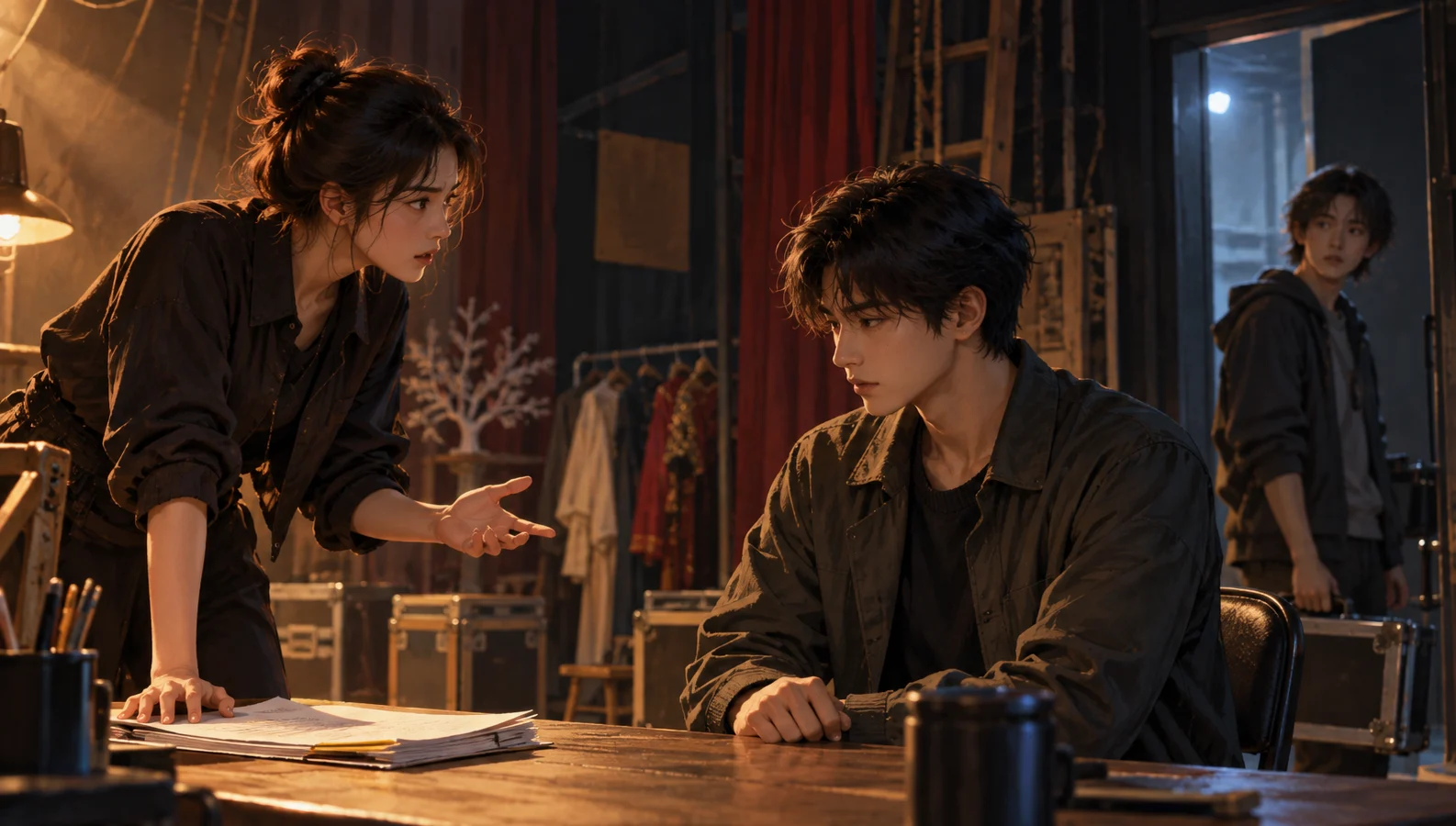
After rehearsal at an old theater, Zhou Lan discovers an altered program and asks Lin Zhou, the character played by the player, “Did you remove my name?” A companion is waiting at the doorway to collect props. The player knows the program has passed through several people’s hands but cannot yet identify who changed it. Choosing “Don’t answer for now” could mean sorting through clues, avoiding a public argument, or observing Zhou Lan. The author cannot use that button alone to assign any one of those motives.
The card below can be copied directly into a node script. Every cell must contain a filmable action, audible dialogue, or an explicit story record, rather than merely “the atmosphere is tense.”
| Field | Example for this scene |
|---|---|
| Confirmed input | The player chooses not to answer for now |
| Certainty about intent | The reason is unconfirmed; do not invent inner thoughts |
| Visible behavior | Lin Zhou stays where he is and does not speak |
| Another character’s interpretation | Zhou Lan suspects he is admitting it through silence, but has no evidence yet |
| Signal attributing the interpretation | Zhou Lan says, “When you act like this, I start thinking it was you” |
| Next opportunity to express a position | Explain the pause, suggest checking the facts, or continue not answering |
| Consequences that may persist | The companion has heard the argument; the accusation remains unproven |
The order matters: first establish the limits of what is known, then decide how the characters speculate. If you write the angry reaction first, you may later invent a motive for the player to make the performance seem justified.
Three continuations: leave space, ask a follow-up, or allow a misunderstanding
Option one: leave space in the shot and keep intent open. Hold a two-shot that clearly shows both characters’ positions. Zhou Lan waits a moment, then places the program on the table: “Tell me when you’ve thought it through.” Lin Zhou neither nods nor walks away. The choices “Examine the program,” “Ask the person at the door to leave first,” and “Continue not answering” then appear. These actions open paths for investigating, changing the conversation’s setting, and maintaining silence, respectively.
This option suits scenes where you want players to express their purpose through later actions. The tradeoff is that the conflict will not escalate immediately, so elements in the scene, such as the program and the companion at the doorway, must sustain attention. Do not use a lingering shot without characters as a substitute for emotional depth. If the pause yields neither a new action nor new information, shorten it.
Option two: have the character ask a follow-up so the player can define the silence. Cut to Zhou Lan’s reaction. She first looks toward the doorway, then asks, “Do you not want to talk here, or can’t you say anything right now?” Return to a composition that includes Lin Zhou and offer “Let’s talk somewhere else,” “I haven’t figured it out yet,” and “Don’t explain yet.” The first two let the player actively supply an intention; the third preserves room to decline an explanation.
A follow-up should not suggest only two possible motives and force the player to accept one. Zhou Lan’s guesses can be incomplete, but the choices must let the player reject her categories. This approach suits nodes where motivation will directly affect the next exchange. If every silence immediately prompts a demand for its reason, remaining silent becomes just another question the player must answer.
Option three: allow a misunderstanding, but make the camera show whose misunderstanding it is. Zhou Lan takes back the program: “If you won’t say anything, I’ll take that to mean you did it.” Keep this line in a frontal shot of her, without overlaying a result label such as “Accusation admitted through silence.” The companion at the doorway looks toward Lin Zhou, but does not nod on his behalf. Immediately offer “Interrupt: I haven’t admitted anything,” “Ask to check the facts together,” and “Put up with this misunderstanding for now.”
Here, the scene advances because Zhou Lan acts on a mistaken judgment, not because the author declares the accusation true. This suits scenes that need friction between characters, but it also costs more to produce: later dialogue must distinguish “she thinks you admitted it” from “you actually admitted it.” If subsequent scenes cannot preserve that distinction, choose one of the first two options instead.
Follow the third option through: correcting a misunderstanding does not undo everything
Suppose the player chooses “Interrupt: I haven’t admitted anything.” Lin Zhou says, “Just because I didn’t answer doesn’t mean I admitted removing your name.” Hold the shot until he finishes the full line before cutting to Zhou Lan. She replies, “All right. Then let’s find out.” They spread the program back out on the table and begin checking it.
At this point, preserve three separate facts: Lin Zhou has not taken responsibility for removing the name; Zhou Lan previously interpreted his silence as an admission; and the companion at the doorway heard the argument. The opportunity to clarify corrects the misreading of silence as an admission without erasing the other two events from the story. Later, the companion may ask, “Why were you two arguing earlier?” They cannot treat “Lin Zhou admitted removing the name” as an established event.
If the player chooses “Put up with this misunderstanding for now,” the next scene can still provide a natural opportunity to correct it. For example, when the companion repeats Zhou Lan’s account, let Lin Zhou respond, “That was her judgment.” This does not guarantee that all consequences can be reversed at any time. It prevents a temporary decision not to argue from becoming a permanent confession.
Place the clarification before consequential action. If Zhou Lan is about to announce her conclusion publicly, the player needs an opportunity to speak first. Do not wait until every relationship has broken down to offer an explanation no one will hear. In scenes where an interruption truly is impossible, establish that limitation in advance and let a later response change at least one thing that can still be changed.
Use four counterexamples to check whether the camera oversteps
The first failure is smuggling in an action. The player only chose not to answer, yet the actor nods, hands over a note admitting fault, or turns and leaves. Each action carries additional meaning and should be an explicit choice, not a supposedly harmless transition.
The second failure is conviction through editing. Zhou Lan delivers the accusation, the image cuts to Lin Zhou lowering his head, and a sound signals that the truth has been revealed. This can make a character’s suspicion look like the author’s conclusion. You can preserve the ambiguity of the lowered head, but do not settle its meaning with narration or a result label.
The third failure is an ineffective clarification. Although “I haven’t admitted anything” is offered, the subsequent scene still plays the confession branch word for word. Check every form of address, accusation, and reason for action after the correction. You should be able to identify at least one line changed by the clarification; otherwise, the opportunity is merely decorative.
The fourth failure is overprotection. If everyone understands silence accurately, the conflict loses the differences between characters’ perspectives. Let characters misunderstand, remain stubborn, or even refuse to believe the player, but make it clear that this is the other person’s reaction, not an intention invented for the player.
Before handing in the script, separately circle “observable facts,” “character judgments,” and “the player’s explicit statements” in the card and storyboard. Wherever either of the first two jumps directly to the third, add a choice or remove the conclusion. Silence can make the situation harder, but it should not take away the player’s right to explain what they did.