Hacked: The Streamer Low-Spoiler Clue and Ending Route Log Template
Based on public information on Steam, this guide outlines clue categories, decision questions, and methods for logging ending routes in Hacked: The Streamer.

Introduction
To protect PinkyPie, start by building a chain of evidence rather than guessing which line of dialogue sounds most like the correct answer. Distinguish facts you have directly confirmed from other characters’ claims and your own inferences; before making a choice under pressure, check four categories of clues: identity, devices, relationships, and timing.
Four Categories of Clues
Identity clues answer “Who is contacting her?”; device clues record accounts, files, and unusual actions; relationship clues explain who has opportunities to approach or influence her; timing clues check the sequence of threats and livestream events. The official description mentions focus/memory mechanics, but how they are triggered must be confirmed in actual gameplay.
Ask Three Questions Before Choosing
Does this action actually reduce risk, or does it only quiet things down temporarily? Could it expose new personal information or a location? If the other person is lying, do I still have room to verify and back out?
These questions form a spoiler-free decision framework, not official walkthrough answers.
How to Verify the Five Endings
| Item | What to Record | Verification Standard |
|---|---|---|
| Clue | How it is obtained, whether it can be missed | Can be obtained repeatedly |
| QTE | Success/failure and consequences | Changes only the execution outcome |
| Choice | Original wording, timer, prior state | Visible differences appear later |
| Ending | In-game name | Independently reproduced twice |
Real-world account breaches or extortion should not be handled according to game logic; preserve evidence and use platform, professional organization, or law enforcement channels.
This article does not offer definitive answers such as “a particular option will always protect the character,” nor does it treat third-party video walkthroughs as verifiable official conclusions.
How to Use the Focus and Memory Mechanics
The official description presents focus and memory as ways to discover clues. When logging a route, specify the scenes in which they become available, whether they consume resources, whether you can return after missing something, and whether discovering a clue immediately changes the available options. If a clue only adds background information, label it “additional context”; only if it unlocks a new action does it count as a route condition.
After each clue discovery, save three types of evidence: the screen before the action, the clue’s contents, and the feedback that follows. Keeping only the final options loses what readers need most: “why this option appeared.”
Protecting a Character Does Not Mean Always Complying with Her
Stories about online extortion can easily conflate “making the character happy” with “reducing risk.” A decision may ease distress in the short term while exposing more information; it may also damage trust while preserving channels for seeking help and verification. A walkthrough should record safety, relationships, and public image separately rather than summarize every consequence with a single affinity score.
Likewise, making information public is not necessarily always right, and remaining silent is not necessarily always safe. Whether a decision is reasonable depends on the evidence available, the reach of the information, the other party’s capabilities, and whether the action can be reversed, rather than applying a single piece of real-world advice across the board.
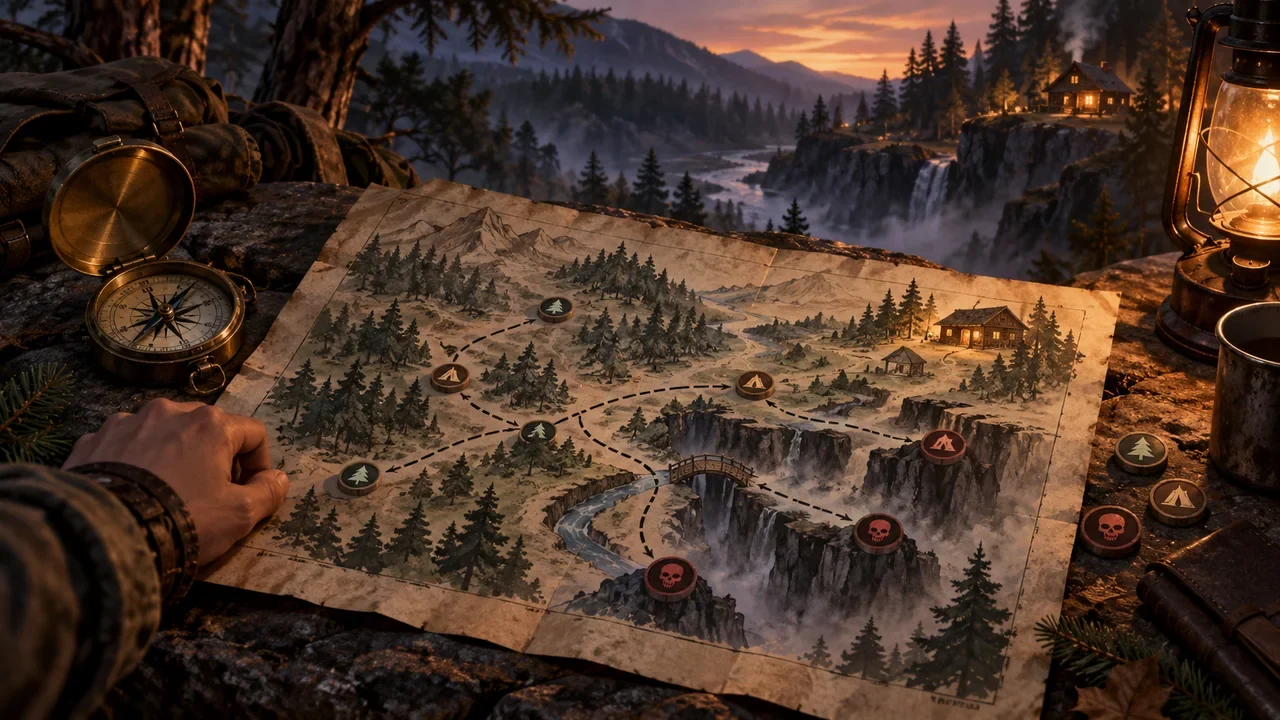
How to Build a Five-Ending Tree Backward
After completing a baseline route, change one choice at the nearest node before the ending. If the ending stays the same, observe whether relationships or information differ; then work backward step by step to find the actual control points. Each time you confirm a control point, connect it to the required clues, QTEs, and character states.
The ending tree should distinguish “verified necessary conditions” from “possibly related conditions.” Only after ruling out alternatives through controlled comparisons should you label a state as a necessary condition, so that two events occurring on the same route are not mistaken for cause and effect.
Real-World Safety Boundaries
A game can turn risky exchanges into dramatic conflict, but real-world breaches, extortion, or threats to personal safety call for prioritizing evidence preservation, account protection, and contact with platforms and trusted professional organizations. A walkthrough must not present game options as a guide to handling real situations, or encourage readers to keep engaging with attackers to verify their identities.
Fields Needed for a Route Log
For each ending, record the trigger time, chapter, prior state, and in-game name; mark the chapter and appearance location in the key clue table; maintain a separate checklist for the 17 achievements. This keeps the article text-only while allowing readers to verify routes and quickly locate conditions that no longer work after a version update.
Sources
- Hacked: The Streamer — Steam (Verified: 2026-09-22)
A Safe Template for Logging a Playthrough
For each node, record the time, objective, visible information, available abilities, choice, immediate feedback, and subsequent changes. For abilities involving privacy or manipulation, also specify whether the target is aware, whether the information is necessary, and whether an alternative path exists without using the ability. This reveals whether a “success” comes from reasoning, resource management, or reading the answer at no cost.
When reviewing an ending, separate technical success from character outcomes. Successfully stopping an event does not mean relationships were unharmed, and obtaining a secret does not mean you have the right to share it. A walkthrough that pursues only the shortest path to completion will miss the work’s discussion of trust and boundaries; a better route comparison should explain efficiency, the amount of information gained, relationship costs, and irreversible consequences together.
If a game update changes the limits of abilities, reverify key nodes and note version differences alongside earlier conclusions. Do not treat hacking depicted in the story as real-world operational guidance; this article analyzes only fictional mechanics and the consequences of choices, and provides no steps for bypassing the security of real systems.