When Branches Rejoin, How Do You Preserve the Player’s Earlier Choices?
When routes return to the same place, earlier choices should still leave a trace. An original waiting-room example shows how information, items, and promises survive a merge.
Introduction
If two routes both end up back in the waiting room, does that mean the earlier choices were pointless? Not necessarily. What determines whether those choices leave a trace is whether the story still remembers what you did when you return.
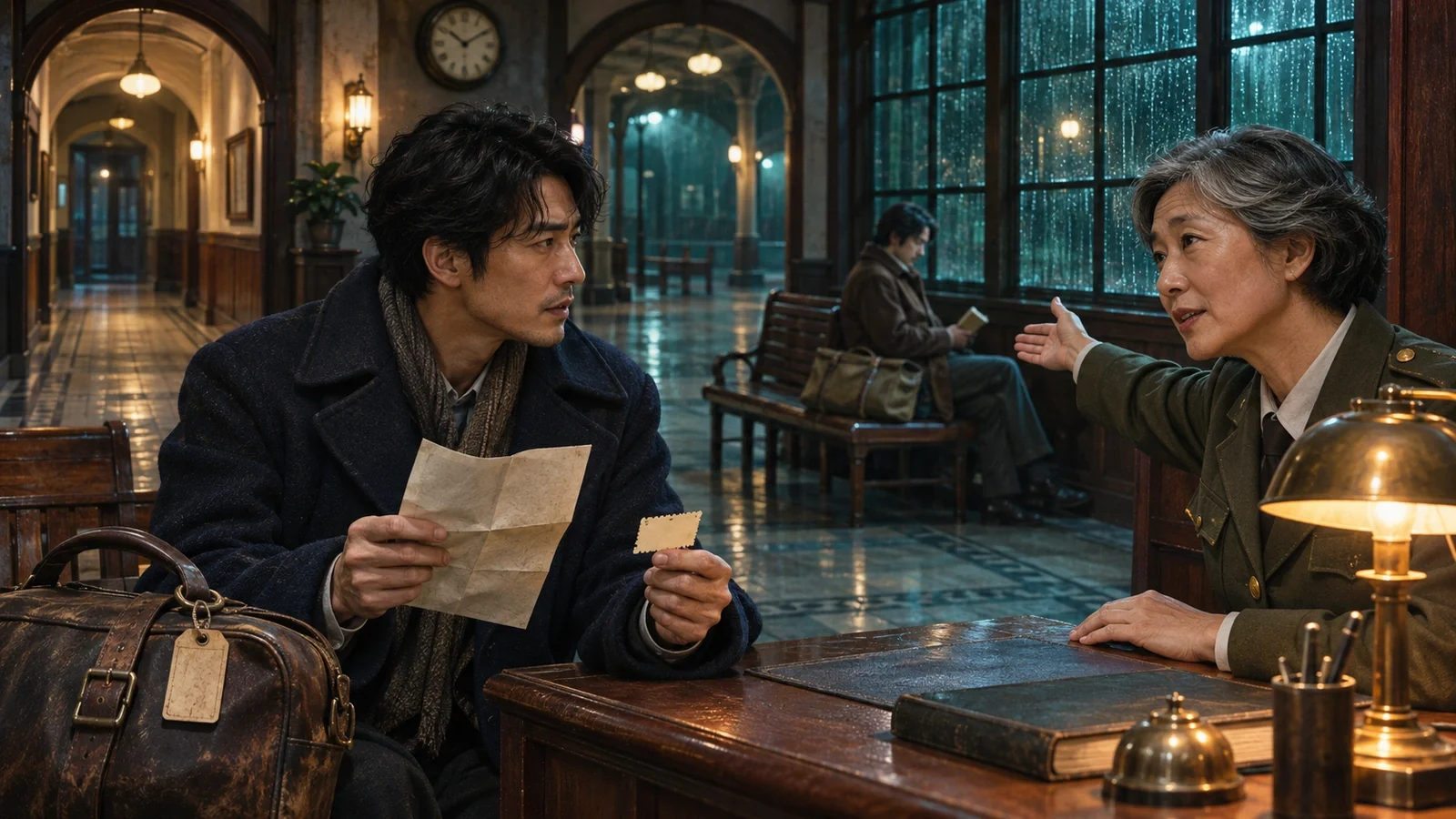
Suppose the player needs to tell a traveler that the last train’s platform has changed. Route A first takes the player to the noticeboard to verify the change; Route B first takes them to the attendant to ask where the traveler is. Both routes eventually return to the waiting room, but the player arrives with different information.
The location can be the same without resetting the state
Merging branches keeps the number of scenes manageable; it should not erase what happened along the way. On Route A, the player knows the new platform but still does not know where the traveler is sitting. On Route B, the player has found the traveler but has not yet checked the platform. The next passage cannot tell both players, “You know nothing about this,” nor should it give everyone the benefits of both routes for free.
Start by making a small table for the merge point:
| What to preserve | Route A | Route B |
|---|---|---|
| Confirmed information | Platform change verified | Traveler’s location obtained |
| Missing information | Traveler’s exact location | Official notice of the change |
| Next step | Find the traveler and tell them | Verify the change, then tell them |
The two routes have not become entirely separate works, but they can still lead to different next steps. You can explore related experiences on the text games page and notice whether you prefer routes that split completely or come back together with their differences intact.
Record fewer judgments and more facts about what happened
“The player is conscientious” is not a useful way to track whether something has been checked. Clearer records would be “read the official notice,” “asked where the traveler is,” and “told the traveler that confirmation is still pending.” These facts can affect the available options and keep characters’ responses consistent.
You do not need a new variable for every line of dialogue. Record only changes that will matter later: knowledge, items, resources spent, promises made, and explicit refusals. Wording with no later consequences can stay in the narration.
The same cost should not be paid twice
If the player has already paid the luggage storage fee on Route A, they should not be forced to pay again after the merge. Checking “has stored luggage” is more reliable than checking “took Route A”: if a third route is added later, it can use the same fact.
The same applies to promises. If the user only agreed to pass on a message, do not write at the merge point that they have agreed to accompany the traveler for the entire journey on the last train. Anything they have not agreed to should be asked about again, and anything they have already refused must not automatically become available again just because the scene changes.
Dialogue after the merge should acknowledge the differences
When the player returns from Route A, the attendant might ask, “You’ve checked the platform. Have you found the traveler?” After Route B, the attendant might instead say, “The traveler is by the window. Have you read the official notice?” Both lines move the same task forward while acknowledging different experiences.
This approach is also useful when designing character IP chat: characters should respond based on facts already provided, without inventing a shared past or repeatedly asking for information that was just confirmed. How the website stores different types of memory depends on its actual features; writing advice must not be treated as a promise of functionality.
Read through each route separately
First follow only Route A through to the merge, then do the same with Route B. Check for sudden knowledge of things the player has not seen, missing items, repeated expenses, or rewritten promises. When you find a contradiction, fix the state tracking and conditions first; there is no need to add more plot immediately.
Merging branches can save space while preserving the weight of choices. As the scene moves forward, what the player has already done moves with it.