One Strange Event, Two Explanations: Writing Folk Mystery Without a Last-Minute Reversal
Three bell strokes at night: wind, a person, or a response? Folk mystery can leave questions open without undermining choices. Fix the facts first, then test both explanations.
Introduction
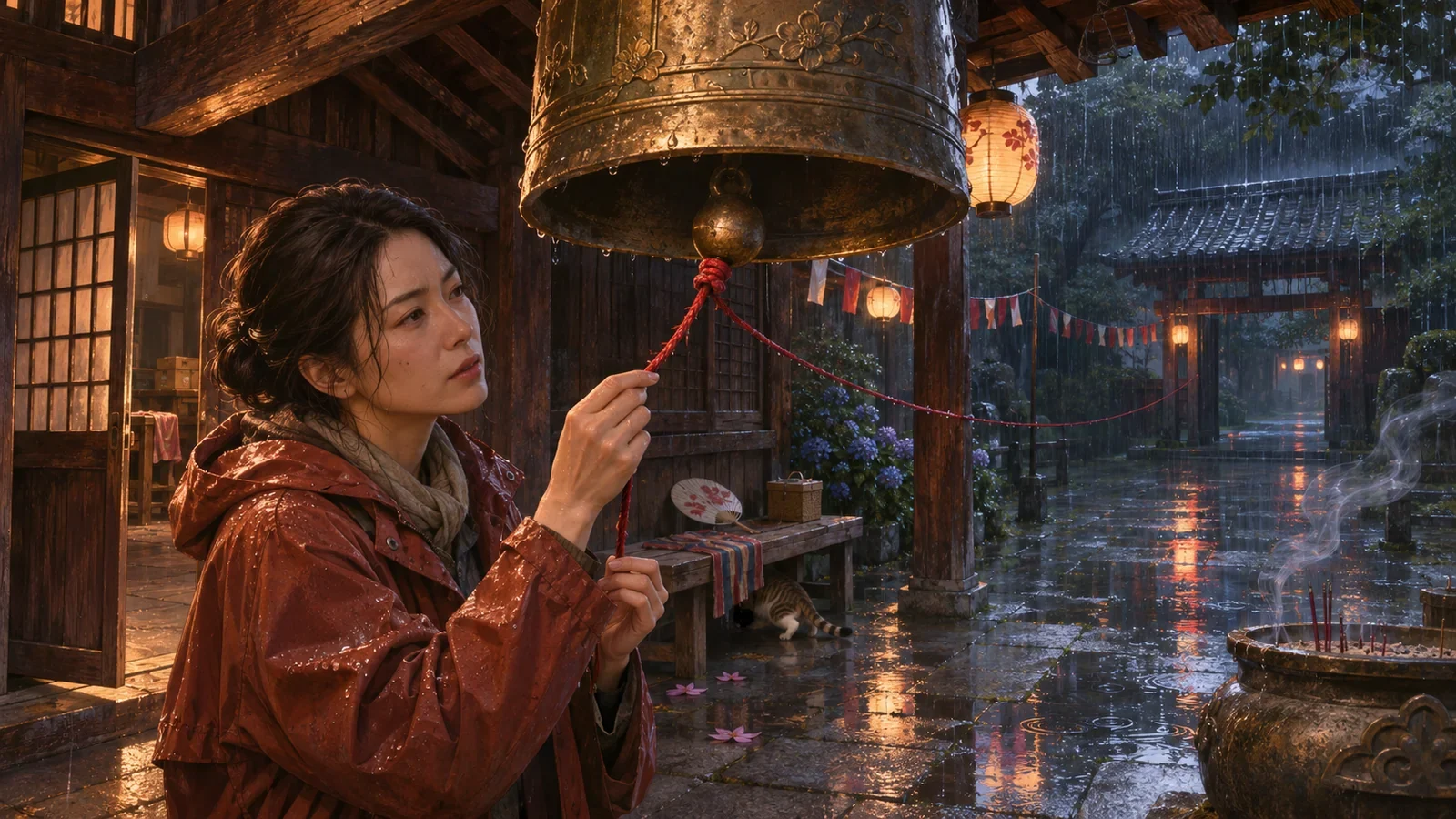
After the neighborhood temple fair ended, the bell rang three times. The courtyard gate was open, with no one at the entrance. By the next day, the neighbors had already supplied three different stories to explain those three strokes.
This is a good opening for a mystery. The trouble usually comes at the end: after a long, careful investigation, a final line—“It was all a hallucination”—wipes away every detail. Or one route establishes that someone pulled a cord, while another says the cord never existed, leaving the two routes with nothing in common but their atmosphere.
To keep both everyday and supernatural explanations possible, you need not decide at the outset which one readers should believe. First decide which events will never change their account just because the choices differ. The old temple, neighborhood temple fair, and characters below are all original fictional teaching examples. They are not based on real religious events and make no judgment about the truth of real-world beliefs.
The Strange Event Can Remain Unexplained, but What Happened Must Hold Up
First, establish what can be confirmed about that night: two volunteers closing their stalls both heard three bell strokes; the courtyard gate was half-open; a wet red cord was tied to the bell clapper; the gate latch was loose; no one saw who made the bell sound.
Here, “no one saw” does not mean “no one passed through.” Nor does “the gate latch was loose” mean “the wind has been proved responsible.” If the narration supplies causes for these observations too early, later claims that the truth is uncertain will merely contradict what it has already said.
You can leave the explanations to the characters. The elderly tea seller says it was a response to a particular request; the young volunteer suspects a prank. Both must account for the same red cord. Readers may favor one of them, but the object itself does not change to suit that preference.
If you are writing multiple routes, first check whether different narrators have treated the same past event as different facts. How to separate facts from interpretations across routes is useful for checking this kind of problem.
Give Both Explanations Real Support—and Leave Their Gaps Visible
| Confirmed observation | How an everyday explanation might account for it | How a supernatural explanation might account for it | What still cannot be concluded |
|---|---|---|---|
| Two people heard three bell strokes | Wind or a person's movements caused repeated impacts | A particular request received a response | The sound itself cannot identify who caused it |
| A wet cord was tied to the bell clapper | Someone left a cord for pulling or securing the bell clapper | Someone prepared a ritual beforehand, after which something unusual happened | The cord's existence does not prove who pulled it |
| The gate latch was loose and the courtyard gate half-open | Wind or someone passing through may have pushed the gate open | People may interpret the open gate as a trace of a visitor | A possible route through is not evidence that someone used it |
| No one witnessed anyone pulling the cord | Sightlines, timing, and lighting were limited | Those involved believe this exceeds their everyday experience | Not being seen is not proof of nonexistence |
This table is not meant to force every detail into a fifty-fifty balance. Some clues may strongly favor human involvement; others may remain unsettling. What matters is that the work does not quietly turn “unsettling” into objective proof, or give everyone an equally long argument merely to distribute space fairly.
One very concrete sentence can often do more than another strange shadow: “That cord wasn't there when I closed my stall.” This is a memory that needs checking. Who said it, when they said it, and what they could see at the time are all more useful than a mysterious laugh at the end of the sentence.
You Can Make Consequential Decisions Without Discovering Divine Intent
Should the second evening's activities continue? Should the red cord be left as it is? Are there enough people to close the stalls? None of these questions requires a verdict on whether supernatural forces exist, yet someone still has to bear the consequences.
In this short teaching example, the player has only one block of closing-up work time left: they can reinforce the courtyard gate first, or question another volunteer and leave the gate inspection until tomorrow morning. The former makes closing the gate tonight more secure, but costs a chance to check an account promptly; the latter may fill in eyewitness details, but means accepting that tonight the gate will still be secured with the existing gate latch. That block of work time can only be used once, and no one else will automatically take over.
Establishing “whether a god exists” is not the condition for completing this story. What the player actually accomplishes is deciding what to do first, and which unconfirmed matters to explain to their companions, without knowing every cause. Even if they never learn who pulled the cord, the arrangements they have already made will leave their mark.
Leaving Room for Interpretation Does Not Mean Letting the Interface Lie
“The courtyard gate was not fully closed” can be misinterpreted by a character. But if the player chooses to inspect the gate, and the work deducts their time only to say they did not actually inspect it, that undermines the basis for their actions.
An inspection may not yield a final answer, but it should at least answer the questions it promised to address: whether the gate latch is loose, whether the cord passes by the gate, and how much of the area is visible. If no one was seen, record that no one was seen; do not casually resolve it as “confirmed that no one came.”
This relates to the difference between an unreliable narrator and action feedback. Characters can guess wrong, but the actions performed, resources spent, and area actually examined must be clearly accounted for. Readers then have room to question the explanations within the story without having to question the choice they just selected.
Bring the Ending Back to What This Night Left Behind
If the player reinforced the courtyard gate first, the ending might show them putting away the tools with their companion, then listening to the elderly tea seller talk about that request. If the player checked the account first, have them return with the description they have just heard and explicitly put the still-unrepaired gate latch on tomorrow morning's task list. Both routes must follow through on what the player did and did not do.
As for the three bell strokes, two interpretations can remain. The ending does not need an extra shot that quietly endorses one side. Leave the red cord, the characters' explanations, and the small cost the player has borne in the same scene, and the story will leave something to reflect on.
After finishing, read it once from the perspective of someone who believes the everyday explanation, and once from that of someone willing to leave room for the supernatural: can both readings accommodate the facts already presented? If an explanation only works by deleting an earlier clue, go back and revise that explanation. Do not ask the player to forget the clue on the author's behalf.