 Most relevant
Interactive narrative
Best Interactive Movie Games in 2026: 7 FMV & CG Picks
Beyond Detroit: Become Human, what FMV games are worth playing in 2026? See Late Shift, The Invisible Guardian, and Love Is All Around plus guide and FAQ.

Creator blog
Discover practical AI tools, interactive storytelling methods, and production lessons—from the first idea to a story people can play.
Editorial / 01
Articles related to “interactive film”
The next move is yours
Do not wait for every video to be finished before testing the story. Build the characters, rules, and branches first, then let real choices guide what you make next.
Start with one story decision
Try a playable example
Interactive micro-dramas vs. interactive series vs. FMV games: play style, why young viewers stop for choices, and costs to make your own—plus table & FAQ.

Bulin 47 AI Video works as more than a face replacement. A familiar scene, one-photo entry, and instantly visible contrast let viewers imagine themselves inside the performance. This article separates that light participation loop from consequential interactive storytelling.

In an age of ever-dazzling visuals, the text game seems to move backward: no 3D scenes, no live action, only lines of text and choices. Yet it is what keeps players inside its world long after the screen goes dark. This article looks at the text game's most unique asset: it hands the work of imagery to the player's imagination

Interactive film games, text games, and character IP are rapidly converging under the influence of generative AI and changing user experience demands. This article examines their differences, crossover cases, product matrix strategies, and the possible future form of seamless interactive storytelling.

A bad ending should still bring a narrative to completion, rather than display “You failed.” It needs to help players understand which choices combined to produce the outcome, give them information or an emotional experience unique to that route, and provide a clear direction for their next attempt. An ending can be painful, but it should not feel as though the system suddenly pulled the plug.

Controlling branch explosion does not mean making every option immediately return to the same line of dialogue. It means separating “content paths” from “player state.” Paths can reconverge after providing feedback, while earlier choices continue to affect what follows through relationships, evidence, resources, or world state. Setting a branch budget for each chapter then lets the team reserve expensive permanent splits for the places that truly matter.
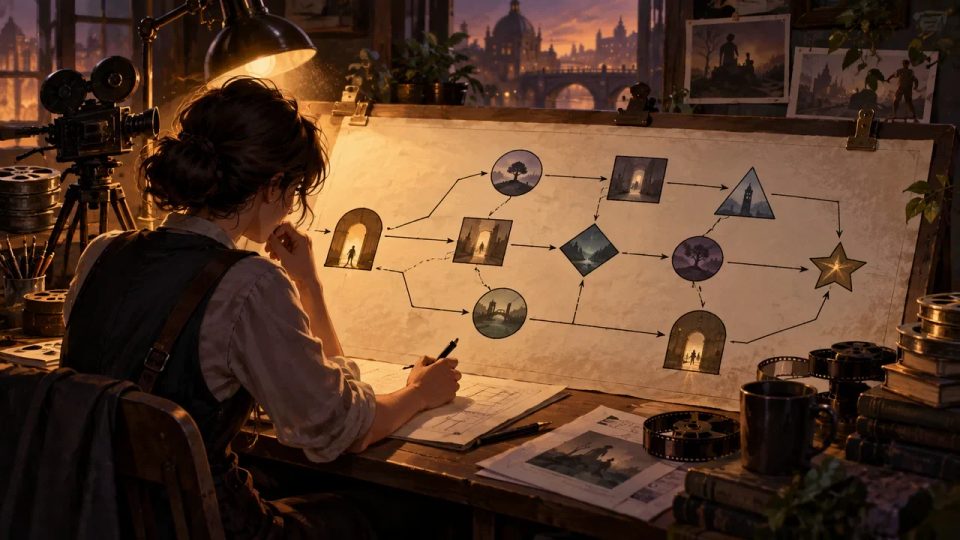
A branching diagram ready for production is a routing map shared by the team, rather than a story poster. Every node must have a stable ID, clear entry conditions, verifiable state changes, and explicit exits. The diagram answers “where do we go?”; the script answers “what do we perform?” Cramming entire pages of dialogue into a flowchart only makes both impossible to maintain.

The value of a variable lies not in how many there are, but in whether it can explain player behavior, change subsequent content, and be reliably maintained by the team. An interactive film game with manageable production usually needs only four layers of state: relationships, evidence, resources, and world facts. Every variable should have a single meaning, clearly defined write points, visible feedback, and an eventual payoff; variables that cannot meet these requirements should be merged or deleted.

Interaction formats are tools that help players complete different cognitive tasks, not seasoning. Untimed choices support deliberation, timed choices reveal instinct, QTEs create physical pressure, and clue combinations test understanding. Decide what players should think or feel at that moment before choosing an interaction format, so the entire work does not become a showcase of buttons.

The core purpose of choice text is not to shorten dialogue, but to help players understand what they are deciding. The most common confusion comes from mixing two kinds of promises: one asks players to predict the outcome of an action, such as “Pry the door open / Find the key”; the other asks them to express a character’s attitude, such as “Trust her / Question her.” Both can work, but every option in a set must use the same basis for comparison.

A meaningful choice does not have to open up an entirely new storyline every time, but it should do at least one of four things: change an outcome, demand a cost, use information the player has, or express a character’s position. An option that does none of these is just a page-turning button; teams can keep it to control pacing, but should not promote it as changing destiny.

Neither AI video nor low-budget live-action filming can turn any script into a consistently reliable finished work at low cost. A more reliable approach is to control, during writing, the number of characters on screen together, continuity across extended actions, scene changes, prop interactions, and shot length, and convert content that is difficult to produce reliably into sound, interfaces, text nodes, or reusable reaction shots.

A fair mystery does not require players to guess the whole truth in advance. It means that once the answer is revealed, they can look back and confirm that the key facts appeared and that they had a chance to reach a judgment closer to the truth. Hidden clues can be hard to find, but they must not depend on characters who never appeared, rules changed at the last minute, or explanations known only to the author.

A relationship map only shows who is connected to whom; it cannot explain what makes the suspense work. An interactive story also needs an information gap matrix: which facts each character knows, where they learned them, what they deliberately conceal, what they mistakenly believe, and under what conditions they are willing to speak. Often, players’ choices change the flow of information rather than the events themselves.

Choices in interactive film games cannot simply represent what the player wants to do; they must also be actions the character might take in their current circumstances. Character motivation does not restrict interaction; it establishes believable boundaries for choices. The same person can hesitate, lie, take risks, or change their position, but every change needs a reason rooted in desire, fear, information, or relationships.

The three-act structure can work for interactive film games, but you cannot simply finish a linear script and insert choices between acts. A more practical approach is to retain a fixed causal framework while letting players change the order in which they obtain information, character relationships, methods of resolving the conflict, and the final cost. The framework keeps the story moving, while variable nodes ensure that player actions are remembered.