Writing Choice Text: Are Players Predicting Outcomes or Expressing Attitudes?
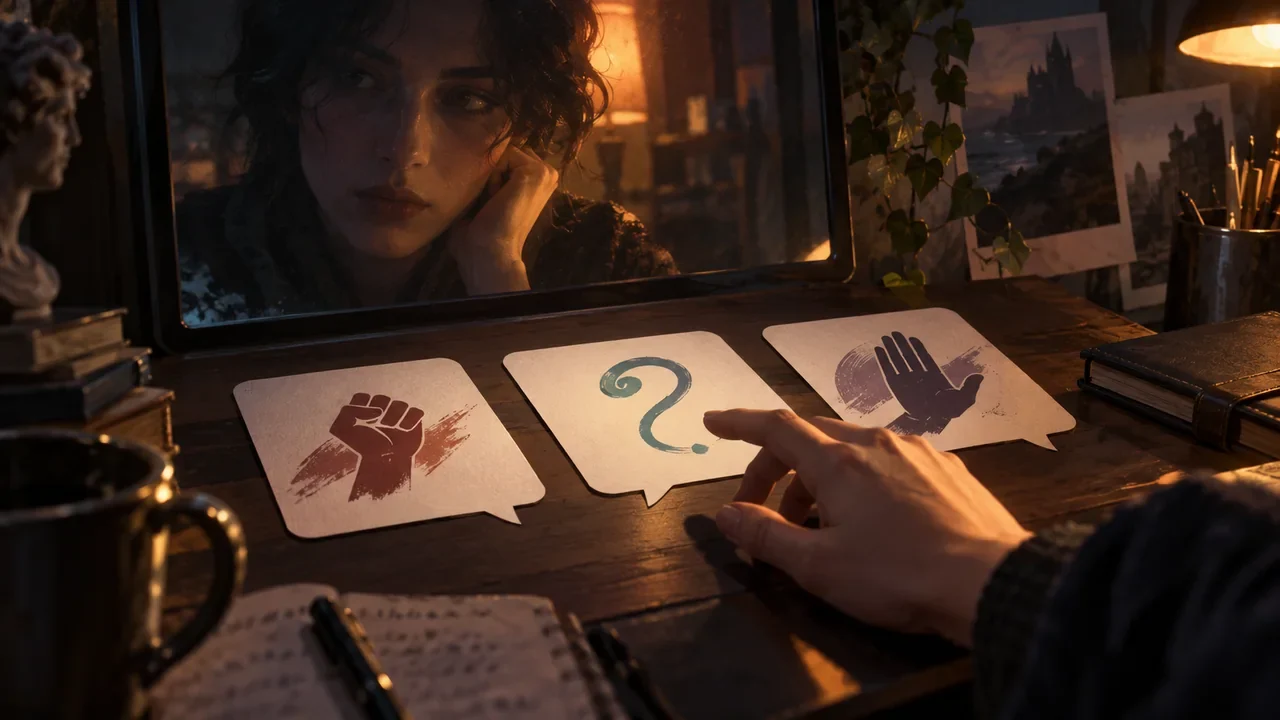
The core purpose of choice text is not to shorten dialogue, but to help players understand what they are deciding. The most common confusion comes from mixing two kinds of promises: one asks players to predict the outcome of an action, such as “Pry the door open / Find the key”; the other asks them to express a character’s attitude, such as “Trust her / Question her.” Both can work, but every option in a set must use the same basis for comparison.
Introduction
The core purpose of choice text is not to shorten dialogue, but to help players understand what they are deciding. The most common confusion comes from mixing two kinds of promises: one asks players to predict the outcome of an action, such as “Pry the door open / Find the key”; the other asks them to express a character’s attitude, such as “Trust her / Question her.” Both can work, but every option in a set must use the same basis for comparison.
First, Identify the Type of Choice
Action choices answer “What do I do next?” and are suited to advancing matters of space, resources, and risk. Attitude choices answer “What kind of person am I willing to become?” and are suited to shaping relationships and characters. Judgment choices answer “What do I think the truth is?” and are suited to detective stories and deduction. Management choices answer “Where do I allocate limited resources?” and are suited to management or survival systems.
For example, in 《零点回拨》, the protagonist hears a voice message from their missing partner. If the options are “Call back immediately / Check where the number came from first,” players are comparing speed and risk; if they are “She’s still alive / This is a trap,” players are expressing a judgment. Do not place “Trust her” alongside “Check where the number came from first”: the former is a stance, while the latter is an action, so players cannot tell how they compete with each other.
State the Intention; Do Not Hide the Action
Good choices allow unexpected outcomes, but they do not allow the character’s behavior to contradict the text. If a player selects “Ease the tension” and the character suddenly insults the other person, that is not a dramatic twist; it is a loss of control. The attempt to ease the tension can fail, and the other person can misunderstand it, but the protagonist must actually try to ease the tension.
A practical format is “verb + object + necessary cost.” For example:
- Make the recording public, risking a confrontation to press the supervisor for answers;
- Conceal it for now to protect your partner’s family;
- Delete the backup in exchange for ten minutes.
When interface space is limited, you do not have to spell out every consequence, but you must at least make the intention clear. Information that is genuinely unknown can remain unknown; immediate actions the character knowingly takes must not be deliberately omitted.
Create Real Tension Between Options
Three near-synonymous sentences are not three choices. “Comfort her,” “Comfort her gently,” and “Tell her not to worry” merely let players pick a line of dialogue. Effective choices usually put two values in conflict: truth versus relationships, efficiency versus safety, or personal commitments versus the public interest.
When reviewing each set of options, complete this sentence: “By choosing A, I gain ____, while giving up ____.” If there is nothing to give up, A is probably the obviously correct answer; if all three options offer and sacrifice exactly the same things, they are merely decorative branches.
Differences in Tone Must Be Acknowledged Later
Attitude choices do not necessarily need to split into three storylines, but they must leave a perceptible response. A character can respond with a different line, change how they address the protagonist, volunteer information later, or cause a relationship value to change. Otherwise, players will quickly learn that being gentle, being forceful, and staying silent are just three buttons for the same video.
Do not merely add or subtract values behind the scenes. A single cold response should produce at least one near-term echo; repeated cold responses can then accumulate into longer-term changes. This both keeps filming requirements under control and gives character development continuity.
Provide Enough Information to Reason About Outcomes
Action choices must be grounded in information players already know. If “Take the stairs” leads to an ambush, there should first be footsteps, a surveillance blind spot, or a warning from a companion; without any clues, choosing incorrectly is just a coin toss. Conversely, you should not label the answers directly as “Safe route” and “Death route.” The design goal is to make players exercise judgment, rather than recognize the designer’s color-coded hints.
You can construct a decision using “known facts + uncertain factors + time pressure”: players know the elevator is monitored, do not know whether anyone is in the stairwell, and the call will disconnect in thirty seconds. In this situation, both options have reasons in their favor.
Create a Choice Review Sheet
Before submitting the draft, record the following for each set: choice type, information known to the player, the intention of each option, immediate feedback, state changes, and the latest point at which the choice will pay off. Then ask four questions:
- Are all options at the same level of abstraction?
- Does the text accurately represent what the character will do?
- Can players describe the benefits and risks of each option?
- Would removing one option have almost no effect on the experience?
If the answer to the fourth question is “yes,” prioritize removing the weak option over forcing the set to contain three. A choice between two options is often sharper than a choice among three.
Limitations and Exceptions
Deliberate ambiguity can serve horror, dreams, or unreliable narration, but ambiguity must be a rule of the work, rather than an occasional deception. Comedies can also use exaggerated choices to create jokes, but the actual performance must still respect the basic direction the player chose. Whatever the style, players should be able to understand afterward “why it happened this way.”
Next step: randomly select ten sets of options from your existing script and assign each set one of “action, attitude, judgment, or management.” Rewrite any set that mixes types before discussing the consequences of its branches.
Finally, preview everything once more on an actual screen: line breaks, font size, and button width can also change how players interpret the tone.