Adapting a Three-Act Story into an Interactive Structure: A Fixed Framework and Variable Nodes
The three-act structure can work for interactive film games, but you cannot simply finish a linear script and insert choices between acts. A more practical approach is to retain a fixed causal framework while letting players change the order in which they obtain information, character relationships, methods of resolving the conflict, and the final cost. The framework keeps the story moving, while variable nodes ensure that player actions are remembered.
Introduction
The three-act structure can work for interactive film games, but you cannot simply finish a linear script and insert choices between acts. A more practical approach is to retain a fixed causal framework while letting players change the order in which they obtain information, character relationships, methods of resolving the conflict, and the final cost. The framework keeps the story moving, while variable nodes ensure that player actions are remembered.
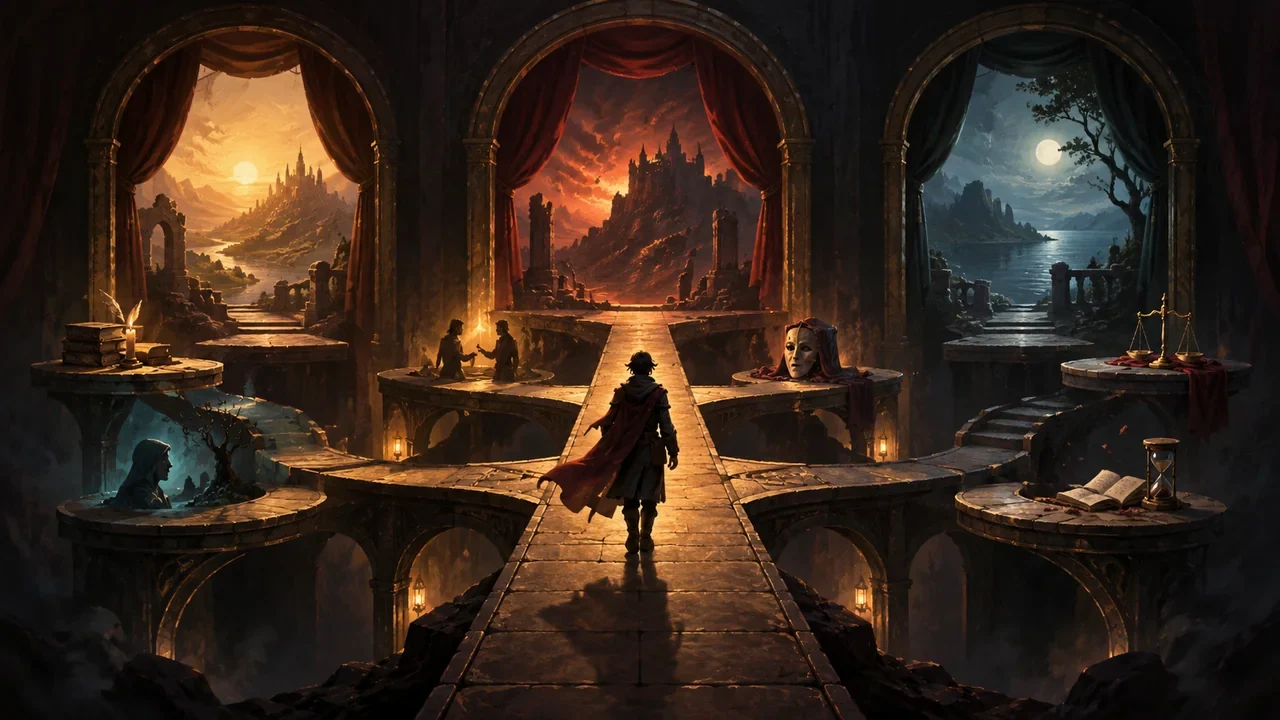
A fixed framework does not mean false choices. An interactive work can still take every route through the same crisis, as long as players enter it with different information, allies, and resources. Those differences change how the crisis unfolds and what it means.
Act One Establishes the Problem; How Players Respond Can Vary
Act One needs to establish the character’s everyday life, an unusual event, and an unavoidable objective. For Midnight Callback, the fixed framework is this: Lin Zhixia works the night shift, receives a phone call from the future, sees one prediction confirmed, and learns that an accident will occur in the server room before midnight.
What can vary is whether players answer the call, which piece of information they verify first, and whom they ask for help. Whatever the path, the end of Act One must establish the same question that can move the story forward: how trustworthy is the call, and will Lin Zhixia get involved?
Act One should not open too many long-term branches. Players do not yet understand the characters and rules, so choices are better suited to establishing attitudes, information, and early relationships.
Act Two Gives Different Paths Different Capabilities and Costs
Act Two is not about continually adding new mysteries. It is about letting players’ early choices change the conditions of the investigation. Trusting Chen Mo opens the server-room route, trusting Zhou Lan provides access to accident records, and acting alone preserves autonomy but leaves players without access permissions.
Different routes can visit different settings, but they should accumulate resources around the same central conflict: evidence, relationships, time, and the degree of control over the model. The midpoint needs to introduce a new understanding shared by all routes—for example, that calls from the future change with player actions, rather than following a fixed timeline. This discovery reinterprets the first half and brings every route into a higher-risk phase.
Place an irreversible decision at the end of Act Two. Players can no longer retain every ally and resource at once; they must choose their main strategy for Act Three.
Act Three Converges on a Location, Not a State
To control filming costs, multiple routes can return to the same server room or live broadcast location. But do not reset variables when they converge. The same shot can reflect different states through preceding dialogue, available choices, which characters arrive, and paths to endings.
For example, every player faces a power-off switch: those with complete evidence can upload the material first, those with high trust from Chen Mo have someone handling the rescue, and those running out of time must choose immediately. The location is the same; the available decisions differ.
This design is called state convergence: content becomes shared again, while the player’s history continues to have an effect. It is better suited to small teams than filming every route entirely separately.
Use a Beat Sheet to Record Both Fixed and Variable Elements
| Beat | Fixed event | What players can change | State read | Required outcome |
|---|---|---|---|---|
| Unusual call | A prediction appears | How the call is answered and verified | None | Establish a question of credibility |
| First turning point | The prediction comes true | Choice of ally | Early attitudes | Begin active investigation |
| Midpoint | The timeline can change | Which type of evidence is obtained | Route and trust | Redefine the risk |
| Second turning point | The accident occurs earlier | Whom and what to retain | All resources | Lock in a resolution strategy |
| Climax | Server crisis | Rescue people, secure evidence, or cut the power | Relationships, evidence, time | Ending conditions |
In the table, “Fixed event” ensures that every route has a complete dramatic progression, “What players can change” ensures that paths are more than decoration, and “State read” helps programming and testing track them.
Do Not Make Branches Carry the Full Weight of Separate Stories
If every Act One choice leads into an entirely new film, costs and testing paths will grow exponentially. First distinguish between “local branches” and “main routes”: local branches converge after providing information or changing relationships within a few minutes; main routes change the objective or perspective of an entire chapter; ending branches resolve the accumulated state.
A first work usually needs only a small number of main routes. Most choices can be expressed through local branches and state changes.
Check the Completion Conditions for Each Act
By the end of Act One, players should be able to state the objective and the main uncertainty. By the end of Act Two, they should understand which capabilities and losses their route has brought them. By the end of Act Three, they should be able to connect the outcome to their earlier actions.
If a route lacks a turning point, do not simply add more video. First check whether information, choices, and state have changed the problem. After completing the interactive beat sheet, the next step is to define the protagonist’s desires, fears, lines they will not cross, and boundaries of variation, so that every option still belongs to the same believable character.
Before formally writing scenes, check the shortest and longest paths once more. The shortest path must still have a cause, escalation, and outcome; it must not feel as if pages are missing. The longest path must not repeatedly explain the same fact simply because players collect all the information. The climax of each path should read its own accumulated state, rather than turning into exactly the same film after convergence.
If the team needs to estimate the amount of filming, add three columns to the beat sheet: “shared video,” “conditional variants,” and “independent video.” Shared video is filmed once for all paths, conditional variants replace only a small amount of dialogue or reactions, and only independent video adds a complete new asset. This allows the dramatic structure to reveal production costs in advance.
Finally, connect the acts using node IDs rather than scene titles. Scene names may repeat or change during revisions; stable IDs keep the script, assets, programming, and testing pointing to the same thing. The character boundaries discussed in the next article should also be recorded in this same node and state system.