• Home
  • Blog
  • Gallery
  • Pricing
  • Home
  • Blog
  • Gallery
  • Pricing
Start creating

Create.Play.

Creator blog

Home/Blog/Getting started

The 'imagination dividend' of word games: Why is immersion stronger without art?

In an age of ever-dazzling visuals, the text game seems to move backward: no 3D scenes, no live action, only lines of text and choices. Yet it is what keeps players inside its world long after the screen goes dark. This article looks at the text game's most unique asset: it hands the work of imagery to the player's imagination
D
DramaFork Editorial TeamInteractive storytelling and AI production
2026.10.12Estimated reading time: 4 min
Players use text and options to imagine interactive story worlds through illustrations
Article contents
Creator blog
  1. 01Imagination is the ultimate rendering engine
  2. 02Why picturing it yourself is more immersive
  3. 03A broad spectrum, from commands to AI
  4. 04Authorship vs. freedom is a spectrum
  5. 05In closing
Back to article top

Imagination is the ultimate rendering engine

Film and 3D games give you a fixed image, while text only gives clues and your mind completes the scene, which is usually the version best tuned to your own taste and memory. A hundred readers picture a hundred scenes from the same line, each playing a version made for them. Text doesn't omit art so much as enlist the most powerful graphics card there is: the player's brain.

Why picturing it yourself is more immersive

  • Participation: the scene must be actively imagined, and that effort is itself an investment;

  • Negative space: what isn't written is filled by your own emotion and experience, leaving a longer aftertaste;

  • Low distraction: with no flashy shots or controls, story and character come first.

That is why a good novel can feel like a film, and the text game turns that feeling into something interactive.

A broad spectrum, from commands to AI

  • Command parsing, as in Zork, offers very high freedom;

  • Choice-based games like most galgame and 80 Days give the author strong control;

  • Visual novels add sprites, backgrounds, and CG to reinforce the text;

  • AI-driven games like AI Dungeon have no preset script and respond in real time.

They share the same foundation, text as the core medium, differing only in how much freedom the player gets.

Authorship vs. freedom is a spectrum

Command and AI styles are free but authorially loose, while choice and visual-novel styles are controlled but bounded. There is no absolute best; the key is matching freedom and narrative density to the story you want to tell.

In closing

The text game seems to have nothing yet owns the most expensive thing: the player's active imagination. When the world grows from images in the player's own mind, it's no longer a story told by someone else but a place they have truly been.

Discussion: What passage of text gave you a mental image more striking than any game's? Do you prefer free text adventures or authored visual novels? Tell us in the comments.
Explore product capabilities Play interactive stories

Continue reading

Browse more articles
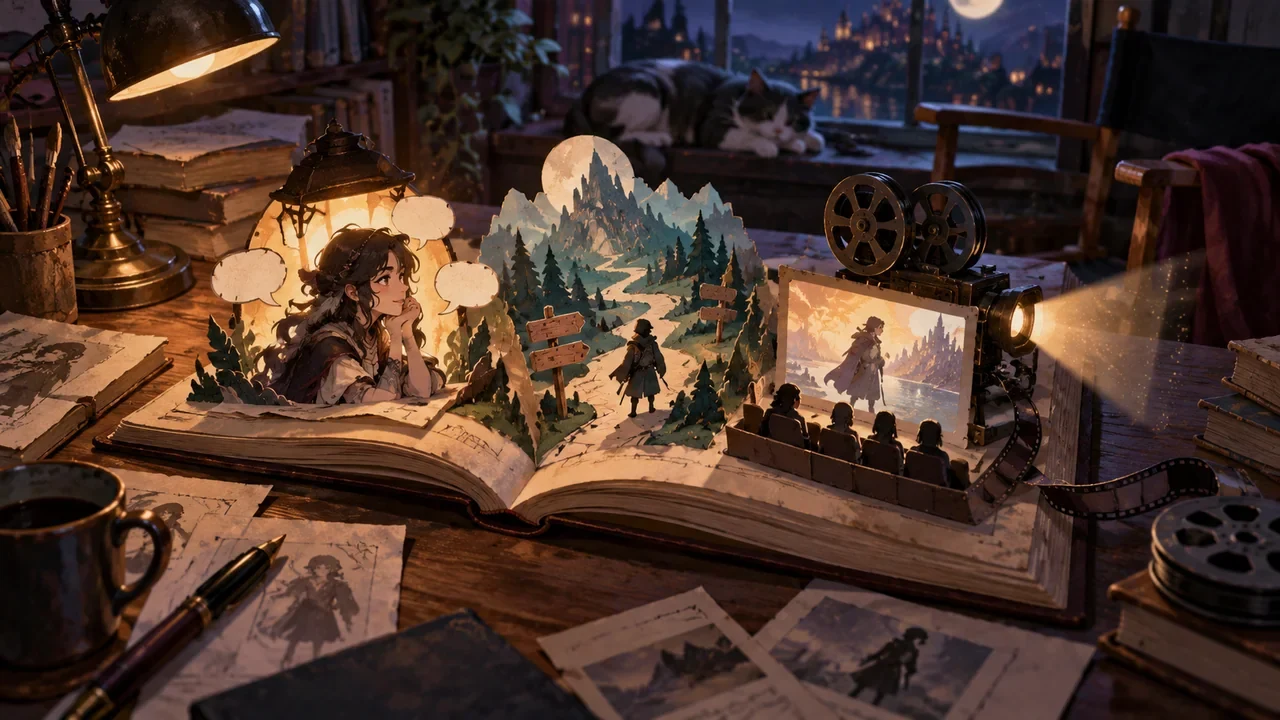
An open storybook on a director's desk connects a glowing conversational lantern, a folded paper adventure landscape, and a miniature film projector; triangular tabletop composition viewed from above.
Choosing tools2026.09.02 · 14 min

Same IP: Should You Start with Character Chat, Text Adventure, or Interactive Film-Game?

Choose the hypothesis that most needs validation first, then choose the content format. If the question is whether a character has recognizability, you can start with character chat; if the question is whether actions and costs can form a loop, you can start with a text adventure; if the question is whether performance, camera, and timing of choice hold up, you need an interactive film-game prototype. The three formats answer different questions, and the success of one prototype cannot be used to draw conclusions for another.

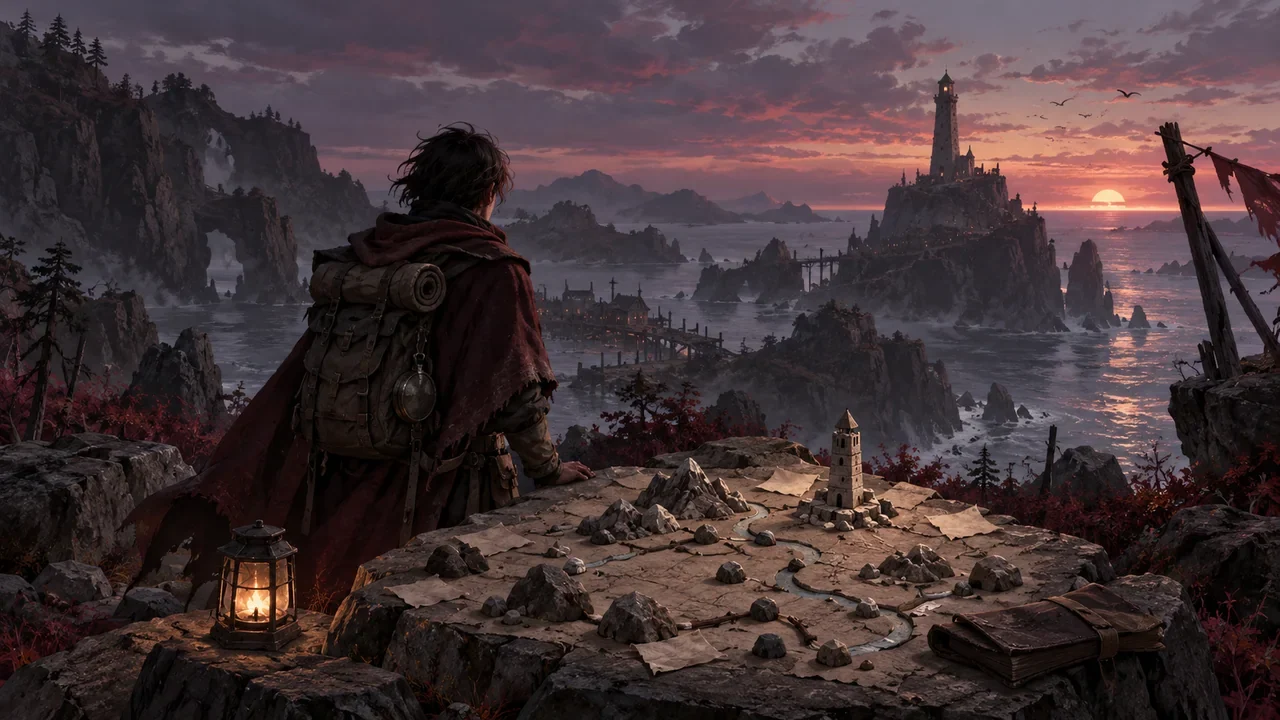
A traveler stands beside a simple landmark map made of physical stones, a tower model, and a river ribbon, oriented toward a visible real tower in the distance.
Interactive narrative2026.09.12 · 15 min

Text Adventures Without Map Images: How Can Players Know Where They Are?

Write space as a repeatable list, not as location hinted at through narrative atmosphere. After reading a passage, the player should be able to answer three questions: what is the place I am in called, what recognizable reference is nearby, and where can I go next. On the author's side, keep a topology table that does not change with writing style, recording places, connections, and return paths. The fictional teaching example "Grey Reef Island" below illustrates the method; the island's place names, directions, and turns are all invented and do not correspond to any real project.

Three travelers approach one damaged bridge using distinct tools: a measuring cord, a repair kit, and a listening horn.
Interactive narrative2026.09.13 · 14 min

How Talent in Text Adventures Affects the Same Action: Change the Information, Not Just Add a Compliment

The same action, with different talents, should produce different information and different available paths, rather than the same result paired with three compliments. The method is: first fix the action itself, then for each talent write one "clue only it can see" and one "follow-up only it can take," and finally add an alternative path for players without that talent. Below, a fictional teaching example, "Night Rain Train Signal Failure," breaks it down. Character names, numbers, and dialogue are all teaching setups, not tested data.

From a story to a playable world.

Create interactive narrative games with DramaFork: connect scripts, characters, shots, and choices into a playable first version.

Product

  • Pricing
  • Credits guide
  • Capabilities
  • Workflow
  • Examples
  • FAQ

Explore

  • Playable gallery
  • Creator blog
  • Creator partnership

Legal

  • Privacy
  • Terms
  • Cookies
© 2026 DramaFork/DramaFork · Interactive narrative games
Press Enter to send, or drag away and release.