Designing Text-Game Mechanisms That Actually Change the Map
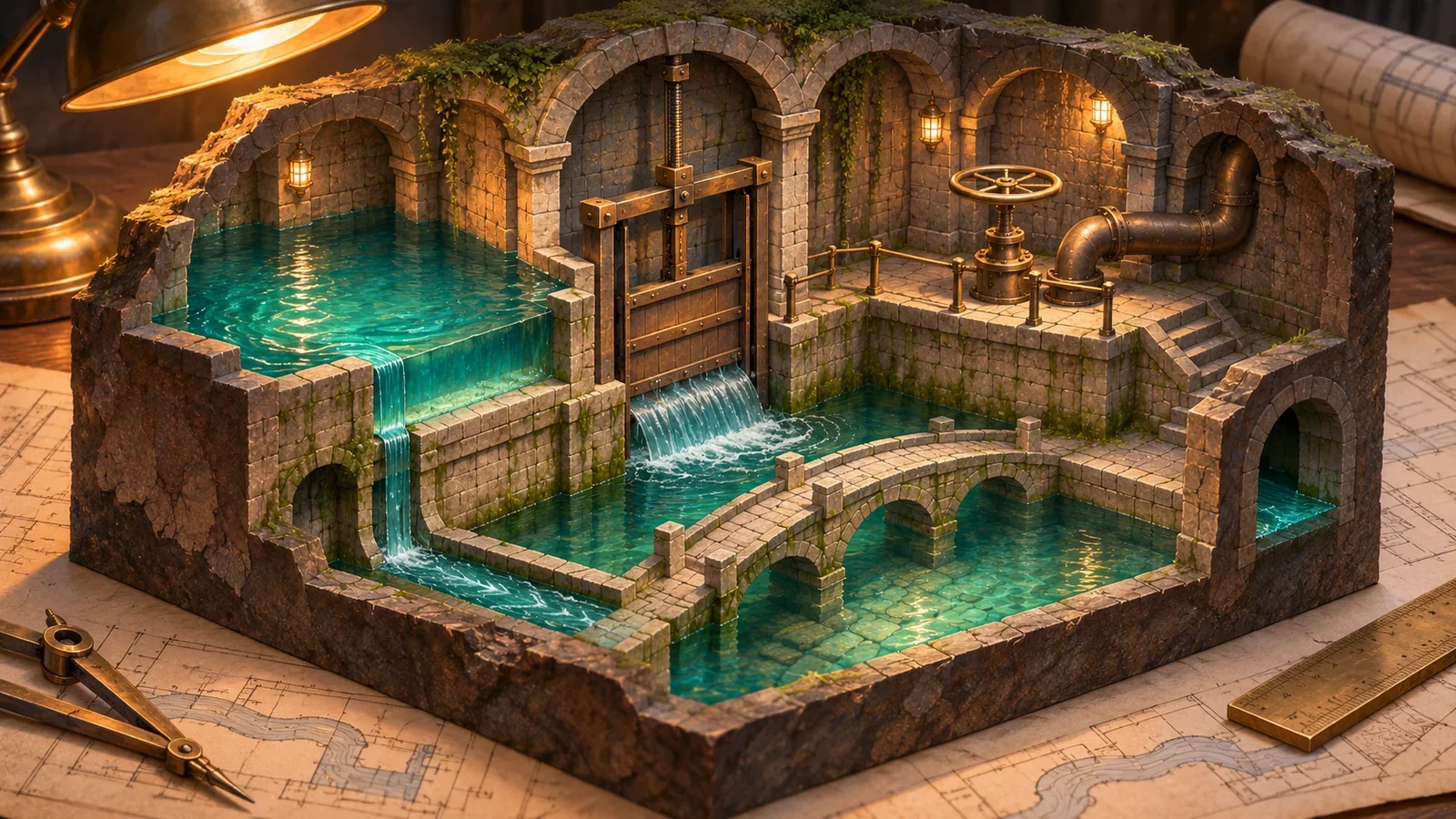
An invented underground waterworks shows how a valve changes routes. Track before-and-after states, return paths and repeatable actions so players can reason from the text.
Introduction
The player has already turned the valve, but the next paragraph still says the bridge is underwater. They turn it again. The story describes moving gears without ever explaining which route changed.
Often, the writer has supplied the sound of an action but not the map that results from it. A mechanism may conceal its solution; it should not conceal a change that has already happened.
The underground waterworks below is an original teaching example, not engineering advice or a demonstration of an existing visual map editor on the website.
Connect the valve to a specific route
There are only three places: the control room, the east maintenance passage and the north records platform. The main valve sits in the control room and transfers water from the east channel into the north basin. Initially, the east water is high and covers a stone bridge, while the north platform is accessible. Opening the transfer valve lowers the east water, reveals the bridge and raises the north basin enough to block the platform’s low entrance.
The control room and a dry return walkway always remain accessible. Players operate the valve only in the control room. No NPC changes it for them, and there is no real-time countdown.
That is enough for a small mechanism. Ten types of gear and seven secret doors can wait. First, make one operation genuinely change two exits.
Make a table that works before and after the action
| Recorded feature | Water not transferred | Water transferred |
|---|---|---|
| East water level | High | Low |
| East stone bridge | Impassable | Passable |
| North records-platform entrance | Accessible | Blocked by water |
| Dry walkway back to the control room | Passable | Passable |
The valve controls a reversible pump. This example treats pumping as immediate within one action: closing the valve pumps water back and restores the left column. Entering a different location does not reset it, and a change in descriptive wording cannot reset it either. Collected objects are recorded separately and do not reappear when the water returns.
If the connections between the three places remain unclear, first read about orientation in a text adventure. Location descriptions answer “Where am I?” This table adds “What did my last action change?”
Tell players what they can do next
The result of opening the valve might read:
“The east stone bridge emerges, leading to the maintenance passage. In the north basin, water now covers the records platform’s low doorway; you cannot enter it. The dry walkway beside your feet is unaffected and still leads back to the control room.”
This reports the change, the exit and the return route. The player can visit the passage or close the valve and approach the records platform instead. Gear noises and lighting add atmosphere, but cannot replace those three pieces of information.
Closing the valve also needs a corresponding report. “Everything returns to normal” assumes the player remembers what normal meant. Say that the bridge is submerged again and the platform is accessible, so the next action has a clear starting point.
Separate repeated operations from collecting objects
This small scene allows repeated valve changes without rewards or resource costs. Repeatedly observing the same machine does not generate extra clues.
A marked token lies in the maintenance passage. Once collected, its record becomes obtained; on later visits the shelf is empty. The valve changes access, not the token’s existence. If a transcript can also be taken from the records platform, track it independently rather than combining both objects into an investigation-progress score.
If you add battery power or a limited number of operations, state each cost before the choice and ensure a usable return route remains when the resource runs out. This example adds no such cost, keeping a route mechanism separate from an additional resource puzzle.
Establish reversibility before the choice
You could write an irreversible version in which transferring water ruins paper records. That changes the question players face. Before they act, they should see the unprotected papers and understand where the water will go. Do not announce permanent destruction of a vital clue only after the valve has been turned.
A reversible version supports observation and gradual collection. An irreversible version supports trade-offs. Choose the experience first, then write the cost. Mixing the two without notice makes it hard to distinguish reasoning from luck.
Write rules someone else can repeat back
A short text game built from this waterworks should make four answers available: the current valve state, the available exits, the objects already collected and the route back. The prose may vary; those answers should remain stable.
When choosing an exploration story from the text-game collection, watch for these reports. A small mechanism can support real judgment when actions, routes and results agree. However many mechanisms you add, unclear changes leave players with little to do except click through every option.