Designing Evolution Text Games: Make Every Upgrade Change How Survival Works
A thick shell should do more than add defense, and a thin fin should do more than add speed. An imaginary tidepool creature shows how abilities, food costs, accessible terrain, and return routes can make evolution a decision worth weighing.
Introduction
If a thick shell, long fins, and sharper senses all amount to “ten more combat points,” players will soon stop reading and pick the largest number. The interesting promise of evolution—living differently because your body has changed—disappears.
A text game does not need a vast skill tree. Make one change affect the next action, and players will take the second upgrade seriously.
Start with the immediate problem, not a skill catalog
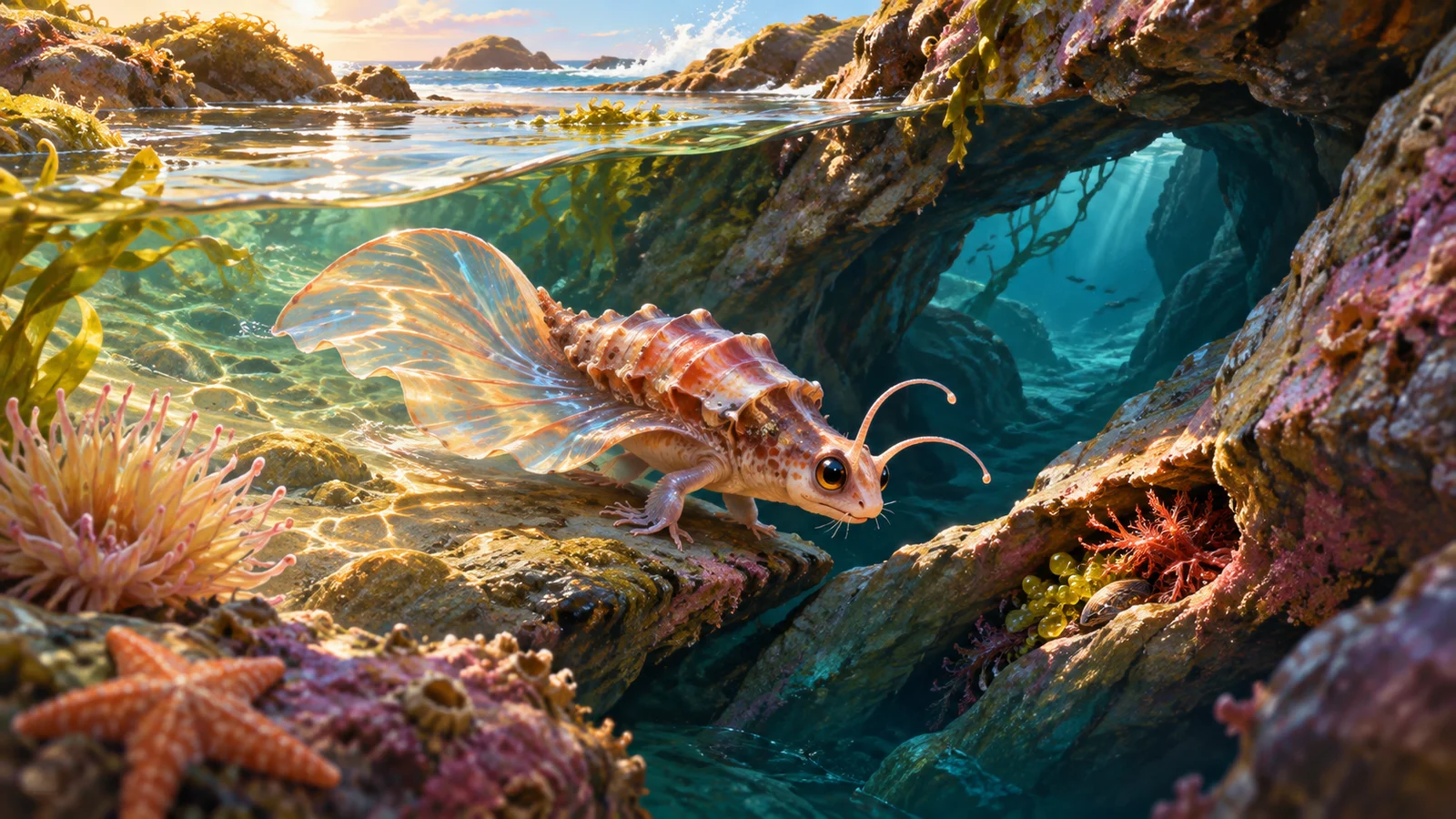
Imagine an entirely fictional tidepool creature with three units of stored food. Before the tide rises, it must choose among a sheltered rock ledge, a narrow crevice, and an outer channel. Waves reach the ledge, the crevice is tight, and the channel is farther away. All of this can be observed before evolving.
This chapter allows one bodily change. It cannot immediately be reset and chosen again, and delaying evolution is also an option. The creature and numbers are design examples, not an explanation of how real species evolve.
Give the player a concrete question first: “Where am I heading, and what obstacle will this body encounter?” Then introduce the abilities. The choices will answer the environment instead of waiting for the author to announce an impressive name.
Specify at least four things for each change
What problem does the ability solve? What does it cost immediately? Which later actions become more expensive? Which route remains inaccessible? Leave one out, and players may read the upgrade as a gift with no downside.
| Change | Immediate cost and benefit | Later constraint |
|---|---|---|
| Thick shell | Costs one food unit; withstands one wave strike on the ledge | A wider body cannot pass through the narrow crevice |
| Thin fin | Costs one food unit; makes the outer channel available | Crossing costs another two food units, leaving none on arrival |
| Lateral feelers | Costs one food unit; detects the scent of food behind the rock wall | Locating food does not mean the body can pass through the crevice |
There is no strongest evolution here yet. The shell helps hold the ledge, the fin opens the distant route, and the feelers provide information. Each changes the conditions for action rather than advancing the same progress bar.
Delaying evolution also needs a defined outcome: keep three food units and the original body, then observe or take a detour; the tide still advances through its planned events. Do not secretly treat waiting as a wasted turn, or make it unconditionally better than everything else.
Show the cost before the choice and deliver it afterward
If the narrow crevice is revealed for the first time after the player takes the shell, the author appears to have tricked them into a dead end. Show the crevice first and explain that the shell increases body width. The player may still choose it because holding the ledge was their plan.
The response afterward should also be specific. “You are stronger” does not explain the next available action. Try: “The wave strikes your shell ridge, but you hold the ledge. At the crack, the shell’s edge catches against the entrance.” Delivering benefit and limitation within an action is easier to understand than a later statistics panel.
Calculate the fin route all the way through: three food units at the start, one spent changing, two spent crossing, zero on arrival. Whether food or rest is available in the new area must be established as a scene condition. Do not invent unlimited supplies when the player is about to starve.
A way back does not erase the tradeoff
A shelled creature blocked at the crevice might return to the ledge, search for another entrance, or carry its new ability into the next chapter. These routes acknowledge the changed body instead of quietly turning it back.
Watch for the opposite problem: providing the same shortcut after every choice, until every body can take every route. Failure need not be fatal, but differences must persist. The fin might reach the outer waters earlier while requiring an immediate search for food. The shell might secure a safe area while missing an observation opportunity farther away.
Test the second action after evolving
Authors often check whether an upgrade succeeds and forget ordinary actions afterward. From the same starting conditions, test squeezing through, resisting waves, finding food, and returning. Description, resource changes, and available actions should agree. A body cannot become wider in one paragraph and pass through the crevice without explanation in the next.
To explore the rhythm of resource tradeoffs, try Raft Survival Simulator (Simplified Chinese edition) while asking “What am I missing now?” and “What will the next step cost?” Then return to your example and check whether players have enough information to plan. This does not imply that the game uses the evolution rules in this article.
For your own version, start with one tidepool, one evolution, and two subsequent actions in the text-game creation studio. Confirm that the shell changes the route before designing a twentieth ability.