How Do You Write a Verifiable Exploration Turn in a Space Greenhouse Story?
Compressing a distant setting into an on-site fault is the core technique of this kind of turn: first give the player three independent readings that may contradict each other, then have them take an action that returns new information capable of changing their judgment, and finally use a log or physical evidence to resolve the contradiction into an explainable cause.
Introduction
Compressing a "distant setting" into an "on-site fault" is the core technique of this kind of turn. The specific method is: first give the player three independent on-site data readings whose values may contradict each other; then have the player perform an action, and the action must return new information that can change their judgment; finally use a log or piece of physical evidence to resolve the contradiction into an explainable cause. Below, a fictional teaching example, The Seeds of Cabin Nine, is used to walk through the whole process. The cabin numbers, readings, and character lines in it are all invented for demonstration and do not represent real aerospace engineering.
First Build Three Readings That Can Contradict Each Other
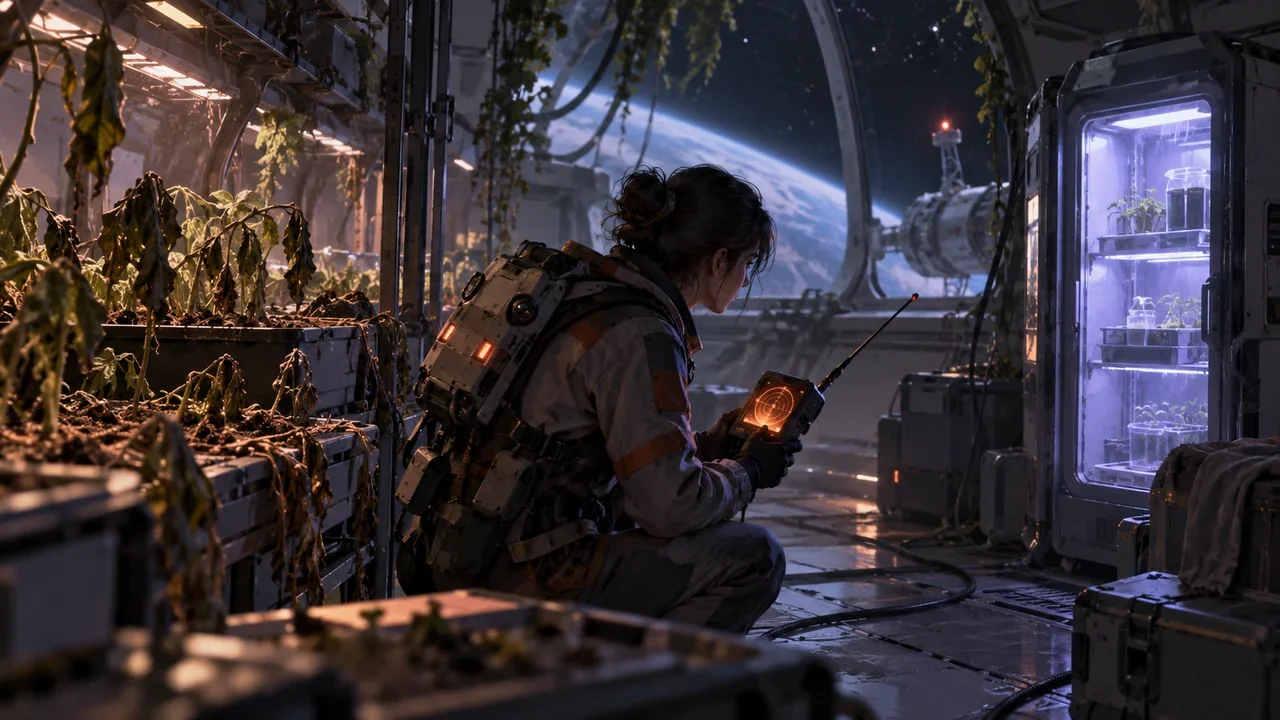
The Seeds of Cabin Nine is set on an abandoned orbital agricultural station. The player plays a maintenance technician whose task is to determine whether the seed vault in Cabin Nine can still be saved. No conclusion is given at the start; only three readings are given:
| Source | Reading | What the player can directly infer |
|---|---|---|
| Power panel | Bus voltage 61%, Cabin Nine branch 0% | The cabin has no power, but the main bus still has reserve |
| Environmental probe | Cabin temperature −4°C, humidity 12% | Only the main cabin environment is known; whether the seeds are here still needs confirmation |
| Signal relay | Cabin Nine beacon emits a pulse every 40 seconds | Something inside the cabin is still powered and working |
These three data points are deliberately inconsistent: the branch is unpowered, yet the beacon is still pulsing. At this point the player cannot determine whether the probe is broken, whether the beacon is on a backup battery, or whether someone has connected a bypass inside the cabin. The key is not to make the readings complicated, but to make them point toward different explanations.
Every Action Must Return Information Usable for Judgment
The player's first available action is "restart the Cabin Nine branch." If it is written as "you restarted the power, and the cabin lit up," that is an invalid action—it only advances the plot and provides no basis for judgment. A verifiable way to write it is to have the action return a new piece of data that can be compared with the other readings:
You close the Cabin Nine branch switch. A line pops up on the power panel: branch current 0.4A, below the 3A required to maintain temperature control. The beacon pulse interval changes from 40 seconds to 12 seconds.
Now the player has two more clues: the current is far below what temperature control requires, meaning that although the branch is connected, it cannot drive the heater; the beacon has sped up, meaning that some device in the cabin has detected the restoration of power and is increasing its call frequency. The action does not solve the problem, but it advances the question of "what is powering the beacon" by one step.
One Anomalous Record Resolves the Contradiction into Cause and Effect
After three readings plus one action, the player needs a piece of physical evidence that can explain the whole situation. Here a log is used:
Retrieving the Cabin Nine maintenance log, the last entry reads: "Temperature control failed, seed vault moved to backup cold cabinet, main cabin deliberately powered down. The cold cabinet has its own battery, the beacon was rewired to the cold cabinet, and it speeds up its pulses when it receives an external power signal. When the battery is below 10%, transfer cannot be completed." The record's timestamp is eleven days earlier than the beacon's last maintenance.
This log explains three things: the main cabin power-down was deliberate; the seeds are not in the main cabin, so the low main cabin temperature does not mean the seeds are dead; the beacon keeps working because the backup cold cabinet has an independent power source. At this point, the player can overturn the initial judgment that "the seeds are dead."
Two Misjudgments and Their Consequences
Misjudgment one: the player sees "branch 0%" and gives up on Cabin Nine. Before they choose to leave, first prompt: "There is still an unexplained pulse; the seed status cannot be confirmed." If the player has read the maintenance log, the limitation of the independent battery should also be mentioned. After leaving, it can be written as an incomplete transfer; there is no need to suddenly declare all the seeds dead. The consequence should correspond to the risk the player could know at that time.
Misjudgment two: the player has read the log, has checked that the cold cabinet has 18% power, and still chooses to search the habitation area. Before execution, prompt that this search takes time and is expected to drop the power below 10%; after the player confirms, the power drops to 9%, and the transfer window is missed. 18% and 9% are fictional rule values, not engineering calculations. If the player has not yet checked the power level, the feedback can only say "transfer risk unknown"; they cannot be treated as knowingly committing the error.
First-Turn Demonstration
Write the above steps as a turn that can be directly referenced:
You drift into the outer ring of Cabin Nine. The power panel shows main bus 61%, Cabin Nine branch 0%. The environmental probe reports cabin temperature −4°C and humidity 12%. The signal relay shows the Cabin Nine beacon pulsing once every 40 seconds.
You can: one, restart the Cabin Nine branch; two, retrieve the maintenance log first; three, follow the beacon to find the transmission location.
You choose to restart the branch. The switch closes, branch current 0.4A, far below the 3A required for temperature control. The beacon pulse interval shortens to 12 seconds.
You retrieve the log and read that the seeds were moved to the cold cabinet, the beacon was rewired to an independent battery, and there is a 10% lower limit for transfer. The log time is eleven days earlier than the beacon's last maintenance.
Now you know: the seeds are not in the main cabin, and the beacon comes from the cold cabinet. How much power the cold cabinet has left, you have not yet confirmed.
Author's Explanation: Why This Turn Is Verifiable
The three readings are each independent, and the player cannot draw a conclusion from one piece of data. Restarting the branch returns two new data points, current and pulse interval, and the player uses them to revise the assumption that "the beacon is powered by the main cabin." The log, as physical evidence, explains the contradiction between "the main cabin is powered down" and "the beacon is still working" as two separate power systems. Both misjudgments correspond to specific consequences, and the consequences are derived from data the player has already seen, not from a sudden punishment.
It should be noted that when AI generates this kind of turn, the output is not guaranteed to be correct every time. If AI is used to help write logs or readings, it is recommended to manually check whether each piece of data can really be used by the player for judgment, and delete numbers that serve only as decoration.
Completion Checklist
After writing an exploration turn, check item by item:
- Are there at least three readings from different sources that may contradict each other?
- Does each of the player's actions return new information that can be used for judgment?
- Is there a log or piece of physical evidence that can explain the contradiction between the readings?
- Do the misjudgments have specific consequences, and can those consequences be derived from data that has already appeared?
- At the end of the turn, has the player gained a basis for judgment they did not have at the start?
If all five are satisfied, this turn can be handed to the player for verification. Next, pick a scene in your existing story where "the character decides," rewrite it into a version with three readings plus one action, and see whether the player can reach the conclusion on their own.