How to Write What Players Can Do in a Work Synopsis: Use Actions Instead of Piling Up Worldbuilding Nouns
What a synopsis needs to answer is not "how grand this world is," but "what the player needs to do right now after entering." A usable approach is four sentences: who you are, what must be dealt with right now, what categories of actions you can take, and what the actions cost. Keep only the worldbuilding nouns necessary to understand these four sentences. Below, a fictional teaching example, "Wind Station Duty Officer," demonstrates three synopsis versions and provides a sentence-function table so you can check your own synopsis sentence by sentence.
Introduction
What a synopsis needs to answer is not "how grand this world is," but "what the player needs to do right now after entering." A usable approach is four sentences: who you are, what must be dealt with right now, what categories of actions you can take, and what the actions cost. Keep only the worldbuilding nouns necessary to understand these four sentences. Below, a fictional teaching example, "Wind Station Duty Officer," demonstrates three synopsis versions and provides a sentence-function table so you can check your own synopsis sentence by sentence.
First Write Four Sentences, Then Decide Which Nouns to Keep
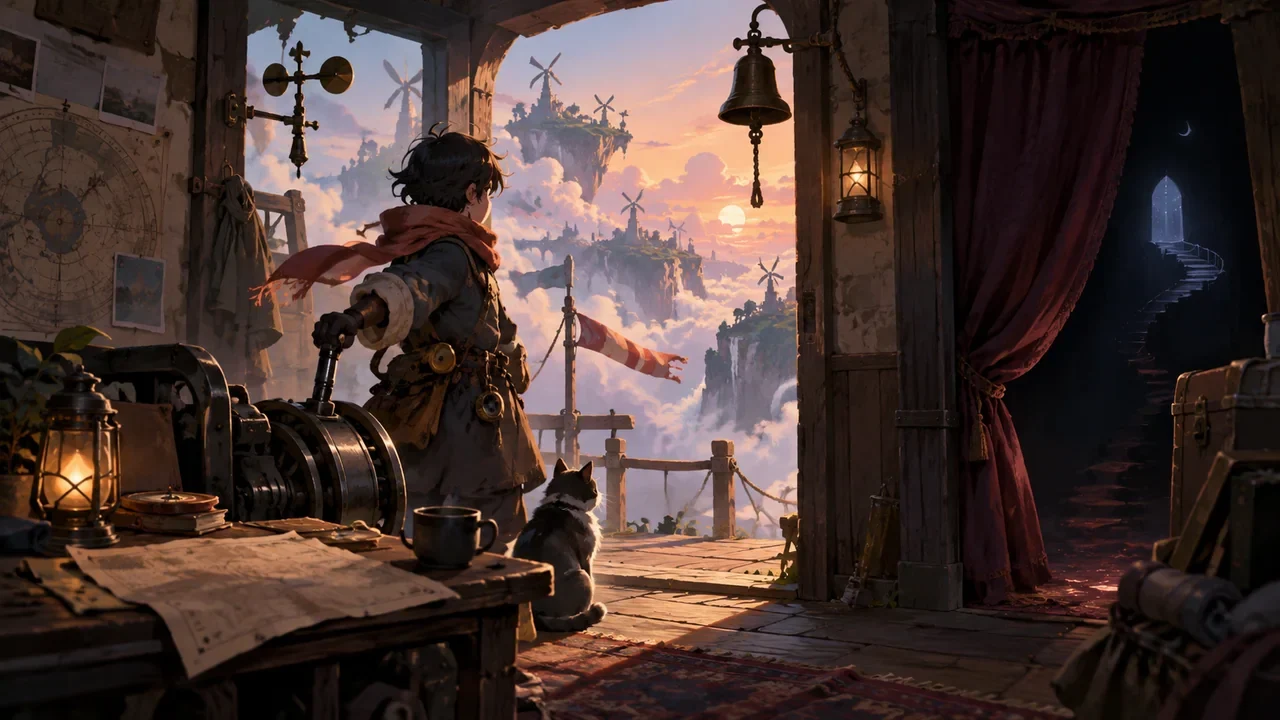
The setup of "Wind Station Duty Officer" is: only one duty officer remains at the mountaintop weather station, and at intervals the wind vane must be manually calibrated, otherwise the migrating groups from the village below will receive incorrect warnings. The player plays this duty officer.
Draft of the four sentences:
- You are the only duty officer at the mountaintop wind station.
- Tonight the wind vane begins to drift, and the next calibration window is before dawn.
- You can check records, repair parts, issue warnings, and decide whether to wake the people below the mountain.
- Each calibration consumes spare parts; if you issue one incorrect warning, the village will trust you one point less.
These four sentences do not contain nouns such as "wind vein," "observation cult," or "seventh era." They can be placed later, or even omitted. To judge whether a noun should stay, see whether after deleting it the player still knows what they need to do. If deleting it does not affect the action, delete it first.
Three Synopsis Versions, Differing in Action Density
Version A: Noun-piling type (negative example)
In the seventh era of the declining wind vein, the observation cult rules the mountains. The wind station is a holy site left from the old era, and the duty officer bears the mission of harmonizing the wind vein. When the ancient prophecy comes true again, you will, on this forgotten land, uncover the dust-covered truth.
This passage does not tell the player any action they can take. "Harmonizing the wind vein" is setting, not action; "uncover the truth" is a result, not a method. After reading it, the player does not know what to click first.
Version B: Action-list type
You are the only duty officer at the mountaintop wind station. Before dawn the wind vane will completely drift, and three migrating groups below the mountain depend on your warning. You can search old records to find the drift pattern, remove spare parts to replace worn components, issue a warning during the window, or first wake the people in the village to judge together. Parts are limited; if you issue one wrong warning, the villagers' trust in you drops one point. You also have to decide whether to tell the next duty officer about that crossed-out old matter in the records.
Version C: Suspense-first type
Before dawn, the wind vane will drift. You are the only one who can calibrate it, but there are only enough spare parts for two attempts. The people below the mountain are waiting for your warning, and one page in the record book has been torn out. You can repair, can check, can issue a warning, can wake the villagers, and can also do nothing and watch the wind turn back by itself.
The three versions have similar amounts of information, but the actions in B and C are more specific. B is suitable for the first two paragraphs of a store page, and C is suitable for a position that needs to grab attention first. Neither needs to explain first what "wind vein" is.
Sentence-Function Table: Check the Synopsis Sentence by Sentence
Break the synopsis into sentences and label the function of each. Missing or repeated functions are the places that need revision.
| Sentence (Version B of "Wind Station Duty Officer") | Function | Consequence if missing |
|---|---|---|
| You are the only duty officer at the mountaintop wind station. | Identity | The player does not know whose identity they act as |
| Before dawn the wind vane will completely drift. | Immediate task and time limit | The player does not know where the urgency comes from |
| Three migrating groups below the mountain depend on your warning. | stakes | The action seems to matter little |
| You can search old records, replace parts, issue a warning, and wake the villagers. | Available actions | The player does not know what they can do |
| Parts are limited; if you issue one wrong warning, trust drops one point. | Cost | Choices have no weight |
| Whether to tell that crossed-out old matter in the records. | Preserved mystery | The synopsis becomes an instruction manual |
This table can also be used in reverse: first write down each action you want the player to take, then check whether each sentence serves some action. Sentences that serve no action should either be deleted or downgraded to background.
One Sentence Each for Identity, Task, Action, and Cost Is Enough
The identity sentence should be specific to "your position in this scene," not a title. Writing "you are the only duty officer" is more useful than writing "you are the chosen successor," because the former implies "no one can replace you."
The task sentence should carry time or conditions. "Before dawn" gives the action a boundary better than "one day." The condition does not have to be a countdown; it can also be "the next calibration window" or "before the parts run out."
Action sentences are best started with verbs, listing three to five categories. Too few feels linear; too many means no focus. It is best if the actions involve trade-offs: repairing parts and issuing a warning may compete for the same window, so the player will truly make a choice.
The cost sentence should land on something the player can perceive: number of parts, villagers' trust, your own stamina, whether a piece of information is leaked. The cost does not have to be punishment; it can also be "you can only keep one thing."
The mystery sentence goes at the end, closing with a question or an unresolved action. It does not need an answer; it only needs to let the player know "there is something here to investigate."
Difference from a Collaboration Proposal: The Reader Is a Player, Not a Collaborator
A collaboration proposal should clearly state the team, progress, division of labor, rights, and expected returns; the reader is someone evaluating whether to collaborate. The reader of a work synopsis is a player deciding whether to play, so do not write the production process.
The following content does not go into the synopsis: what tool was used to generate it, how many versions the storyboard was revised through, how nodes are organized, how many times assets were retried, whether export uses a local package or a remote link. These are production details, and players do not need them at the synopsis stage. If the AI-involved part is directly related to the player experience, you can briefly explain that the output has uncertainty, but do not expand on the toolchain.
The synopsis also does not promise click effects. Judgments such as "want to play right after reading" or "conversion rate increase" have no basis and should not be written. The task of the synopsis is to make the actions clear, not to guarantee results.
Completion Check
After writing the synopsis, go through it in order:
- If all proper nouns are covered, can the player still say what they need to do?
- Are there at least one sentence each for identity, task, action, and cost?
- Do the action sentences start with verbs, and do trade-offs exist?
- Is at least one mystery without an answer preserved?
- Is production process or tool information mixed in?
- Are there promises such as "certainly," "guaranteed," or "inevitably"?
If all six pass, the synopsis meets the standard of "what players can do." The next step is to write Version B and Version C once each, place them in different positions, and see which version better fits the tone of your work.